
Glossary
ACCA eligibility
Also called: ACCA eligibility criteria · ACCA entry requirements

By Naveen J D, Founder · Reviewed 22 Sept 2026
Definition
ACCA eligibility is the evidence-based route an applicant uses to register for ACCA. Indian Class 12 students who meet ACCA’s subject and mark rule may enter directly, while applicants who do not may begin Foundations. A degree or prior study can result in exam exemptions, but does not create a fixed exemption entitlement.
In practice
- Use the Class 12 marksheet to test direct registration before choosing tuition or subjects.
- Use Foundations in Accountancy when direct ACCA Qualification entry is unavailable.
- Use ACCA’s calculator for degree-based exemptions instead of relying on a generic BCom exemption count.
- Keep award evidence, marksheets, identity evidence and translations ready before applying.
The direct-entry route
Indian Class 12 applicants can register directly only when their results meet ACCA’s five-subject, Year XII, English and Mathematics or Accounts, 65% and above-50% conditions. Class 10 alone does not meet the direct-entry threshold. Read the ACCA registration guide after checking the marksheet against the rule.
The Foundations route
Foundations in Accountancy is the entry route for students who do not meet the direct-registration requirements. It has no minimum entry requirements, so it is a route into further ACCA study rather than an exemption decision.
The graduate route
A graduate or current degree student should enter the awarding institution, exact course and relevant graduation or last-study year in ACCA’s calculator. See how BCom with ACCA works for the practical difference between degree study and an ACCA exemption result.
Rules and dates checked as of September 2026.
Start with evidence, not a degree label
The decision is straightforward: qualifying Class 12 results support direct registration, results below the direct-entry threshold point to Foundations in Accountancy, and degree study requires an ACCA calculator result before any exemption is assumed. A degree can change the exams left to sit, but it does not create one standard BCom exemption package.
Three routes to the correct starting point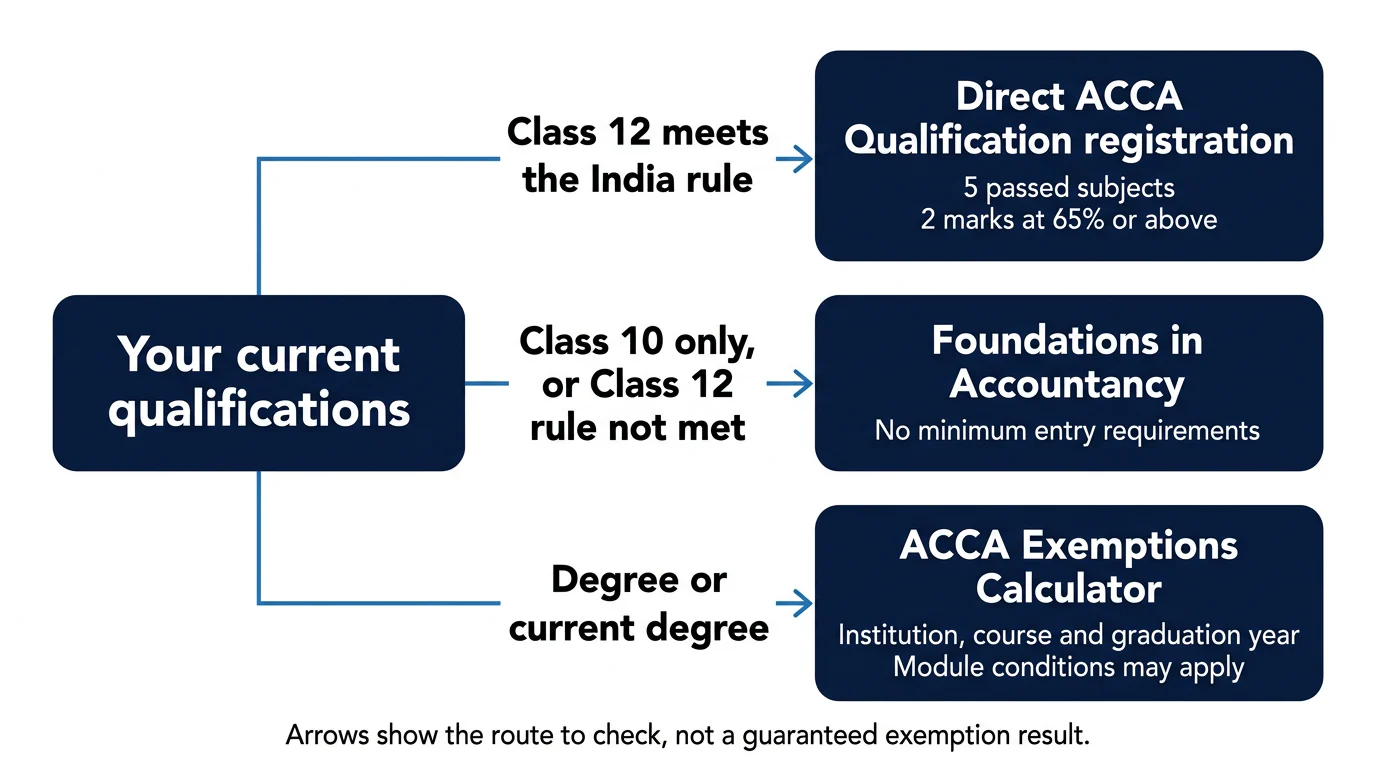
The Class 12 test is more specific than “65% in English and Maths”
ACCA lists India’s direct-entry route as five passed subjects, with at least three in Year XII, including English and Mathematics or Accounts. At least two subjects need marks of 65% or above, while the other subjects must be above 50%. For Higher Secondary marks reported out of 200, ACCA treats more than 130 as 65% and more than 100 as 50%. ACCA’s India entrance requirements also state that Class 10 alone is insufficient for direct ACCA Qualification registration.
Students who do not meet that direct-entry test can begin Foundations in Accountancy, which has no minimum entry requirements. The Foundations route is useful for building the required base, but it is not the same as entering the ACCA Qualification directly.
A completed or current degree needs an individual exemption check
Use ACCA’s calculator with the awarding institution, exact qualification and graduation year. If the degree is part-completed, enter the last year of study. Calculator results can make exemptions conditional on passing specified modules, so a course title alone is not enough evidence. See how BCom with ACCA works before treating an integrated programme or coaching arrangement as an exemption guarantee.
A current degree student can register by providing the expected graduation date and a transcript of completed modules. ACCA generally advises students who intend to finish their degree to wait before claiming exemptions, so they can avoid duplicate study. ACCA’s exemptions guidance explains both rules.
Have the registration documents ready
Prepare copies of qualification evidence, identity evidence and a passport-style photograph. Qualification documents should show the award, transcripts or marksheets, subjects or module codes, marks, and completion information. Documents not issued in English need the original-language copy and an official English translation completed and stamped by a licensed translator. ACCA’s application guidance sets out the application requirements.
Plan subjects and dates after the route is confirmed
The current ACCA Qualification has 13 exams, comprising three Applied Knowledge papers, six Applied Skills papers, two Strategic Professional Essentials and two chosen Options. Membership also requires the Ethics and Professional Skills Module plus 36 months of relevant experience and nine performance objectives. Use the ACCA subjects list only after the route and any exemptions are confirmed.
ACCA’s current Applied Skills and Strategic Professional exams have their final sitting in June 2027. New Foundations and Knowledge exams begin in July 2027, followed by the first new Expertise and Strategic Professional sitting in September 2027. ACCA’s transition timeline is the reference point for students planning beyond 2026.
Related terms
Keep reading



Frequently asked
Yes, if the Class 12 record meets ACCA’s India rule: five passed subjects, at least three in Year XII, English and Mathematics or Accounts among them, two marks of at least 65%, and the other marks above 50%.
A Class 10 certificate alone is insufficient for direct registration to the ACCA Qualification. Students who do not meet the direct-entry requirements can use Foundations in Accountancy, which ACCA says has no minimum entry requirements.
There is no fixed BCom exemption number that applies to every Indian graduate. ACCA assesses the awarding institution, exact course, graduation year and, where relevant, the modules completed before it determines any exemption result.
Yes. ACCA says a current degree student can register by confirming the expected graduation date and submitting a transcript of completed modules. ACCA generally recommends waiting until graduation before claiming exemptions where the degree will be completed.
Applicants need copies of qualification evidence, proof of identity and a passport-style photograph. Academic evidence should include the award and marksheets or transcripts, while non-English documents require the original copy and an official English translation.
Map the next registration step
Use the registration guide after identifying your direct-entry, Foundations or exemption route.
Read the ACCA registration guide