
Glossary
ACCA subjects
Also called: ACCA subjects list · ACCA papers · ACCA exam subjects

By Naveen J D, Founder · Reviewed 14 Sept 2026
Definition
ACCA subjects are the exams that make up the ACCA Qualification. A student with no exemptions completes up to 13 exams: 3 Applied Knowledge papers, 6 Applied Skills papers, both Strategic Professional Essentials and 2 Strategic Professional Options selected from 4. The Ethics and Professional Skills Module and relevant practical experience are separate membership requirements.
In practice
- Check exemptions before choosing papers, because prior qualifications can change the number of earlier exams you need to sit.
- Choose only 2 Strategic Professional Options, rather than treating all 4 Options as compulsory papers.
- Confirm the Law, Taxation and Advanced Taxation variant before buying materials or booking an exam.
- Separate ACCA registration, exam-entry and local CBE costs from any tuition quote.
The structure is 3 + 6 + 2 + 2, not 15 compulsory papers
ACCA divides its exam route into 3 Applied Knowledge papers, 6 Applied Skills papers and Strategic Professional. At Strategic Professional level, both Essentials are required, while only 2 of the 4 Options count toward the route. ACCA’s qualification structure confirms that this produces an exam requirement of up to 13 papers for a student with no exemptions.
Last reviewed: 13 September 2026.
What each ACCA subject covers
Applied Knowledge
- Business and Technology (BT): How businesses operate, including their environment, people, systems, technology, governance and ethics.
- Management Accounting (MA): Information, costing, budgeting, variance analysis and performance monitoring for management decisions.
- Financial Accounting (FA): Double entry, transactions, financial statements, basic consolidation and interpretation.
ACCA positions these 3 papers as an introduction to finance and essential accounting techniques. BT, MA and FA syllabuses define the detailed scope. Before choosing a first paper, use the Indian ACCA registration route guide to check eligibility and exemptions.
Applied Skills
- Corporate and Business Law (LW): The legal framework and business law, including obligations, employment, companies, insolvency and criminal behaviour.
- Performance Management (PM): Applying management-accounting techniques to planning, decisions, performance evaluation and control.
- Taxation (TX): The tax system of the selected jurisdiction for individuals and companies.
- Financial Reporting (FR): Applying IFRS Accounting Standards to entity and group reporting, analysis and interpretation.
- Audit and Assurance (AA): Audit regulation, planning, risk, internal control, evidence, review and reporting.
- Financial Management (FM): Investment, financing, dividend and risk-management decisions.
Law and tax content can vary by jurisdiction, so an ACCA paper list is not enough to identify the correct LW, TX or ATX version. ACCA’s TX guidance explains the jurisdictional approach, while the PM, FR and FM syllabuses set out these papers. Use the ACCA total-cost calculator before committing to an exam schedule.
Strategic Professional
Essentials, both required:
- Strategic Business Leader (SBL): Organisational leadership, senior advisory capability and professional skills through an integrated case study.
- Strategic Business Reporting (SBR): Corporate reporting, IFRS Accounting Standards, stakeholder information needs and ethical stewardship.
Options, choose 2 of 4:
- Advanced Financial Management (AFM): Senior-level investment, financing, acquisition, reorganisation and risk advice.
- Advanced Performance Management (APM): Strategic management accounting for planning, control and organisational performance.
- Advanced Taxation (ATX): Applying tax knowledge and judgement to advise individuals and businesses on major taxes and financial decisions.
- Advanced Audit and Assurance (AAA): Advanced audit and assurance work across planning, risk, controls, evidence, review and reporting.
ACCA describes Strategic Professional as a combination of Essentials and specialisation Options that can match a candidate’s career direction. ACCA’s Strategic Professional structure is the authoritative source for the current requirement. If you are weighing paid preparation for a specific paper, see which ACCA papers need tutor support.
A 13-paper example with no exemptions
An India-based student who meets ACCA’s entrance requirements and receives no exemptions plans 3 Applied Knowledge papers, then 6 Applied Skills papers, then both SBL and SBR, then 2 of the 4 Options. The decision is to select 2 Options, not prepare all 4, so the planned route is 3 + 6 + 2 + 2 = 13 exams.
ACCA requires exams to follow module order, although papers within a module can be attempted in any order. ACCA’s exam FAQ also states that the pass mark is 50% for all exams.
The subject list is not a full study plan
A paper list does not determine whether you are eligible, which exemptions ACCA will award, what local CBE fees apply or which support format fits a particular paper. ACCA’s India fee page states that Applied Knowledge exam fees can be set by local CBE centres, while other charges depend on the exam stage and entry deadline. ACCA’s India fees page should be checked before booking.
Self-study can suit candidates who can work through current materials and timed practice consistently. Paid tuition may be useful when feedback, structure or paper-specific explanation solves a clear preparation gap, but it does not replace registration, exam entry, EPSM or practical experience. An ACCA Approved Learning Partner status is one quality signal, not a guarantee that a particular course fits every student.
The route in one view
ACCA’s current structure separates the 13-exam route from the membership requirements that sit alongside it. ACCA’s 2026 qualification structure also requires the Ethics and Professional Skills Module and 3 years of relevant practical experience for membership.
The route from first paper to membership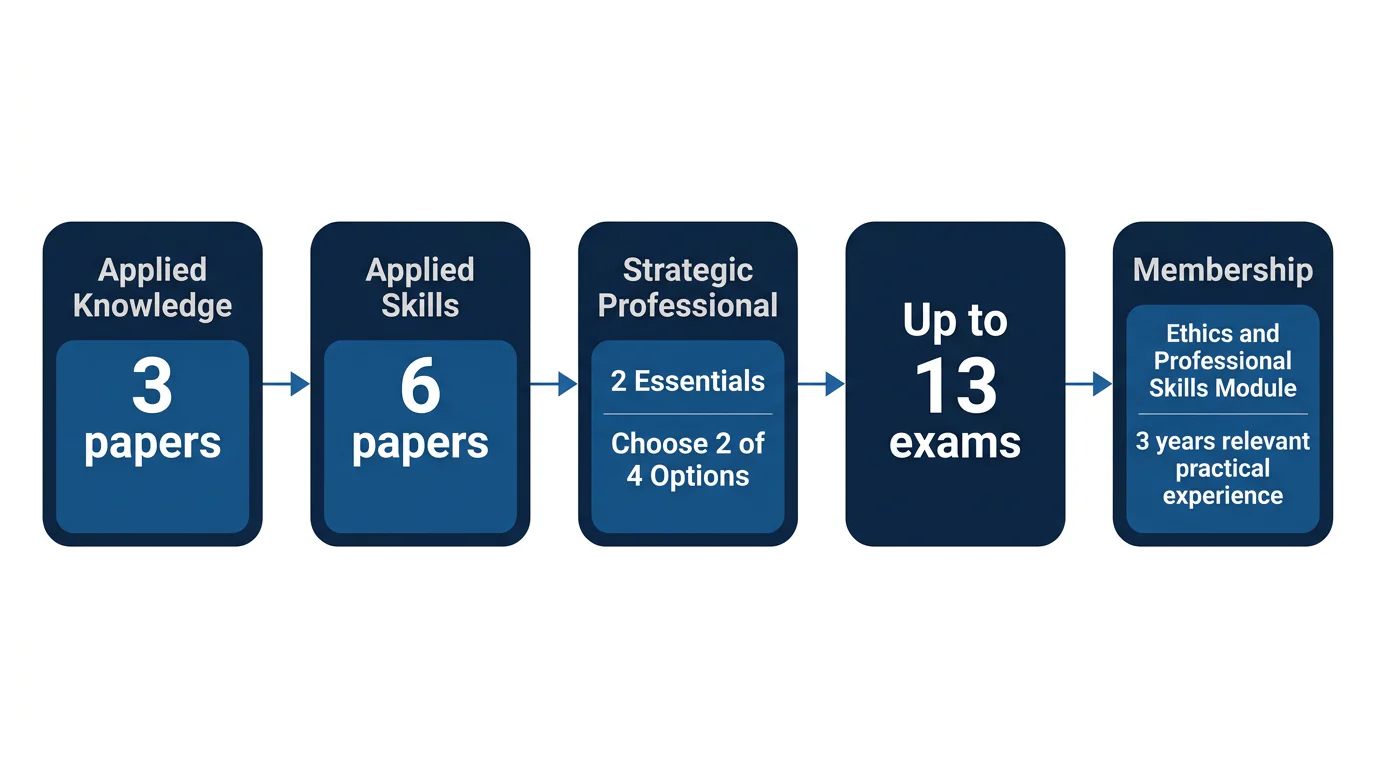
Related terms
Keep reading



Frequently asked
A student without exemptions completes up to 13 ACCA exams: 3 Applied Knowledge papers, 6 Applied Skills papers, 2 Strategic Professional Essentials and 2 Strategic Professional Options selected from a choice of 4.
No. The 3 Applied Knowledge papers, 6 Applied Skills papers and 2 Strategic Professional Essentials form the standard route. At Strategic Professional level, students choose 2 Options from Advanced Financial Management, Advanced Performance Management, Advanced Taxation and Advanced Audit and Assurance.
ACCA’s India entry guidance requires passes in 5 subjects, including English and Mathematics or Accounts, with 65% in at least 2 subjects and more than 50% in the others. Candidates who do not meet the entry requirements can use Foundations in Accountancy as a route onward.
Passing the required exams alone does not complete ACCA membership. ACCA also requires completion of the Ethics and Professional Skills Module and 3 years of relevant practical experience before a student can qualify for membership.
No. Corporate and Business Law, Taxation and Advanced Taxation can have jurisdiction-specific variants. Candidates should confirm the applicable exam version and examinable legislation through ACCA before choosing tuition, study material or an exam sitting.
Choose support for the paper you are actually planning
Compare where structured support may add value before committing to a full package.
Explore paper support