
Match Your Indian ACCA Registration Route Before Choosing Papers
Rules, fees and transition dates are checked as at September 2026.
6 chapters · Updated Sep 16, 2026 · By Naveen J D
- 36 months
- minimum relevant experience required for current ACCA membership
In brief
Indian students can register directly after Class 12 only when they meet ACCA's subject and mark thresholds. Students below that threshold use the Foundations route, while graduates and current degree students should use ACCA's Exemption Calculator instead of assuming a fixed exemption count. Registration, exemptions, papers and fees need to be dated because ACCA begins a qualification transition in 2027.
Start with a route, not a coaching package
ACCA registration is not one route for every Indian student. A Class 12 student can enter the ACCA Qualification directly only by meeting the marks and subject conditions in ACCA's India entrance-requirements database: five passed subjects including English and Mathematics or Accounts, at least three Year XII subjects, two marks at 65% or higher and the remaining marks above 50%.
A Class 10 certificate by itself is insufficient for registration. Students who do not meet the direct-entry threshold can join Foundations in Accountancy, which ACCA says has no minimum entry requirements. That route is useful for access, but it is not the same thing as direct entry to the ACCA Qualification.
Graduates and current degree students should not begin with a generic promise about BCom exemptions. ACCA assesses prior learning through its Exemption Calculator using the university, course and graduation year. That assessment, rather than the degree title alone, determines where a student may start.
Three ACCA entry routes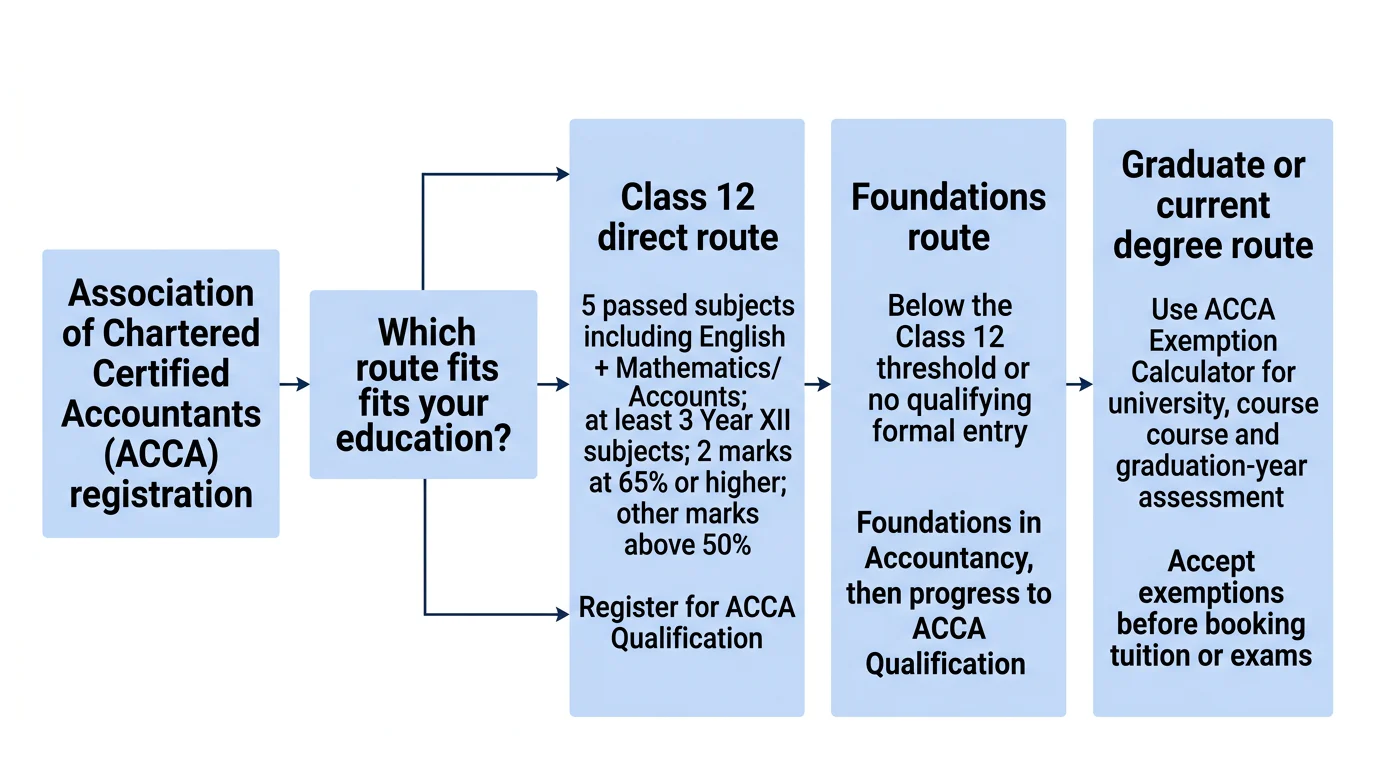
A complete application avoids an avoidable delay
ACCA allows students to register online at any time of year. Its application guide estimates about 10 minutes for the form and allows applicants to save and resume it. The checklist is specific: qualification evidence, identity evidence and a passport-style photograph are required. Qualification documents should show the award, relevant transcript or marksheets, subjects or module codes, marks and completion evidence.
ACCA's registration guidance accepts a passport, birth certificate, national ID card or driving licence as identity evidence. Copies are requested rather than originals. If documents are not in English, submit the original-language copy with an official translation stamped by a licensed translator. If ACCA has everything it needs after application and payment, it says student-status confirmation follows within five working days.
For an exemption request, include both the qualification completion certificate and an academic transcript. ACCA also says students should wait until registration is complete and eligible exemptions are accepted before booking tuition or exams. That sequence prevents study plans from being built around an assumed starting paper.
Exemptions change the starting point, not the final requirement
An exemption means ACCA recognises prior learning as equivalent to particular exams. Under the current qualification, ACCA's exemptions FAQ allows a maximum of nine exemptions across Applied Knowledge and Applied Skills. No Strategic Professional exam exemptions are awarded, and work experience does not create ACCA Qualification exam exemptions.
For a completed degree, enter the university, course and graduation year in the calculator, then submit the documents ACCA requests. For a part-completed degree, ACCA says it is generally best to wait before claiming exemptions, although some partial-completion exemptions may be available. A current student can still register by giving an expected graduation date and submitting a transcript of completed modules.
The trade-off is straightforward. Exemptions may remove duplicate study, but they do not remove the need to understand the knowledge behind later papers. They also do not turn a degree name into a fixed entitlement. Read how BCom with ACCA works alongside the official calculator before choosing papers or tuition.
The current paper map has three exam stages and two non-exam requirements
The current ACCA Qualification has 13 exams. Applied Knowledge contains Business and Technology, Financial Accounting and Management Accounting. Applied Skills contains Corporate and Business Law, Taxation, Financial Reporting, Performance Management, Financial Management and Audit and Assurance. Strategic Professional requires Strategic Business Reporting, Strategic Business Leader and two options selected from Advanced Financial Management, Advanced Audit and Assurance, Advanced Taxation and Advanced Performance Management.
ACCA's qualification structure also requires the Ethics and Professional Skills Module and Practical Experience Requirement for membership. Current PER requires a minimum of 36 months of relevant work experience, nine performance objectives and supervisor sign-off. ACCA runs four exam sessions each year, with a maximum of four exams per session and eight distinct exams per calendar year.
The paper list is a route map, not a reason to select papers before registration. A direct Class 12 entrant, a Foundations student and a graduate with exemptions can face different first papers. Use the ACCA syllabus guide to explore what each level covers after ACCA confirms the route.
Registration cost is a stack of official charges and separate tuition
ACCA's India fee page lists a 2026 initial registration fee of £89 and an annual student subscription of £140. It also lists £86 for each Applied Knowledge exemption, £114 for each Applied Skills exemption and £83 for the Ethics and Professional Skills Module. ACCA states that an annual subscription is due to keep student status active, and that an exemption fee is charged for each exemption awarded.
Exam entry is separate and uses tiered timing. For the December 2026 sitting, the listed standard and late fees are £151 and £387 for each Applied Skills paper, £268 and £430 for Strategic Business Leader, and £191 and £430 for Strategic Business Reporting or each Strategic Professional option. The standard deadline is 2 November 2026 and the late deadline is 9 November 2026 at 23:59 GMT, according to ACCA's India fees page.
Tuition is not included in these ACCA charges. ACCA says tuition is paid separately to the tuition provider, so compare a provider's written scope with the official fees. Use the ACCA India fee guide for a fuller cost checklist.
The 2027 redesign makes dates part of the plan
The current 13-exam structure is not the permanent structure. ACCA's transition timeline says the final sitting of current Applied Skills and Strategic Professional exams is June 2027. Redesigned Foundations and Knowledge exams begin in July 2027, while redesigned Expertise and Strategic Professional exams begin in September 2027.
ACCA says students part-way through the qualification will receive credit for equivalent completed elements. From September 2027, Strategic Professional will require one Option rather than the current two. ACCA also says redesigned-qualification exemptions will appear in its Exemption Calculator from July 2027. This is why a route map should record both what you have completed and when you expect to sit each paper.
The transition is not a reason to delay a sound application. ACCA encourages students to continue progressing, while its transition rules and tool show how completed elements transfer. If you later compare tuition support, first understand what an ACCA Approved Learning Partner means.
Go deeper
Frequently asked
Yes, if your Class 12 results meet ACCA's India entry rule: five passed subjects including English and Mathematics or Accounts, with at least three subjects in Year XII, two marks of 65% or higher and the remaining marks above 50%.
Students who do not meet ACCA Qualification entry requirements can enter through Foundations in Accountancy. ACCA states that Foundation-level study has no minimum academic entry requirements and provides a progression route to the ACCA Qualification.
There is no single BCom exemption number that applies to every Indian graduate. ACCA assesses exemptions against the university, course and graduation year in its Exemption Calculator, and the current qualification allows no exemptions at Strategic Professional level.
Applicants need identity evidence, qualification evidence and a passport-style photograph. Qualification documents should include the award evidence and transcript or marksheets, while documents not issued in English require an official translation and the original-language copy.
The current ACCA Qualification has 13 exams: three Applied Knowledge papers, six Applied Skills papers, two Strategic Professional Essentials and two Strategic Professional Options. Membership also requires the Ethics and Professional Skills Module and the Practical Experience Requirement.
Turn your route into an ACCA study plan
Explore iProledge ACCA coaching formats after confirming your ACCA entry route and exemptions.
Explore ACCA coaching