

TL;DR
At iProledge, we explain BCom with ACCA as two connected but separate commitments: a university commerce degree and progress toward ACCA membership. Students should verify their exact exemptions, remaining exams, ethics, practical experience, costs, and study calendar before choosing integrated support or deciding what it is worth.
ACCA’s current qualification contains 13 exams before any valid exemptions, which is why a BCom integration needs more scrutiny than a course brochure can provide. The degree can make the route more coordinated, but it does not make every professional requirement disappear.
BCom with ACCA combines a university commerce degree with preparation for the ACCA qualification. It can reduce the exams you need to take, but it does not automatically complete ACCA membership. You must verify exemptions, remaining papers, fees, ethics, practical experience, and workload before deciding whether coordinated support is worth paying for.
We will show how the two pathways fit together, where an integrated route can break down, and how students and parents can compare support with clear evidence.
What Does BCom with ACCA Award, and What Does ACCA Still Require?
The most useful way to understand this route is to separate the degree award from the professional qualification. Your university decides whether you earn a BCom, based on its credit, attendance, assessment, and programme rules. ACCA separately decides exemptions and membership progress.
| BCom Gives You | ACCA Still Requires |
|---|---|
| A commerce degree, subject to university rules | Remaining ACCA exams after valid exemptions |
| Semester teaching, internal assessments, and university exams | Registration, subscription, and exam entries |
| Potential subject alignment with accounting papers | The Ethics and Professional Skills Module |
| Potential internship exposure and placement support | Relevant practical experience and performance objectives for membership |
The current ACCA route includes three Applied Knowledge papers, six Applied Skills papers, two Strategic Professional Essentials, and two Options. It also requires the ethics module and practical experience, so finishing college is not automatically the same as becoming an ACCA member. ACCA states that membership requires at least 36 months of relevant supervised experience and nine performance objectives under its qualification requirements.
A sensible BCom plan should also leave room for employability, not only professional papers. Our BCom job roadmap can help students identify the practical skills and evidence employers may expect alongside academic results.
How Should You Map Semesters, Exemptions, and Exam Dates?
A programme becomes genuinely integrated only when its academic calendar, subject coverage, ACCA route, and student support work together. We recommend treating every claimed alignment as something to document, not assume.
What Should a Semester-Paper Map Show?
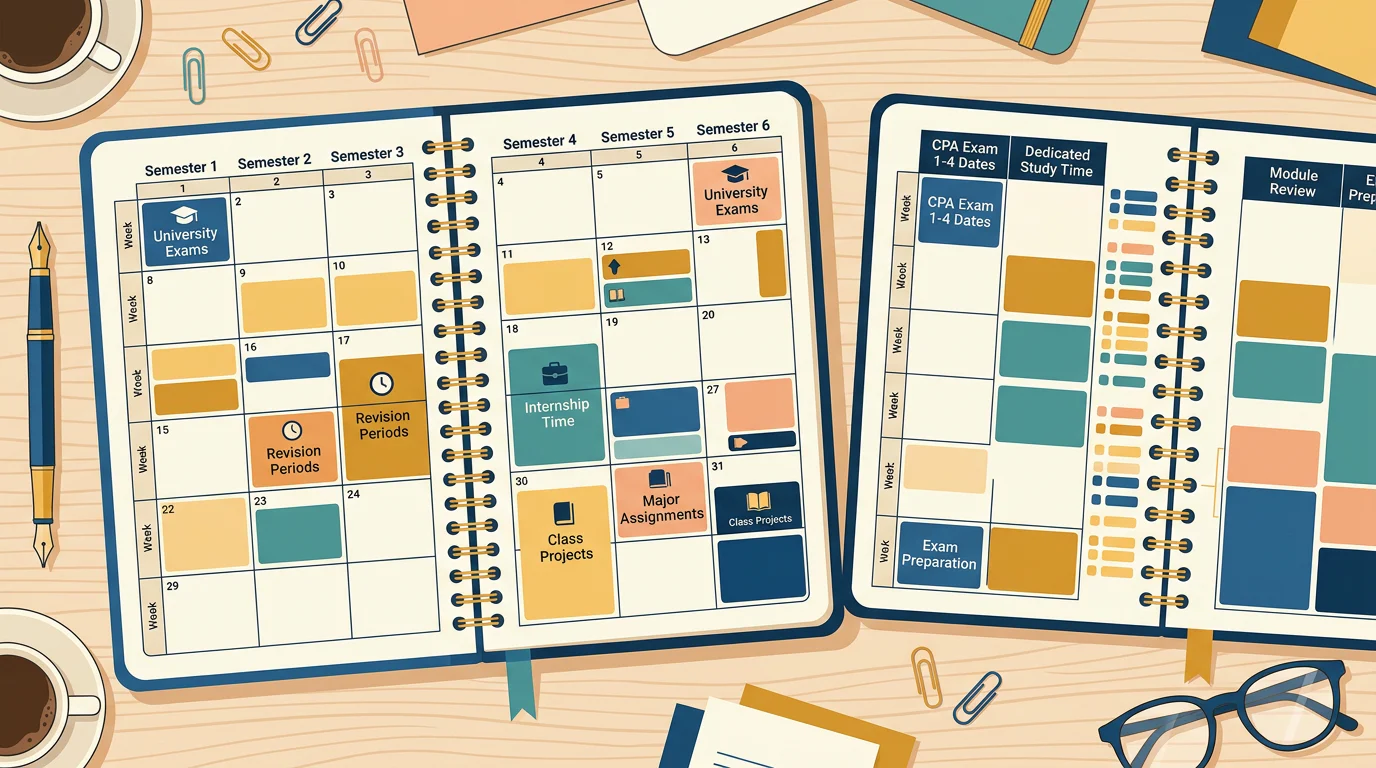
Build one table for your own university with six columns: semester, university subject code, subject name, related ACCA area, ACCA status, and evidence. The status column matters most. It should say whether a subject merely teaches related material, prepares you for an ACCA exam, or supports an officially confirmed exemption.
A paper can have a similar name without producing an exemption. “Financial Reporting” on a university timetable may be excellent preparation, but ACCA exemption eligibility depends on the exact awarding institution, programme, graduation year, and sometimes specific completed modules.
What Does an Approved Curriculum Look Like?
An official 2024 to 2027 BCom integrated curriculum provides a useful example of how detailed a map should be. It places Business and Technology and Financial Accounting in Semester I, Financial Management and Corporate and Business Law in Semester II, then Management Accounting, Financial Reporting, and taxation in Semester III. Later semesters include Audit and Assurance, Performance Management, and advanced subjects in the published semester structure.
That is a curriculum example, not a universal promise. Before admission, ask for your selected institution’s current curriculum PDF and map every claimed ACCA benefit to that specific document. Students comparing local delivery options can also review our integrated course options.
Where Can the Calendar Fail?
ACCA runs exam sessions in March, June, September, and December. University internals, end-semester exams, compulsory attendance, travel, and internship windows can collide with those sessions if nobody owns the integrated calendar.
Create a one-page yearly plan before enrolling. Mark university assessment weeks, ACCA standard-entry deadlines, revision blocks, exam days, and one future sitting for a possible resit. A timetable that looks efficient on paper can become stressful when both institutions expect peak effort in the same month.
How Can You Verify BCom ACCA Exemptions Before Paying?
Never rely on a verbal exemption count. The official ACCA calculator is the starting point because it asks for the awarding institution, graduation year or last year of study, and the exact qualification.
Use the calculator before paying an admission deposit, then save the result with the programme brochure and curriculum. If the result is conditional, ask the university to explain exactly which modules must be passed and when ACCA will recognise them. ACCA’s official calculator also explains what to do if the institution or qualification is not listed.
The verification sequence is straightforward:
- Identify the awarding body: Search for the university that issues the BCom, not a tuition partner.
- Use the correct academic year: Enter the expected graduation year or last year of study accurately.
- Match module names: Compare course codes and titles against official transcripts and the current curriculum.
- Save written evidence: Keep the calculator result and any ACCA correspondence.
- Price exemptions separately: Exemptions can save exam sittings, but they may still carry ACCA fees.
Students who already hold a BCom or are changing pathways should use our ACCA exemptions guide to plan remaining papers without treating one institution’s outcome as another’s.
What Remains After BCom with ACCA?
After graduation, your remaining work depends on the exemptions ACCA actually awards. Some students may have several papers left, while others may enter later stages of the qualification. Either way, the post-degree route can include exams, ethics, subscription costs, and practical experience.
The Practical Experience Requirement is often the most misunderstood part. ACCA says relevant experience can be gained before, during, or after exams, but it must be supervised, recorded, and signed off. The full membership route needs 36 months of relevant experience, so an internship is useful exposure but should not be assumed to complete the whole requirement. Review ACCA’s PER guidance before treating a placement promise as a membership promise.
Your workload plan should have three safeguards. First, schedule one professional paper at a time when university demands are heavy. Second, reserve revision time before each sitting rather than assuming regular classes are enough. Third, leave a resit buffer in the following exam session, because a failed attempt affects both timing and cost.
This is where structured support can be valuable, but only when it coordinates deadlines, gives paper-specific exam practice, and responds when a student falls behind. For a broader decision framework, see our ACCA tutor-support guide.
What Does BCom with ACCA Actually Cost?
The advertised programme fee is only one cost line. A complete budget needs university tuition, tuition support, ACCA registration, annual subscription, exemption fees, exam entries, ethics, materials, travel, possible resits, and any taxes shown on invoices.
ACCA’s published India fee page lists a 2026 initial registration fee of £89, an annual subscription of £140, Applied Knowledge exemption fees of £86 per paper, and Applied Skills exemption fees of £114 per paper. It lists the Ethics and Professional Skills Module at £83. Current paper-entry pricing varies by level and entry date, so students should check the live India fee schedule before making a total-cost comparison.
| Cost Item | What To Confirm | Why It Matters |
|---|---|---|
| University Tuition | Full programme fee, hostel, and university charges | Determines the degree cost |
| ACCA Registration | Current one-time registration charge | Needed to enter the ACCA route |
| Annual Subscription | Number of years likely needed | Continues while student status is active |
| Exemption Fees | Exact papers granted by ACCA | Exemptions are not always cost-free |
| Exam Entries | Standard versus late entry pricing | Late entries can cost substantially more |
| Support And Materials | Mock access, books, mentoring, revision | Reveals whether coaching is truly included |
| Resit Reserve | One additional sitting if needed | Prevents an unrealistic budget |
| Tax On Invoice | Tax charged by each supplier | Varies by supplier and transaction |
Do not convert GBP charges into a fixed INR claim unless you are using a dated exchange rate for that specific calculation. For many students, the better question is whether support reduces avoidable resits, late entries, and lost time. Our ACCA coaching cost check can help make that comparison more concrete.
When Is Structured Support Worth Paying For?
Structured support is worth paying for when it solves a visible coordination or learning problem. It is not automatically worth paying for because a programme uses the word “integrated.”

When Is Independent Study a Good Fit?
Independent study can work well for students with verified exemptions, strong fundamentals, reliable self-discipline, and enough control over their weekly timetable. The student must still organise exam entries, revision, materials, and recovery after a missed target.
When Does External or Integrated Support Add Value?
Support becomes more valuable when university assessments overlap with ACCA preparation, when the remaining papers expose gaps in core knowledge, or when the student needs frequent feedback to stay on track. The service should provide named faculty by paper, marked mock exams, doubt support, progress reviews, and a written plan for missed classes or resits.
We recommend using our integrated-program ROI framework to compare the price of support against the specific risk it reduces. If the provider cannot show what changes in your weekly plan, the fee may be buying a label rather than a solution.
What Are the Red Flags?
Ask direct questions before committing:
- Exemption claims: Can the provider show the current ACCA calculator path and conditions for your exact institution?
- Faculty expertise: Who teaches each ACCA paper, and what is their paper-specific experience?
- Exam practice: How often will your answers be marked against ACCA-style standards?
- Progress tracking: What happens when you miss classes, fail a mock, or need a resit?
- Internships: What role, supervision, duration, and learning evidence are actually provided?
- Placement claims: What is the cohort size, date, role type, and outcome denominator behind the claim?
- Attendance rules: How are university attendance and ACCA sessions handled during exam conflicts?
A transparent provider should welcome those questions. For students deciding between guided preparation and full independence, our ACCA self-study comparison provides another practical lens.
How iProledge Helps You Make the Decision
At iProledge, we think families should never purchase an integrated pathway on a brochure promise alone. A good choice begins with the awarding university, the exact graduation-year exemption result, a written all-in cost sheet, and a calendar that shows when classes, university assessments, and ACCA sessions overlap. We can help you turn those documents into a shortlist of questions, compare the support you would actually receive, and decide whether structured tuition solves a real problem for you. Bring the programme curriculum, fee schedule, attendance rules, and any exemption claim to the conversation. We will help you separate what the university awards, what ACCA requires, and what a support provider is genuinely accountable for. That gives you a clearer decision before admission, and a more realistic plan once study begins. It is the practical standard we use when advising prospective learners and parents. Speak with iProledge
FAQs on BCom with ACCA
Does BCom with ACCA Automatically Make You ACCA-Qualified?
No. A BCom degree and ACCA membership are separate. Membership still needs applicable exams, the ethics module, and relevant practical experience documented and signed off through ACCA's process.
How Many ACCA Papers Remain After BCom with ACCA?
The number depends on your awarding institution, programme, graduation year, and completed modules. Use ACCA’s calculator, then budget every remaining paper and membership requirement individually.
Is BCom with ACCA Worth It?
It can be worth it when support coordinates university demands, ACCA entries, marked mocks, and resit recovery. It is poor value when those services are vague or unnecessary.