
TL;DR
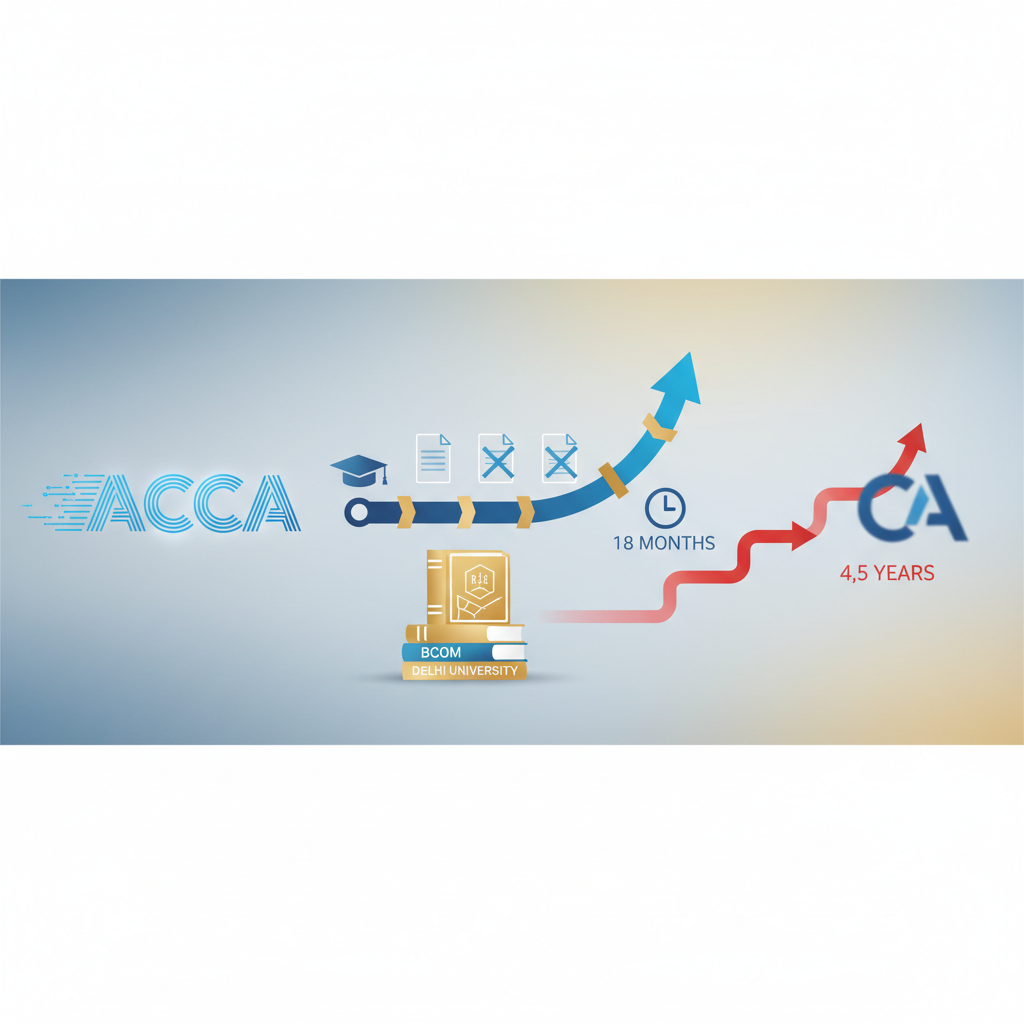
ACCA exemptions for BCom graduates from Delhi University and other Indian universities, with an 18-month ACCA timeline vs the 4.5-year CA route.
A three-year B.Com from an Indian university can trim the ACCA Qualification from 13 exams down to as few as ten, according to ACCA's official exemption guidance for Indian commerce graduates. A Chartered Accountancy candidate starting at the same age, meanwhile, still has Intermediate, articleship, and Final ahead of them, no matter how strong their degree looks on paper.
A BCom from Delhi University, or most other Indian universities, typically exempts you from 3 of ACCA's 13 papers (Business and Technology, Management Accounting, and Financial Accounting). That leaves 10 papers, which a focused candidate can realistically clear in 18 to 24 months. A 24-year-old starting Chartered Accountancy from scratch, by contrast, is usually looking at close to 4 to 4.5 years once Intermediate, mandatory articleship, and Final are all accounted for, even after Direct Entry waivers.
This piece goes further than the exemption lists most guides publish. It maps exemptions by degree type, lays out a month-by-month 18-month ACCA plan, puts that plan side by side with a realistic CA timeline, and compares what each route actually costs and asks of you before you touch a salary slip.
ACCA Exemptions for BCom Graduates: University-by-University Lookup
Exemption bands vary by degree structure more than by university name, which is why most guides that list individual colleges end up repeating the same three or four tiers. Below is how the bands typically break down for Indian graduates, followed by why running your own transcript through ACCA's official tool still matters.
- Plain three-year B.Com: Around 3 papers exempted, usually Business and Technology (BT), Management Accounting (MA), and Financial Accounting (FA), whether the degree is from Delhi University, Mumbai University, Bangalore University, or a similar state board curriculum.
- B.Com with an accounting or finance specialisation (BAF, B.Com Honours in Accounting): Exemptions can run slightly higher than a generalist B.Com, depending on how many finance-heavy papers the syllabus covered.
- M.Com or MBA in Finance: Up to 5 papers exempted, typically adding Corporate and Business Law (LW) and Taxation (TX) on top of the base three.
- CA Intermediate cleared (even without finishing CA): Up to 5 exemptions, which means only 8 papers stand between an Intermediate-qualified student and full ACCA membership.
None of these bands are guarantees. ACCA assesses institutions and syllabi individually, and the only way to get a binding answer for your own transcript is to run it through the official exemptions calculator, where you select your country, institution, and specific programme. If you are weighing ACCA against a traditional integrated BCom-CA program, this is the first number you need before comparing anything else.
The 18-Month ACCA Fast-Track Timeline for a 24-Year-Old BCom Grad
Once your exemptions are confirmed, the remaining 9 or 10 papers can be sequenced around ACCA's quarterly exam sittings. This is a realistic study plan for someone working full-time, not a theoretical minimum, and it assumes steady progress rather than perfect scores on the first attempt.

| Months | Milestone | Papers In Focus |
|---|---|---|
| 0 to 1 | Register with ACCA, submit transcripts, claim BT/MA/FA exemptions | Exemptions confirmed |
| 2 to 4 | First exam sitting | Corporate and Business Law, Performance Management |
| 5 to 7 | Second exam sitting | Taxation, Financial Reporting |
| 8 to 10 | Third exam sitting | Audit and Assurance, Financial Management |
| 11 to 14 | Strategic Professional core | Strategic Business Leader, Strategic Business Reporting |
| 15 to 18 | Strategic options plus Practical Experience Requirement sign-off | Two options papers, PER hours logged |
This pace assumes 15 to 20 hours of study per week alongside a job, which is why most working professionals stretch the same content across 24 to 30 months instead. Anyone deciding between structured coaching and self-directed prep for this exact sprint should read our breakdown on ACCA coaching vs self study before locking in a study plan, because the fastest timelines usually depend on having a fixed weekly schedule rather than raw intelligence.
CA from Scratch at 24: the 4 to 4.5-Year Reality
A 24-year-old commerce graduate does get one shortcut into Chartered Accountancy: the Direct Entry Scheme lets B.Com holders with qualifying marks skip Foundation and register straight for Intermediate. That waiver saves months, not years, and the structural bottleneck of CA remains the same for everyone.

| Stage | Typical Duration | What Happens |
|---|---|---|
| Foundation | Waived for eligible graduates | Direct Entry Scheme lets commerce graduates register for Intermediate directly, per ICAI |
| Intermediate | 8 to 9 months of study before exams | 8 papers across two groups, syllabus set by the ICAI Board of Studies |
| Articleship | 2 to 3 years | Mandatory practical training under a practicing CA, cannot be compressed |
| Final | Sat during or after articleship | 8 papers across two groups |
| Total | Roughly 4 to 4.5 years | From registration to membership |
The articleship stage is the real difference between the two routes. ACCA has no equivalent mandatory multi-year training block before you can call yourself qualified. If you are still deciding which route fits your degree structure, our comparison of BCom CA integrated programs versus doing them separately walks through how much of that 4.5-year window can realistically overlap with your final year of college.
ACCA vs CA Duration and Cost Comparison Table
Cost comparisons for ACCA and CA usually get reduced to a single rupee figure, which hides more than it reveals. The real differences show up in how long you are earning a junior salary versus training on a stipend, and in what you pay to register, sit exams, and claim exemptions along the way.
| Factor | ACCA (with BCom exemptions) | CA (from scratch at 24) |
|---|---|---|
| Papers remaining | 10 of 13, after roughly 3 exemptions | Full Intermediate (8) and Final (8), Foundation waived |
| Typical duration | 18 to 24 months for a focused candidate | 4 to 4.5 years including articleship |
| Exemption fee | Around £110 per exempted paper, per an India-specific ACCA exemption guide | Not applicable, no exemption route exists for graduates |
| Income while training | Most Indian ACCA candidates work full-time while studying | Articleship pays a stipend, not a full salary |
| Recognition | Same global ACCA membership as UK and Gulf candidates | Strongest recognition within India, growing acceptance abroad |
If your career plans point outside India, the recognition gap matters more than the fee gap. Our guide to ACCA vs CPA vs CA for Middle East and UK careers goes deeper into licensing and job access if that is the deciding factor for you rather than pure speed.
Can You Really Finish ACCA in 18 Months? What the Timeline Assumes
The 18-month plan above is achievable, but it is a best-case sprint, not a universal outcome. It assumes you clear most papers on the first attempt, which is the single biggest variable in either qualification's timeline.

- Consistent study hours: The plan assumes 15 to 20 hours a week without long gaps between sittings, since ACCA's syllabus builds on itself and a missed quarter compounds quickly.
- First-attempt pass rate: A failed paper simply pushes that exam to the next quarterly sitting, adding roughly three months rather than derailing the whole plan.
- Exemption confirmation before you start: Delays in submitting transcripts to ACCA can quietly eat a month or two off the front end of your timeline, so this should be the very first task on registration day.
- Practical Experience Requirement: You need 36 months of relevant work experience signed off before full membership, which usually overlaps with the study period rather than extending it, provided you start a finance-adjacent job early.
None of these assumptions apply to CA in the same way, because articleship's fixed 2 to 3 year duration cannot be compressed by studying harder. That structural difference, more than any single exam's difficulty, is why the two timelines diverge so sharply for someone starting at 24.
Get Your ACCA Fast-Track Plan with iProledge
Working out your exact exemption count from a BCom transcript, then building a study calendar around it, is where most 18-month plans quietly slip to 30. iProledge builds that calendar with you: confirming which papers your specific university exempts, sequencing the remaining exams around ACCA's quarterly sittings, and pairing each sitting with structured prep rather than guesswork. If you want a second opinion on your BCom's exemption band before you register with ACCA, explore our courses list or start the admission process directly. You can also message our team on WhatsApp with your transcript details for a quick read on where you stand.
FAQs on ACCA Exemptions for BCom Graduates
How Many ACCA Papers Can a BCom Graduate Skip?
A three-year B.Com from most Indian universities typically exempts you from 3 of ACCA's 13 papers, usually Business and Technology, Management Accounting, and Financial Accounting, leaving 10 papers to complete.
Is ACCA Faster Than CA for a 24-year-old Starting from Scratch?
Yes. ACCA with BCom exemptions usually takes 18 to 24 months, while CA from scratch, even with Direct Entry waivers, typically runs 4 to 4.5 years due to mandatory articleship.
Can I Work Full-time While Completing ACCA in 18 Months?
Most Indian ACCA candidates study while employed full-time, since exams are held quarterly and papers can be spaced around a job, unlike CA's fixed multi-year articleship commitment.
What Happens If I Fail an ACCA Paper During the Fast-track Plan?
A failed paper simply moves to the next quarterly sitting, typically adding about three months to your timeline rather than restarting your entire ACCA study plan.
Do Indian Employers Prefer CA over ACCA?
Preference depends on the role and employer. Domestic audit and tax firms often favour CA, while multinational finance, FP&A, and global shared-services roles frequently value ACCA equally or more.
Does Delhi University's BCom Qualify for ACCA Exemptions?
Delhi University's standard B.Com programs generally fall into ACCA's typical three-paper exemption band, but confirming your exact exemptions requires checking your transcript against ACCA's official exemptions calculator.
How Much Does the ACCA Exemption Fee Cost?
ACCA typically charges around £110 per exempted paper, according to India-specific exemption guides, which is paid separately from your regular exam and registration fees.