
BCom CA Integrated vs Separate: Time, Cost & Quality Compared
Compare BCom CA integrated vs separate paths to see how ICAI's new scheme impacts your timeline, costs, and articleship flexibility.
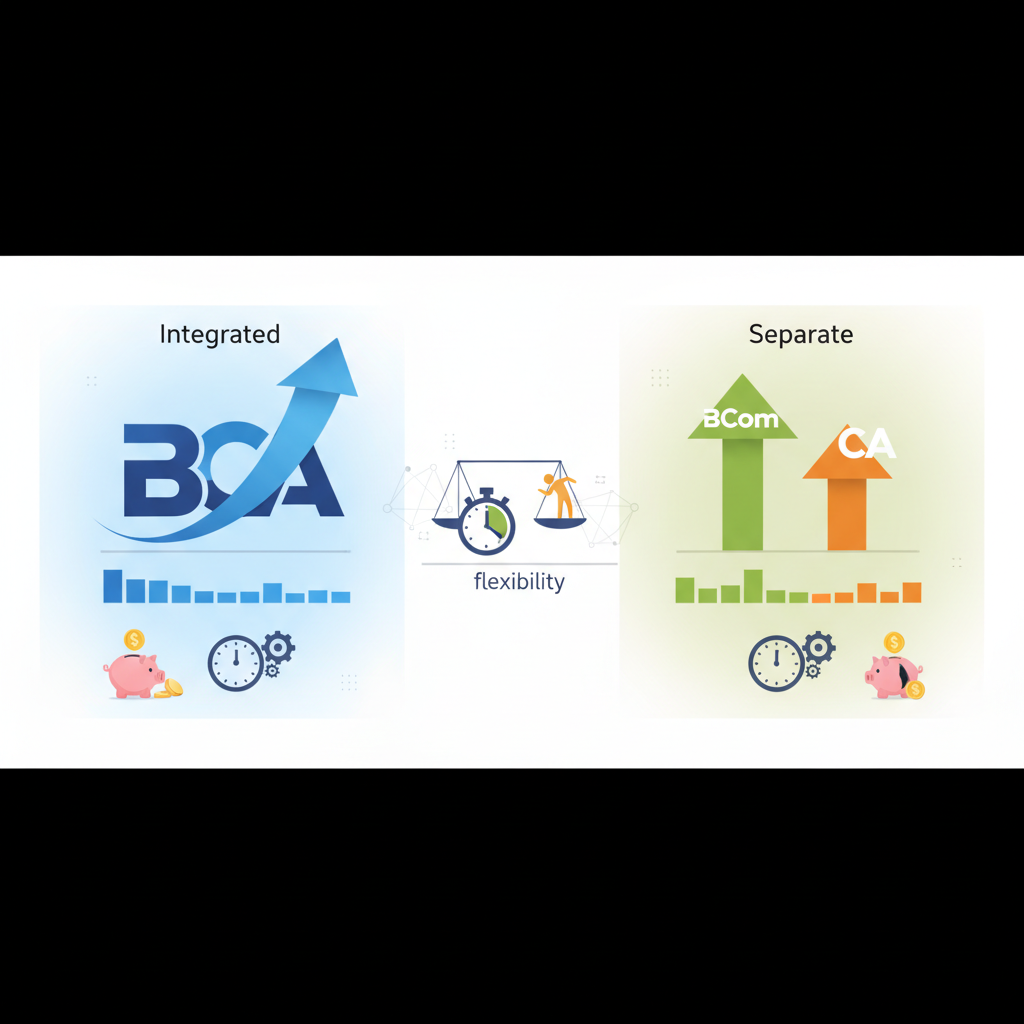
Choosing between BCom CA integrated vs separate is one of the first major decisions every Chartered Accountancy aspirant makes. While both paths ultimately lead to the same CA qualification, the journey, timeline, cost, and learning experience can be very different.
Under ICAI's New Scheme of Education and Training, becoming a Chartered Accountant takes a minimum of 42 months from Foundation registration to clearing the Final examination. If you complete a three-year BCom first and begin your CA preparation afterwards, your overall journey can easily extend beyond six years before you start your career as a qualified CA.
This is why the debate around BCom CA integrated vs separate has become increasingly important. Integrated programs allow students to pursue their BCom degree and CA preparation simultaneously, while separate programs require students to manage college and coaching independently.
Neither option is universally better. The right choice depends on your career goals, learning style, and how certain you are about pursuing Chartered Accountancy from the beginning. While integrated programs save valuable time, standalone BCom courses often provide greater academic flexibility.
Understanding BCom CA Integrated vs Separate
Before comparing timelines and costs, it is important to understand what these two options actually involve. Many students assume that every integrated program follows the same structure, but that is rarely the case.
A BCom with an integrated course combines your undergraduate degree with structured preparation for CA Foundation and CA Intermediate. Instead of attending college during the day and coaching separately in the evenings, both are planned together under one academic schedule.
Subjects like Accounting, Business Law, Taxation, Costing, and Financial Management overlap significantly between the BCom curriculum and the CA syllabus. A well-designed integrated program teaches these concepts in a coordinated manner, reducing duplication and helping students prepare for both university examinations and ICAI examinations simultaneously.
In contrast, the separate route involves enrolling in any BCom college while independently joining a CA coaching institute. Since both institutions operate on different schedules, students are responsible for balancing college attendance, coaching classes, self-study, university examinations, and CA examinations on their own.
The important point to remember is that ICAI does not require students to pursue an integrated degree. The CA registration process remains the same regardless of which academic route you choose. The difference lies entirely in how efficiently your time is managed throughout the journey.
BCom CA Integrated vs Separate: Timeline Comparison
The biggest advantage of choosing an integrated program is the overall timeline. Students following the separate route often spend the first three years focusing mainly on their BCom degree. Although many begin Foundation preparation during college, CA Intermediate preparation frequently gets delayed because university examinations and college commitments take priority.
As a result, articleship also begins later, extending the overall qualification timeline. Students enrolled in integrated programs or supported by CA online coaching usually prepare for CA Foundation from their first year itself. By the time they complete their graduation, many have already cleared both groups of CA Intermediate and become eligible to begin articleship immediately.
That difference may seem small initially, but it often saves between one and one-and-a-half years over the complete journey.
[table]
When comparing BCom CA integrated vs separate, this earlier start to articleship becomes one of the biggest deciding factors because professional experience begins much sooner.
Cost Comparison: Which Option Offers Better Value?
Many students compare only tuition fees while making their decision. However, the actual cost extends beyond classroom expenses. In the separate route, students pay university tuition fees, independent coaching fees, ICAI registration fees, study material costs, mock test expenses, and often transportation costs between college and coaching centres.
These expenses are spread across different institutions and are rarely planned together. An integrated program generally combines most academic expenses into a single fee structure. While the total fee may appear higher initially, students often save money by avoiding duplicate coaching, repeated classes, and additional study resources.
Does an Integrated Program Compromise Academic Quality?
This is probably the biggest concern students have before choosing an integrated program. Many believe that combining BCom and CA preparation automatically reduces academic quality. In reality, the answer depends entirely on how the program is designed.
A good integrated program does not eliminate important BCom subjects. Instead, it aligns overlapping topics with the CA Foundation strategy and later CA syllabus so students learn the same concepts once instead of studying them separately through two different institutions.
Subjects like Financial Accounting, Corporate Law, Taxation, Cost Accounting, and Auditing naturally complement both qualifications. Teaching them together often improves conceptual understanding because students immediately see how theoretical knowledge applies in professional examinations.
However, not every integrated program maintains the same standard. Some institutions simply advertise themselves as integrated while offering very little structured CA coaching.
This is why students comparing BCom CA integrated vs separate should look beyond marketing brochures. Faculty experience, classroom hours, mock test schedules, revision support, and student results provide a much better indication of program quality than the word "integrated" alone.
A well-designed integrated course should help students succeed in both university examinations and ICAI examinations without compromising either.
Exam Preparation: Structured Learning vs Self-Management
Preparing for CA is not just about studying hard. It is equally about studying consistently. Students pursuing the separate route often have to manage two completely different academic calendars. College assignments, semester examinations, coaching classes, and self-study all compete for the same limited hours each week.
Without careful planning, CA preparation often gets postponed until after university examinations. Integrated programs remove much of this coordination burden. Since the academic timetable is designed around both university and ICAI examinations, students follow a structured learning schedule throughout the year. Regular revision sessions, mock tests, doubt-solving classes, and performance tracking become part of the routine instead of something students have to arrange themselves.
This structured approach helps students stay disciplined over several years, which is essential for clearing professional examinations. When evaluating BCom integrated courses, many students underestimate the value of having one coordinated schedule instead of managing two separate systems.
Common Mistakes Students Make Before Choosing
Many students choose a program based on incomplete information or short-term considerations. Avoid these common mistakes to make a decision that supports your academic goals and CA preparation in the long run.
-
Focusing only on course fees while ignoring factors such as faculty quality, student support, mock test frequency, revision planning, and placement assistance.
-
Assuming every integrated program offers the same level of coaching without checking how the academic schedule is actually structured.
-
Not reading CA Foundation course reviews to understand the learning experience, faculty support, and student outcomes before enrolling.
-
Overlooking whether the institute provides dedicated CA faculty, regular performance reviews, structured revision plans, and sufficient classroom hours.
-
Choosing the separate route without realistically assessing whether you can balance two demanding academic schedules over several years.
Why Students Choose iProledge
At iProledge, the focus is not simply on completing a BCom degree alongside CA preparation. The objective is to help students progress through both qualifications in a structured and efficient manner.
The academic calendar is planned around ICAI milestones, allowing students to prepare for Foundation and Intermediate while completing their graduation. This helps reduce unnecessary delays and enables eligible students to begin articleship at the earliest possible stage.
Students also benefit from experienced faculty, regular mock examinations, detailed performance analysis, doubt-solving sessions, and continuous mentorship throughout their preparation.
Instead of forcing students to balance two unrelated academic systems, iProledge provides a single structured pathway that supports both university success and CA examination preparation.
If you have already decided that Chartered Accountancy is your career goal, choosing the right learning environment can make a significant difference to your journey.
Explore all our courses here!
FAQs
What is the difference between BCom CA integrated vs separate?
An integrated program combines your BCom degree with structured CA coaching under one academic schedule. The separate route requires students to manage their college education and CA coaching independently.
Is an integrated BCom with CA worth it?
Yes, if you are certain about becoming a Chartered Accountant. It helps streamline your preparation, reduces scheduling conflicts, and allows you to begin articleship earlier than many students following the separate route.
How much time can an integrated program save?
A well-structured integrated program can help students save approximately 12 to 18 months compared to completing a BCom first and beginning serious CA preparation afterwards.
Does an integrated program reduce the CA syllabus?
No. ICAI prescribes the same syllabus and examination pattern for every student. Integrated programs simply organise your preparation more efficiently without changing the curriculum.
Can I prepare for CA while pursuing a regular BCom?
Yes. Many students successfully complete CA through the separate route. However, it requires strong time management because college and coaching schedules usually operate independently.