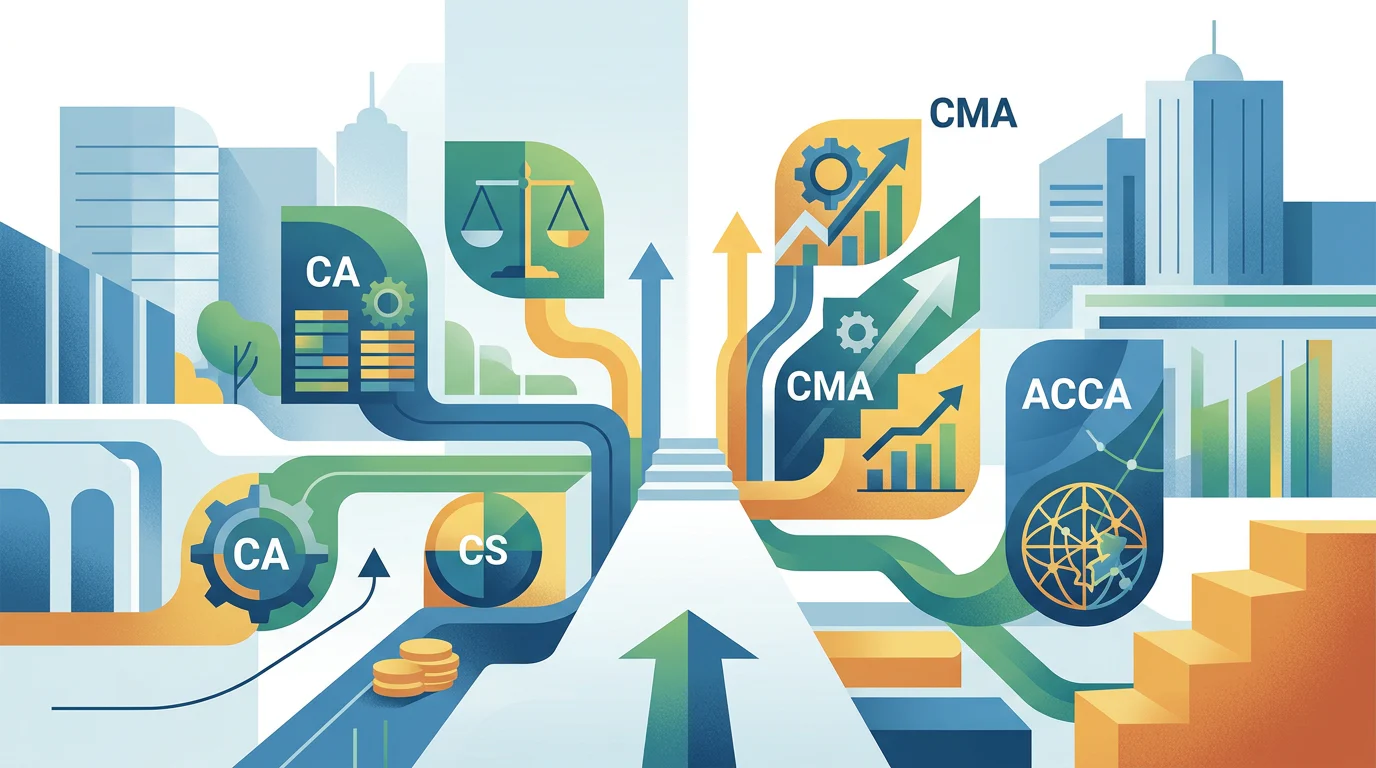
Can CMA USA Help You Move into FP&A? CMA USA for FP&A
Can CMA USA help you move into FP&A? Map the skills, build proof of experience, and choose between CMA and CPA for your next role.

By Naveen J D, Founder · Updated 11 Oct 2026

In brief
We find that CMA USA can support an FP&A move by validating knowledge in planning, budgeting, performance, cost, and decision analysis. We also show where experience still matters most, how to build portfolio proof in 90 days, and when CPA is the better fit for reporting, assurance, or licensure-focused roles.
In this article
- 1Identify the Role Gap Between Finance Management, Audit, and FP&A
- 2Map CMA USA for FP&A to Daily Work
- 3Use Part 1 to Strengthen Planning Credibility
- 4Use Part 2 to Build a Decision-Support Story
- 5Do Not Claim the Exam Replaced Delivery Experience
- 6Close the Skills Gap the Credential Cannot Prove
- 7Separate Knowledge from Demonstration
- 8Use a Self-Rating Rubric
- 9Prioritise Communication with Analysis
- 10Build a Portfolio That Signals FP&A Experience
- 11Choose an Internal or External Transition Route
- 12Build an Internal Route in 90 Days
- 13Build an External Route in 90 Days
- 14Decide Whether CMA or CPA Fits Your Target Role
- 15Build Your CMA USA Transition with iProledge
- 16FAQs on CMA USA for FP&A
Financial management remains a growth-oriented career path, with the U.S. Bureau of Labor Statistics projecting 10% growth for financial-manager employment from 2025 to 2035. The opportunity is real, but moving into FP&A requires a different kind of evidence than simply holding a finance title.
CMA USA for FP&A can strengthen a transition because it tests planning, budgeting, performance analysis, cost management, and decision analysis. It cannot substitute for experience that shows you can build a forecast, explain a variance, partner with operations, and defend a recommendation. Pair the credential with work samples that prove those tasks.
We will show where the CMA aligns with FP&A, what it cannot establish alone, how finance managers and auditors can build credible evidence, and when CPA may be the better next credential.
Identify the Role Gap Between Finance Management, Audit, and FP&A
FP&A is not simply accounting with more seniority. It is a forward-looking function that helps leaders understand what happened, what it means for future performance, and what decision should follow. By contrast, auditors and accountants often begin with the reliability of records, controls, and compliance. The O*NET task list for accountants and auditors includes examining records, reconciling differences, evaluating controls, and preparing audit findings, all useful foundations for an FP&A transition.
The gap is not a dismissal of audit or accounting experience. It is the need to convert historical rigor into a view of future performance, commercial drivers, and management action. A finance manager who has helped explain costs, challenge a budget, or identify an operational driver may already have relevant material, even if the work was never labelled FP&A.
| Function | Core Responsibility | Typical Time Focus | Strongest Transferable Evidence |
|---|---|---|---|
| Audit | Test records, controls, and compliance | Historical | Data rigor, risk identification, clear findings |
| Accounting | Record, reconcile, and report transactions | Historical and current | Close discipline, financial-statement knowledge |
| Controllership | Govern reporting, close, and financial controls | Current and future | Reporting ownership, controls, budget oversight |
| FP&A | Plan, forecast, analyse performance, and support decisions | Future-oriented | Forecasts, variance bridges, scenarios, recommendations |
For finance managers, the practical question is whether your work shows a decision cycle. Did you help set an assumption, compare performance with plan, identify a driver, recommend an action, and explain it to a non-finance stakeholder? If not, start developing that chain deliberately. Our cost-accounting plan can help you turn cost knowledge into analysis that is closer to business decision support.
Map CMA USA for FP&A to Daily Work
The CMA curriculum is relevant because its content follows many of the disciplines that recur in corporate planning and performance work. The official CMA outline allocates substantial attention to planning, budgeting, forecasting, performance, cost management, analytics, and decision analysis.
That overlap matters most when you can connect a topic to a real deliverable. Knowing flexible-budget concepts is useful. Showing a budget-versus-actual bridge that explains volume, price, mix, and cost drivers is far more persuasive.
| CMA USA Topic | Exam Weighting | Related FP&A Work | Evidence To Build |
|---|---|---|---|
| Part 1: External Financial Reporting Decisions | 15% | Establishing reliable actuals and reporting baselines | Actuals-to-management-report bridge |
| Part 1: Planning, Budgeting, And Forecasting | 20% | Annual plans, rolling forecasts, and driver assumptions | Driver-based forecast |
| Part 1: Performance Management | 20% | KPIs, variance analysis, and performance reviews | Monthly variance bridge |
| Part 1: Cost Management | 15% | Margin, profitability, and cost-driver analysis | Unit-economics model |
| Part 1: Internal Controls | 15% | Data checks and model governance | Assumptions and control checklist |
| Part 1: Technology And Analytics | 15% | Data preparation and reporting inputs | Refreshable analysis workflow |
| Part 2: Financial Statement Analysis | 20% | Linking operating drivers to financial outcomes | Three-statement impact review |
| Part 2: Corporate Finance | 20% | Funding and capital-allocation implications | Business-case model |
| Part 2: Decision Analysis | 25% | Scenario evaluation and recommendations | Base, upside, and downside case |
| Part 2: Risk Management | 10% | Downside assumptions and risk flags | Forecast risk register |
| Part 2: Investment Decisions | 10% | NPV, IRR, and project prioritisation | Investment recommendation |
| Part 2: Professional Ethics | 15% | Transparent assumptions and responsible reporting | Model documentation |
Use Part 1 to Strengthen Planning Credibility
Part 1 is especially useful for candidates who need to move from close, reporting, or audit work toward planning and performance conversations. Its planning, budgeting, forecasting, performance, cost, and analytics areas give you the vocabulary to discuss the work accurately.
If you are still studying, our guide to choosing an exam part can help you sequence preparation around the gap you need to close first.
Use Part 2 to Build a Decision-Support Story
Part 2 helps you move beyond reporting what changed. Financial-statement analysis, corporate finance, decision analysis, risk management, and investment decisions support the next FP&A question: what should the business do now?
Do Not Claim the Exam Replaced Delivery Experience
A credential validates a body of knowledge. It does not prove you owned a forecast cycle, presented to an operating leader, or persuaded a manager to change a plan. Keep those distinctions clear in your résumé and interviews.
Close the Skills Gap the Credential Cannot Prove
CMA study can improve your financial judgement, but it cannot automatically create tool fluency, commercial context, or business-partnering confidence. Those gaps are common because FP&A teams need both finance depth and the ability to turn data into decisions.
The demand is visible in hiring expectations. An AFP survey found that 86% of typical FP&A manager job descriptions mention business-intelligence, reporting, or analytical tools. The same research reports that 83% of FP&A professionals value technology and data skills at least as much as finance skills.
Separate Knowledge from Demonstration
CMA can support your understanding of planning, performance measurement, costs, financial analysis, and decision frameworks. You still need to demonstrate that you can build a model, validate inputs, explain assumptions, write management commentary, and handle a challenge from a business partner.
Use a Self-Rating Rubric
Score yourself across forecasting, variance analysis, modelling, data and BI tools, business partnering, and management commentary. Use the same scale for every skill.
- 0, No Exposure: You have not performed the task or cannot explain the workflow.
- 1, Assisted: You supported someone else’s work but did not own the analysis.
- 2, Independent Delivery: You created a reliable output and can explain the assumptions.
- 3, Decision-Ready Ownership: You defended the output, explained trade-offs, and recommended an action.
A total of 0 to 6 suggests you should build fundamentals first. A score of 7 to 12 calls for portfolio work plus internal exposure. A score of 13 to 18 supports targeted FP&A applications while you keep strengthening the weakest area. Our readiness assessment can help you identify where structured CMA preparation would add the most value.
Prioritise Communication with Analysis
A strong FP&A professional does not merely produce a dashboard. They explain the business driver, quantify the impact, identify uncertainty, and recommend a next step in language an operating leader can use.
Build a Portfolio That Signals FP&A Experience
Your portfolio should make a hiring manager’s evaluation easier. It should not mimic confidential employer files or claim results you did not create. Instead, build anonymised or illustrative work that shows your thinking from input through recommendation.
The IMA experience guidance recognises work such as FP&A, auditing, budgeting, forecasting, cost analysis, data analytics, and strategic planning as qualifying examples for CMA experience. That range confirms the transferable foundation, but a portfolio makes your individual contribution visible.
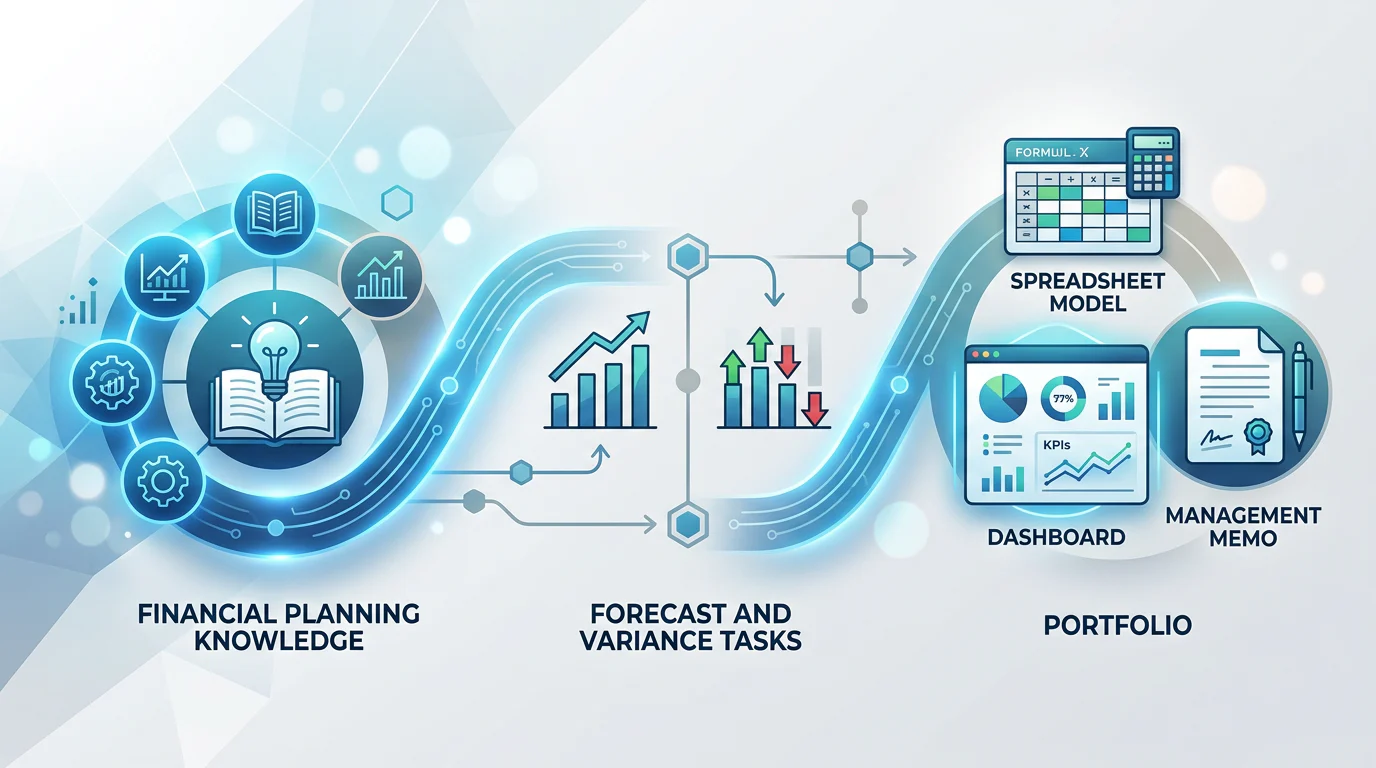
Build these five projects in sequence:
- Driver-Based Budget: Create a budget using operating assumptions such as volume, price, headcount, capacity, or material cost.
- Rolling Forecast: Update expected performance when one or two critical assumptions change, then document why.
- Variance Bridge: Compare budget, forecast, and actuals. Explain the drivers, not just the numerical difference.
- Scenario Model: Build base, upside, and downside cases with clear sensitivity assumptions.
- Management Commentary: Write a one-page memo that answers what happened, why it matters, and what action leadership should consider.
For each project, include source assumptions, calculations, outputs, limitations, and a recommendation. A polished model without a point of view is less valuable than a simpler model that reaches a defensible conclusion. Our margin analysis plan is a useful starting point if you need a practical profitability project.

Choose an Internal or External Transition Route
An internal move lets you gain context, data access, and stakeholder exposure before changing titles. An external move may be better if your current organisation cannot offer planning work, but it demands clearer evidence because the hiring team cannot see your potential in action.
AFP describes business partnering through integrated planning, performance and management reporting, and decision support. That is a useful structure for either route: look for work that puts you inside one of those three activities.
Build an Internal Route in 90 Days
- Days 1 To 30: Ask to support one budget, forecast, monthly performance pack, or business-unit review.
- Days 31 To 60: Produce a variance bridge and revised forecast with a reviewer from finance or operations.
- Days 61 To 90: Present one scenario and recommended action, then retain an anonymised artefact and interview story.
Build an External Route in 90 Days
- Days 1 To 30: Complete your self-rating, rewrite your résumé around business outcomes, and create a variance project.
- Days 31 To 60: Build a forecast and scenario model, then practise a two-minute walkthrough of each.
- Days 61 To 90: Target roles whose work matches your evidence, including planning, reporting, financial analysis, or business partnering.
These are adaptable milestones, not a promise of an offer within 90 days. Their value is that each step creates proof you can discuss under interview pressure. If you are balancing preparation with a demanding role, use our 50-hour workweek plan to set a realistic study rhythm alongside portfolio work.
Decide Whether CMA or CPA Fits Your Target Role
CMA and CPA can both be valuable, but they solve different career questions. If your target is corporate planning, performance analysis, cost management, and decision support, CMA is usually the closer curriculum fit. If the role is centred on external reporting, assurance, public accountancy, or licensing authority, CPA can be more relevant.
The U.S. CPA route is also a licensing route, not merely an exam choice. Current CPA rules describe four four-hour exam sections, while education, experience, ethics, and licensing requirements vary by jurisdiction.
| Target Role Signal | Better Initial Fit | Why |
|---|---|---|
| Budgeting, forecasting, performance, and cost analysis | CMA USA | The syllabus directly supports management-accounting and decision-support work |
| Financial reporting leadership and controllership | Depends On The Role | Both can help, but reporting depth and employer requirements matter |
| Audit-To-FP&A Transition | CMA USA Plus Portfolio | The credential supports the knowledge shift, while work samples prove forward-looking ability |
| Stalled Finance-Manager Growth | CMA USA Plus Evidence Plan | A credential can sharpen the story, but visible delivery creates credibility |
Choose the credential based on the work you want to do repeatedly, not the letters that appear most often in job titles. For a deeper role-by-role comparison, read our CMA vs CPA guide.
Build Your CMA USA Transition with iProledge
At iProledge, we help working finance professionals turn CMA USA study into evidence they can use in an FP&A conversation. Our focused preparation support can help you identify which exam topics need deliberate practice, shape an achievable study routine around your workweek, and convert familiar accounting tasks into clearer business stories. We do not present a certificate as a substitute for forecasting, model building, or stakeholder communication. Instead, we focus on the connection between the curriculum, your current responsibilities, and the proof a hiring manager can inspect. If you are deciding whether to begin, need help sequencing Part 1 and Part 2, or want an honest review of your readiness, we can help you choose a path that fits the job you want next. Explore our learning options, speak with our team, and begin with practical guidance that respects both your ambitions and schedule at iProledge Home.
FAQs on CMA USA for FP&A
These answers resolve the decisions that recur most often when people assess this transition. We keep them short because the evidence and next action should be clear.
Does CMA USA Help for FP&A?
Yes. CMA covers planning and performance concepts, but we would still show a forecast, variance bridge, model, and management commentary to prove practical FP&A readiness.
Can an Auditor Move into FP&A with CMA USA?
Yes. Audit develops rigor around records, controls, and explanations. We would add forward-looking portfolio work, then show how historical analysis became a decision-ready business recommendation.
Is Experience More Important Than CMA for FP&A?
For hiring, experience provides more direct proof. CMA signals relevant knowledge, while a forecast, scenario model, and stakeholder-ready commentary demonstrate how you apply that knowledge.
Should a Finance Manager Choose CMA or CPA for FP&A?
CMA generally aligns more closely with planning, performance, and decision-support work. CPA becomes more compelling when your target role centres on reporting, assurance, public practice, or licensure.
How Long Should an FP&A Transition Plan Take?
Use 90 days to create evidence, not to promise an offer. We recommend one forecast, one variance bridge, one scenario model, and interview stories for each project.