Which CMA USA Exam Gaps Need Coaching? A CMA USA Exam Readiness Assessment
Use a CMA USA exam readiness assessment to identify gaps, choose proportionate support, and avoid paying for coaching you do not need.

By Naveen J D, Founder · Updated 11 Oct 2026

In brief
We use a timed CMA USA exam readiness assessment to distinguish foundational, application, pacing, retention, and coverage gaps before recommending paid help. We explain current exam demands, show an error-log diagnostic, map each result to proportionate support, compare mandatory costs, and set reassessment points so candidates do not keep paying for support they no longer need.
In this article
- 1What Does the CMA USA Exam Demand Before You Buy Support?
- 2How Do We Run a CMA USA Exam Readiness Assessment?
- 3Use a Full Timed Baseline
- 4Keep a Useful Error Log
- 5Set a Threshold You Can Defend
- 6Which Gap Does Your Baseline Reveal?
- 7Weak Accounting Foundations
- 8Application and Scenario Reasoning
- 9Speed, Stamina, or Retention
- 10Use Your Background to Choose the First Part
- 11What Support Matches Each CMA USA Exam Gap?
- 12Official Materials and Review Software
- 13Test Series and Question Debriefs
- 14Targeted Tutoring and Full Coaching
- 15Reassess Before You Upgrade
- 16What Does CMA USA Support Cost Before You Commit?
- 17How iProledge Helps You Use the Result
- 18FAQs on CMA USA Exam Readiness Assessment
The CMA USA exam is not a short test of recall. IMA recommends 150 to 170 hours of study per exam part, so choosing the right kind of help early can protect both your time and budget.
CMA USA coaching becomes worth considering when a specific exam gap persists after disciplined self-study. In a CMA USA exam readiness assessment, we look for weak accounting foundations, low timed completion, incomplete coverage, or flawed scenario reasoning, then match the result to targeted resources, practice, tutoring, or structured coaching.
We will help you run the diagnostic, read its results, select proportionate support, plan your exam order, and count the costs before you commit.
| Diagnostic Result | Evidence To Check | Lightest Effective Support | Escalate Only When |
|---|---|---|---|
| Conceptual Gap | The same topic is missed untimed and timed | Official materials and focused review | Two targeted review cycles do not improve understanding |
| Application Gap | Rules are recalled but scenario choices are wrong | Explained question bank and evaluated practice | The error log repeats the same reasoning mistake |
| Speed Gap | Accuracy is acceptable on completed questions, but too much remains unfinished | Timed test series and pacing practice | Two full simulations still show poor completion |
| Coverage Or Consistency Gap | Several domains are weak or study blocks are repeatedly missed | Tutoring for narrow gaps, full coaching for broad gaps | Retesting confirms multi-domain weakness |
What Does the CMA USA Exam Demand Before You Buy Support?
We begin with the exam itself, because a support decision made without knowing the task is usually too broad. The official content outline assigns Level C coverage to every major domain. That means candidates must move beyond remembering rules to applying, analysing, synthesising, and evaluating them in business situations.
Part 1, Financial Planning, Performance, and Analytics, covers External Financial Reporting Decisions, 15%; Planning, Budgeting, and Forecasting, 20%; Performance Management, 20%; Cost Management, 15%; Internal Controls, 15%; and Technology and Analytics, 15%. Part 2, Strategic Financial Management, covers Financial Statement Analysis, 20%; Corporate Finance, 20%; Business Decision Analysis, 25%; Enterprise Risk Management, 10%; Capital Investment Decisions, 10%; and Professional Ethics, 15%.
The current format matters too. The CMA handbook confirms that each part has 100 MCQs, with three hours for that section and one hour for two written or case-based sets. From the September/October 2026 window, case-based questions become standard for English exams in most regions. Candidates need at least 50% of MCQ points to unlock that second section.
That combination explains why a course may help one person and be unnecessary for another. Our CMA USA coaching ROI framework starts with the gap, not the assumption that everyone needs the same delivery model.
How Do We Run a CMA USA Exam Readiness Assessment?
A readiness assessment should feel like a small version of exam day, not a casual chapter quiz. We use one timed, exam-like baseline to show whether the candidate is struggling with the material, the clock, scenario reasoning, or study consistency.
Use a Full Timed Baseline
Complete 100 mixed MCQs in three hours, then spend one hour on two case or written-response sets. Record questions attempted, questions correct, time remaining, domains missed, and whether both second-section sets were completed.
- Accuracy: Track correct answers by domain, not just a single overall percentage.
- Completion: Record what was finished inside the official time limit.
- Reasoning: Mark whether an incorrect answer came from a forgotten concept, wrong calculation, misunderstood scenario, or rushed choice.
- Retention: Reattempt selected misses after 48 hours, without notes.
We do not convert an official scaled score into a mock percentage. The official passing score is 360 on a 0 to 500 scale, so a provider should only use a target score or completion threshold when it can show credible evidence that its mock is comparable to the exam.
Keep a Useful Error Log
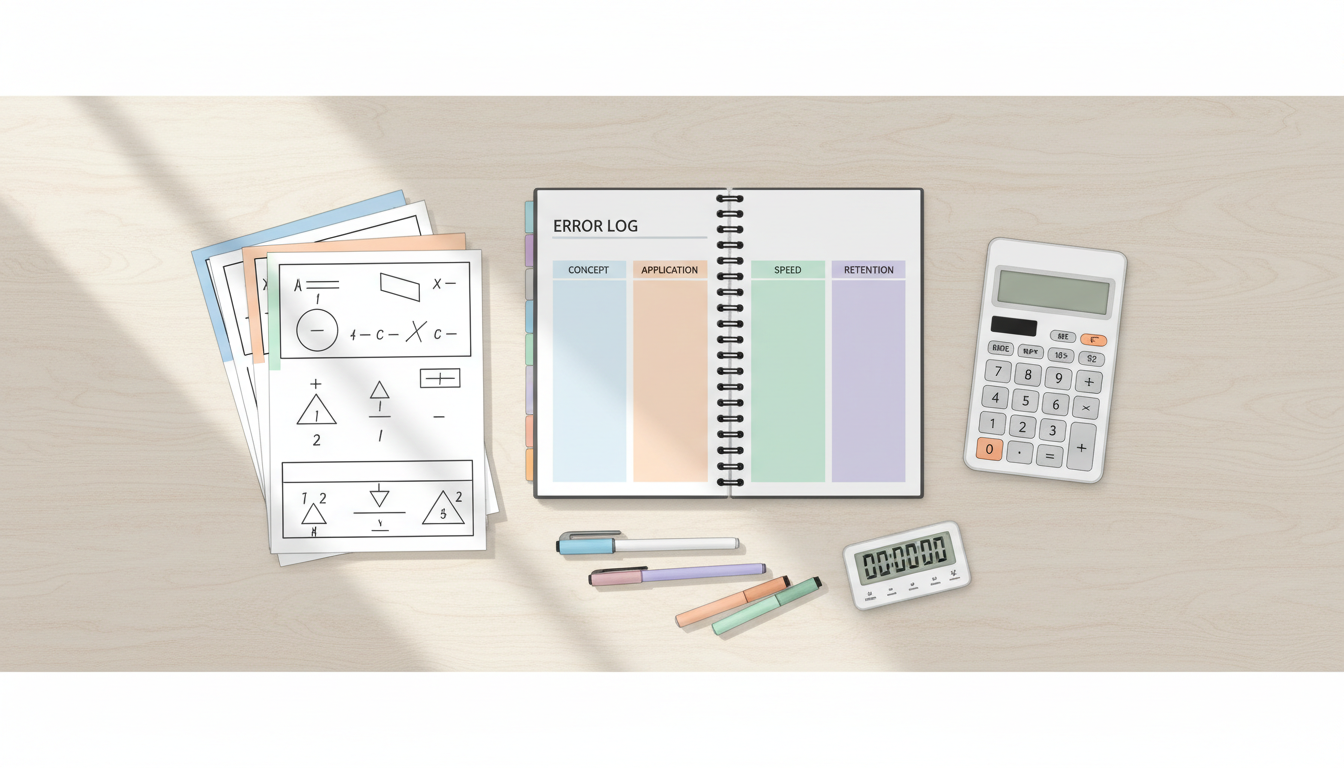
An error log turns a low mock score into a repair plan. It also stops candidates from buying broad coaching to solve one narrow weakness.
| Domain Or Topic | Question Type | Why It Was Missed | Gap Label | Next Action |
|---|---|---|---|---|
| Cost Management | Calculation | Used the wrong cost driver | Application | Review worked examples, then retry |
| Corporate Finance | Formula | Could not recall the formula | Retention | Build spaced-recall practice |
| Internal Controls | Scenario | Misread the business objective | Conceptual | Relearn the principle and contrast options |
| Business Decision Analysis | Mixed MCQ | Ran out of time | Speed | Practise pacing in timed sets |
Set a Threshold You Can Defend
We recommend setting a personal target only after at least two comparable timed attempts. A credible target should include accuracy, completion, and recurring error types, rather than rewarding a single high score on an easier set.
Candidates who want a wider decision framework can use our professional accounting ROI guide alongside the diagnostic. The point is not to prove that coaching is worthwhile. The point is to identify what would actually change the result.
Which Gap Does Your Baseline Reveal?
A low result can come from several different causes. We separate them because the official syllabus assumes prior familiarity with financial statements, economics, time value of money, statistics, and probability. A weak foundation needs a different response from an experienced finance professional who simply runs out of time.
Weak Accounting Foundations
Choose this label when the same concepts are missed with no time pressure, especially in financial reporting, budgeting, cost management, or internal controls. Rewatching question explanations alone may not fix this gap because the underlying model is still unclear.
Application and Scenario Reasoning
Choose this label when you can define a term or recall a formula but cannot select the right action in a new business context. It is especially relevant for Level C testing and case-based work, where candidates must connect calculation, judgment, and explanation.
Speed, Stamina, or Retention
Choose speed when correct work appears in untimed practice but the timed baseline remains unfinished. Choose retention when a topic is understood today but missed again in a later attempt. These gaps often need a better practice rhythm, not a full course.
Use Your Background to Choose the First Part
- Student: Start with the part whose domains best match recent coursework, then add timed practice before paying for live help.
- Accounting Career Switcher: Build fundamentals first if Part 1 exposes repeated errors in reporting, costing, budgeting, or controls.
- Experienced Finance Professional: Start with the stronger part, but test for broad coverage and case pacing before assuming work experience is enough.
IMA lets candidates take either part first, so we use the baseline rather than a universal rule. Candidates comparing delivery formats can also review CMA USA coaching in Bangalore to see which support features matter for their schedule.
What Support Matches Each CMA USA Exam Gap?
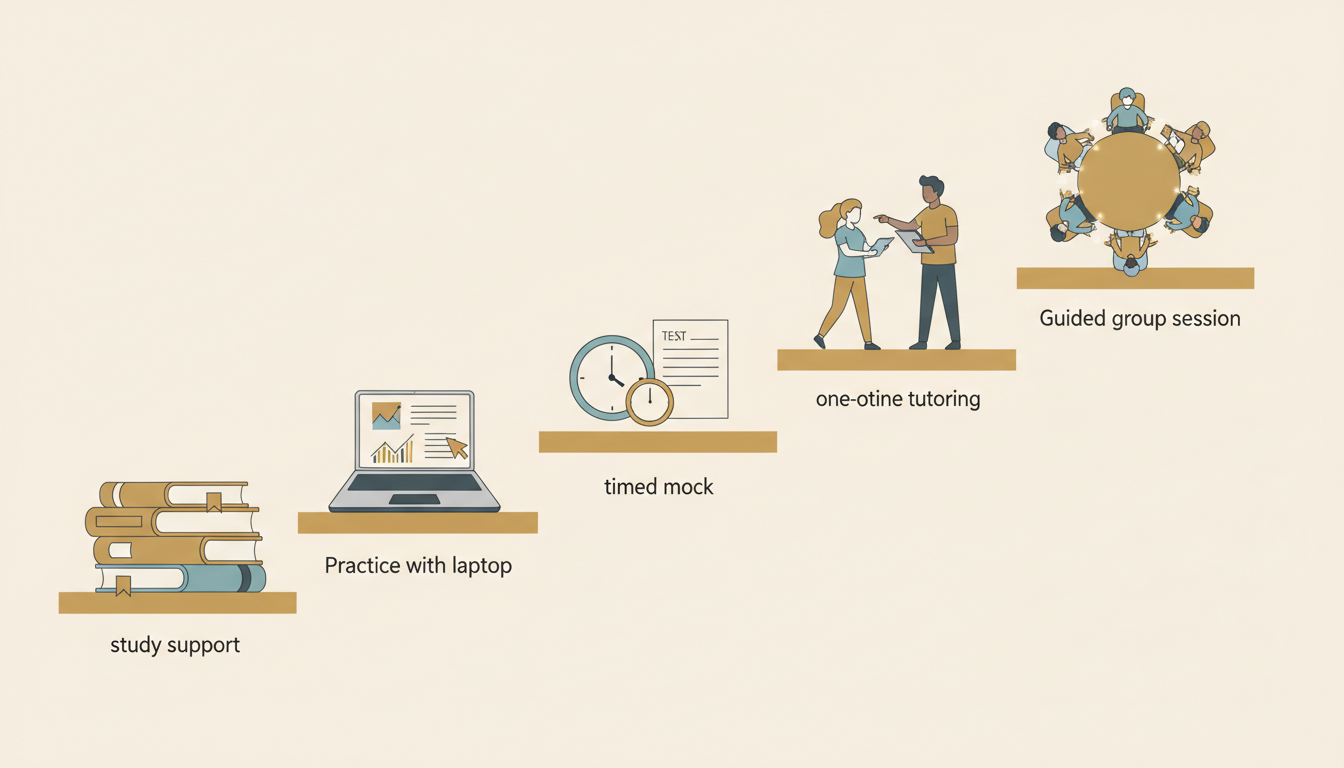
The right support is the least intensive option that removes the identified barrier. We do not treat review software, test series, tutoring, and structured coaching as interchangeable, because they solve different problems.
| Support Level | Best For | What To Verify | Stop Condition |
|---|---|---|---|
| Official Resources | One narrow knowledge gap | Current syllabus coverage and formal study plan | Topic errors stop recurring |
| Review Software | Application and retention gaps | Detailed answer explanations and progress data | Timed accuracy improves across domains |
| Timed Test Series | Speed and stamina gaps | Full-length, current-format simulations | Completion improves in two comparable mocks |
| Targeted Tutoring | One or two persistent domains | Instructor access and question debriefs | Target domains stabilise |
| Full Structured Coaching | Broad coverage, consistency, or accountability gaps | Study plan, tracking, mocks, and escalation rules | Reassessment shows support can be reduced |
Official Materials and Review Software
IMA’s entrance fee includes an exam support package with retired questions and a glossary, but it also says that package should be supplemented by a formal study plan. We use official materials first when the candidate has one identifiable weakness and can follow a schedule independently.
Test Series and Question Debriefs
A test series is most useful when the problem is execution under pressure. Look for full-length mocks, clear explanations, domain-level tracking, and debriefs that explain why a tempting option was wrong. Our class-size checklist can help candidates check whether promised faculty access is practical.
Targeted Tutoring and Full Coaching
Tutoring suits a discrete problem, such as transfer pricing, variance analysis, or capital budgeting. Full coaching suits repeated weakness across several domains, missed study commitments, or a need for a paced plan and regular feedback.
Before enrolling, we ask whether the provider offers instructor access, evaluated question debriefs, meaningful progress tracking, and mocks that mirror the four-hour format. The IMA provider guide similarly advises candidates to match features to learning style and the support they actually need.
Reassess Before You Upgrade
After a focused corrective cycle, rerun a comparable timed baseline. If accuracy, completion, and error patterns have improved, stay with the lighter support. If the same multi-domain issues persist, then coaching may be the efficient next investment.
What Does CMA USA Support Cost Before You Commit?
We encourage candidates to separate mandatory certification costs from optional preparation costs. Candidates balancing a job with preparation can also consider working-professional options after the baseline has identified what level of structure they need.
The live IMA enrollment page lists professional membership at $295, a $300 entrance fee, and $545 per exam part. Student and academic categories have different membership and exam pricing.
| Cost Item | Professional Member | Student Member | Academic Member |
|---|---|---|---|
| IMA Membership | $295 | $49 | $160 |
| CMA Entrance Fee | $300 | $225 | $225 |
| Exam Fee Per Part | $545 | $407 | $407 |
| Two-Part Minimum Before Preparation | $1,685 | $1,088 | $1,199 |
| Review Materials, Test Series, Tutoring, Or Coaching | Varies | Varies | Varies |
| Retakes, Rescheduling, Or Maintenance | Varies | Varies | Varies |
The table excludes taxes, local currency conversion, optional review materials, coaching, and potential retakes. A missed appointment or an unsuccessful attempt can require another registration, and candidates must pass both parts within three years of entering the program.
Study planning affects this cost. Starting with your stronger part can create an earlier checkpoint, while starting with the weaker part may be sensible if it needs foundational work before it blocks everything else. Browse all available programs only after you know which of those routes your diagnostic supports.
How iProledge Helps You Use the Result
At iProledge, we start with the result, not a blanket course recommendation. Our counselling conversation can help you identify whether you need stronger foundations, a pacing reset, tougher question debriefs, or a fuller routine that fits work or college. We explain the support level, expected study commitment, and the point at which you should retest before paying for more.
If you already have mock results, bring the domain scores, missed-question patterns, and timing record, so we can discuss the smallest useful next step instead of overselling a program. We also explain the questions a provider should answer before any enrollment decision, including instructor access, debrief quality, progress tracking, and realistic exam-like practice. Our approach is designed to help you choose targeted support when it is enough, then step back when your reassessment shows you can continue independently. For a practical conversation about your CMA USA readiness assessment, talk with iProledge
FAQs on CMA USA Exam Readiness Assessment
When Do I Need CMA USA Coaching?
Coaching is worth considering after a timed baseline and focused self-study leave the same gap unresolved across several domains or under sustained exam pacing pressure.
Can a Low Mock Score Tell Me Whether I Need Coaching?
No. A low result helps only when an error log separates missed concepts from pacing, incomplete coverage, careless execution, or weak scenario-based application during timed practice.
Should I Start with CMA USA Part 1 or Part 2?
Start with the part whose weighted domains best match your current strengths and schedule, then use a timed diagnostic before booking an exam appointment for either testing window.
What Costs Should I Include Before Buying CMA USA Support?
Include membership, entrance, two exam registrations, review materials, test series, tutoring or coaching, potential retakes, and annual maintenance after certification so your budget reflects total commitment.