

TL;DR
CMA India moves through the entry route that fits your education, three examination levels, required skills and practical experience, followed by separate membership conditions. We map the current 20-paper syllabus, show how it becomes more applied, and give you a grounded way to decide whether self-study or paid coaching fits your documented gaps.
ICMAI’s current curriculum gives the CMA India course a 20-paper academic structure: four Foundation papers, eight at Intermediate, and eight at Final, including a chosen elective. See the current curriculum before relying on old course charts or coaching brochures.
The CMA India course moves from the entry route that fits your education through Foundation, Intermediate and Final examinations, skills training, practical experience and, separately, ICMAI membership conditions. It combines accounting, costing, tax, law, finance, analytics and strategic decision-making. Coaching is optional and pays off only when documented study gaps persist.
Below, we map the route, papers, practical requirements and career relevance in plain language. We also show how to decide whether official resources are enough or structured support would solve a real preparation problem.
Which CMA India Course Entry Route Fits You?
Your starting point depends on your education, not on whether you already feel confident in accounting. ICMAI allows students to begin Foundation after Class 10, while eligibility to sit the Foundation examination follows passing 10+2 or an accepted equivalent. Its entry rules also set out direct routes into Intermediate.
The practical distinction matters. A Class 12 student normally builds through Foundation first, while a graduate or another eligible candidate may move directly into Intermediate. Direct entry saves a level, but it does not remove the need to master the content that Foundation introduces.
| Route | Starting Qualification | First Examination Stage | What To Confirm |
|---|---|---|---|
| Foundation route | Class 10 for admission, then Class 12 or accepted equivalent for examination eligibility | Foundation | Your board qualification and current examination cut-off |
| Foundation-qualified route | Passed ICMAI Foundation | Intermediate | Foundation result and Intermediate registration documents |
| Direct-entry graduate route | Degree from a recognized university, subject to listed exclusions | Intermediate | Degree recognition and documentary proof |
| Other listed direct routes | Eligible CAT, engineering, or specified professional qualifications | Intermediate | The exact qualification and current ICMAI rule |
If you are comparing course formats before enrolling, start with course options only after confirming the official route you qualify for.
How Do Foundation, Intermediate, and Final Progress?
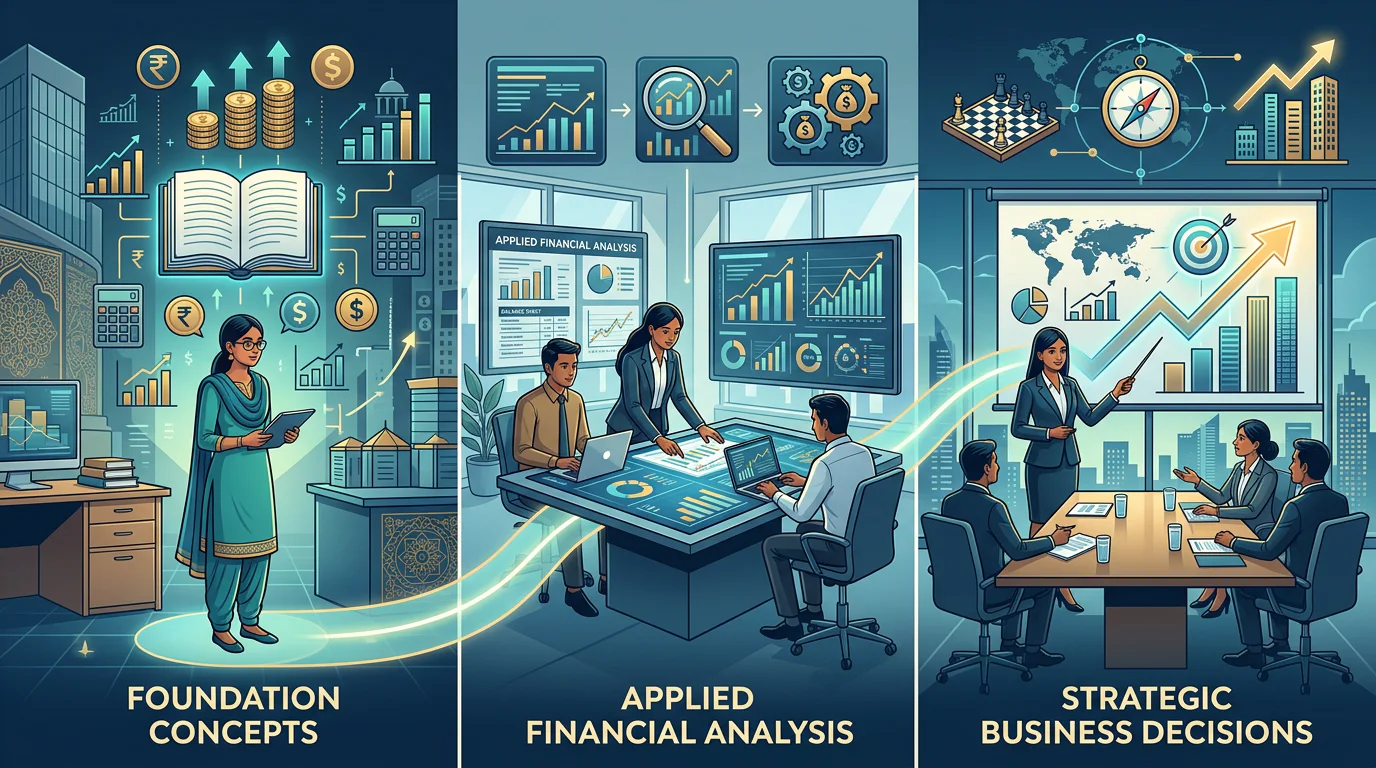
The qualification becomes more demanding in layers. Foundation establishes the commercial base, Intermediate asks you to apply it across accounting, tax, law and management decisions, and Final moves into strategic finance, audit, reporting and specialized choice.
For Intermediate and Final, the published rule is at least 40 percent in every paper attempted and 50 percent aggregate when both groups are taken together. That makes group planning important, but it should not become an excuse to postpone a realistic revision cycle.
| Level | Papers | Main Focus | Progression |
|---|---|---|---|
| Foundation | P1 Business Laws and Communication P2 Financial and Cost Accounting P3 Business Mathematics and Statistics P4 Business Economics and Management | Commercial and quantitative fundamentals | Builds the base for Intermediate |
| Intermediate Group I | P5 Business Laws and Ethics P6 Financial Accounting P7 Direct and Indirect Taxation P8 Cost Accounting | Compliance, reporting, tax and costing | Turns concepts into applied calculations and records |
| Intermediate Group II | P9 Operations and Strategic Management P10 Corporate Accounting and Auditing P11 Financial Management and Business Data Analytics P12 Management Accounting | Analysis, audit, finance and management decisions | Connects finance work with operational decisions |
| Final Group III | P13 Corporate and Economic Laws P14 Strategic Financial Management P15 Direct Tax Laws and International Taxation P16 Strategic Cost Management | Strategic law, finance, tax and cost decisions | Develops senior-level analysis |
| Final Group IV | P17 Cost and Management Audit P18 Corporate Financial Reporting P19 Indirect Tax Laws and Practice P20 One chosen elective | Assurance, reporting, indirect tax and specialization | Completes Final after one elective choice |
What Does the CMA India Syllabus Teach?
The syllabus is broader than cost sheets. ICMAI’s stated learning objectives include strategic, financial, cost and business-performance management, alongside application-oriented work in legal, regulatory, monitoring and reporting contexts. Read the course objectives as a useful reality check on what the qualification is designed to teach.
Foundation Builds Commercial Fluency
Foundation introduces business law, financial and cost accounting, mathematics, statistics, economics and management. This is where students learn the vocabulary and calculations that later subjects assume, including how costs, accounts and basic business decisions connect.
If tuition is part of your plan, compare official course costs with our published fees before deciding what private support would add.
Intermediate Makes Subjects Operational
Intermediate combines taxation, cost accounting, corporate accounts, audit, finance, data analytics and management accounting. For a student already working in finance, this is the level where familiar tasks such as budgeting, reporting, tax compliance and operational analysis begin to connect across subjects.
Final Pushes Toward Strategic Judgment
Final covers strategic financial management, strategic cost management, corporate financial reporting, cost and management audit, direct and indirect tax, and one elective. The elective choice can lean toward valuation and performance management, banking and insurance risk, or entrepreneurship and startups.
How the Subjects Become Applied
Costing develops from basic classification and statement preparation into strategic cost management and decision techniques. Taxation progresses from computations and compliance into direct-tax planning, international taxation and indirect-tax practice. Law advances from fundamentals to corporate and economic laws, while finance moves from financial management into strategic finance and business data analytics.
For an FP&A professional, that does not mean every paper mirrors a monthly forecast cycle. It does mean the syllabus supplies relevant tools for margin analysis, budgeting, performance reporting and decision support. Our guide to practical learning explains where classroom knowledge still needs workplace practice.
Which Practical Components and Membership Conditions Matter?
Examinations are only one part of the route. ICMAI requires skills training at Intermediate and Final, a defined practical-training period for current Intermediate registrants, and separate evidence of practical experience when applying for Associate Membership.
Keep the training stages distinct. The 15-month practical-training requirement supports the course path, while membership rules refer to not less than three years of relevant practical experience, assessed with evidence to the Council’s satisfaction.
| Milestone | Requirement | Current Detail |
|---|---|---|
| Intermediate | Skills training | 120 hours: ERP, communication and soft skills, MS Office, and e-filing |
| Final | Skills training and industry orientation | 80 hours plus a 10-day Industry Oriented Training Programme |
| Final examination timing | Practical-training progress | At least 10 months can matter for notified Final examination timing conditions |
| Course completion path | Practical training | Minimum 15 months for students registered for Intermediate on or after 11 February 2020 |
| Associate Membership | Relevant practical experience | Not less than three years, with acceptable evidence and Council approval |
ICMAI recognizes practical work across cost and management accounting, financial accounting, financial management, audit, tax, compliance, ERP, project work and supply-chain-related functions. That breadth is useful for working professionals, but only documented experience in recognized settings should be assumed to count.
Students approaching Final often need help fitting revisions around training and work. Explore Final support only after mapping the official requirements against your actual calendar.

When Is CMA India Coaching Worth Paying For?
Paid coaching is not an ICMAI requirement. Before paying, use the Institute’s own study materials, practice tests, model question papers, workbooks, MCQ banks, postal tests and examiner feedback available through its student resources.
The right question is not whether coaching is universally necessary. Ask whether your evidence shows a persistent preparation problem that self-study, official practice materials and a disciplined schedule have not fixed.
Use Official Resources First
Track each module, complete timed work, compare answers with official material and record why marks were lost. A weak result without an error log is not a diagnostic. It is only a result.
Run an Evidence-Based Diagnostic
| Signal | What To Record | Verified Benchmark | What Structured Help Must State |
|---|---|---|---|
| Syllabus completion | Paper and module tracker | ICMAI publishes the content, not a coaching-readiness cut-off | A current, paper-level study plan |
| Concept accuracy | Repeated errors by topic | No official readiness score | How errors will be diagnosed and revisited |
| Timed practice | Time used and unfinished answers | No official readiness score | Timed-writing practice and feedback method |
| Mock performance | Full-paper attempts and error patterns | Examination pass rules are not readiness guarantees | Test frequency and marking turnaround |
| Revision discipline | Dated revision log | No official readiness score | Revision checkpoints and accountability |
| Doubt resolution | Doubt log and response time | Provider-specific terms | Written doubt-response process |
| Faculty access | Named faculty and interaction windows | Provider-specific terms | Who teaches and how students reach them |
| Batch capacity | Actual live attendance and interaction | Provider-specific terms | Published cap or student-to-faculty ratio |
Evaluate What You Are Actually Buying
- Faculty access: Ask who will answer subject questions and whether the answer comes from the named faculty member.
- Batch capacity: Ask for a published cap or ratio, not a vague assurance of personal attention.
- Mock analysis: Ask how quickly evaluated answers return and what feedback students receive.
- Doubt-response terms: Ask whether turnaround commitments are written, how long access lasts, and what happens after a syllabus update.
Use batch-size checks to keep the conversation specific. Coaching becomes more defensible when the same weakness persists across real timed attempts, not when a provider simply makes self-study sound inadequate.
What Careers Fit the CMA India Curriculum?
The qualification can support several finance and accounting functions because its papers connect reporting, costing, tax, compliance, audit, finance and strategy. A broader career options map can help you translate those subjects into realistic job functions.
Cost accounting and strategic cost management align with cost analysis, margin review and performance improvement. Financial management, business data analytics and management accounting align with planning, budgeting and decision support. Reporting and audit papers fit financial-control, reporting and assurance work, while tax and law subjects fit compliance-focused responsibilities.
The practical-training scheme explicitly includes areas such as management accounting, financial management, regulatory compliance, systems analysis, ERP and project management. It also recognizes relevant exposure in project planning, quality assessment and supply-chain work. This breadth gives the course operational relevance beyond traditional cost-accounting labels.
For someone already supporting financial planning in a mid-sized company, the curriculum can strengthen how they interpret costs, budgets, controls and performance information. Membership remains subject to ICMAI’s own experience and evidence requirements, so existing work should be documented rather than assumed to qualify automatically.
For a closer look at the work most tied to costing and margins, see cost analysis roles.
Choose iProledge When Support Solves a Defined Problem
At iProledge, we start with the same evidence this guide asks students to collect: their entry route, current level, calendar, completed modules, timed work and unanswered doubts. That lets us discuss support honestly instead of treating every learner as though they need the same package. Our team can explain available Foundation, Intermediate and Final study options, how faculty access works, and which delivery format fits a college or work schedule. We also encourage students to compare the official ICMAI material with any paid plan before enrolling, because structured help should solve a defined problem. Review our fee information, bring your diagnostic evidence to the conversation, and ask us for the commitments that matter to you. We will help you identify a sensible next step, whether that is independent preparation or guided study today. When you are ready, talk with iProledge.
FAQs on CMA India Course
Can I Start the CMA India Course After Class 12?
Yes. After 10+2 or an accepted equivalent, you can sit Foundation. Pass Foundation, register for Intermediate, then complete the remaining examinations and training requirements set by ICMAI.
Do Graduates Need to Take Foundation?
Usually, no. A recognized degree can give you direct entry to Intermediate, provided you meet ICMAI’s current eligibility rules and submit the required registration documents on time.
Is the CMA India Syllabus Mostly Theory?
No. It begins with concepts, then moves into tax computations, costing decisions, financial management, data analytics, audit and strategic work, reinforced by skills and practical training.
When Should I Pay for Coaching?
Pay for coaching when a documented diagnostic exposes recurring problems in concepts, timing, answer writing, revision discipline or feedback access that official materials and self-study have not resolved.