CMA India vs CA for Cost Analysis Roles: Speed, Syllabus Focus, and Management Accounting Relevance Compared
CMA India vs CA for cost analysis roles, comparing speed, syllabus focus, training, and manufacturing relevance.

By Naveen J D, Founder · Updated 11 Oct 2026

In brief
At iProledge, we find CMA India is generally the faster, more cost-focused choice for cost-analysis roles because its required practical training is shorter and its curriculum continues into strategic cost work. We also show where CA remains compelling, compare task-level syllabus coverage, explain training and manufacturing relevance, and flag the practical limits of pursuing both.
In this article
- 1How We Measure Which Path Is Faster
- 2Syllabus Fit for Cost Analysis Work
- 3Cost Variance Analysis
- 4Budgeting and Management Reporting
- 5Product Costing and Cost Control
- 6Practical Training and Role Exposure
- 7Manufacturing Relevance and Employer Signals
- 8Choosing the Right Route for Your Career
- 9Get a Career-Focused Comparison with iProledge
- 10FAQs on CMA India vs CA for Cost Analysis Roles
The current CMA India curriculum spans 20 examination papers across Foundation, Intermediate, and Final levels, including dedicated Cost Accounting, Management Accounting, Strategic Cost Management, and Cost and Management Audit papers in its ICMAI curriculum. That structure matters when the job you want is about explaining product costs, budgets, variances, and operational performance.
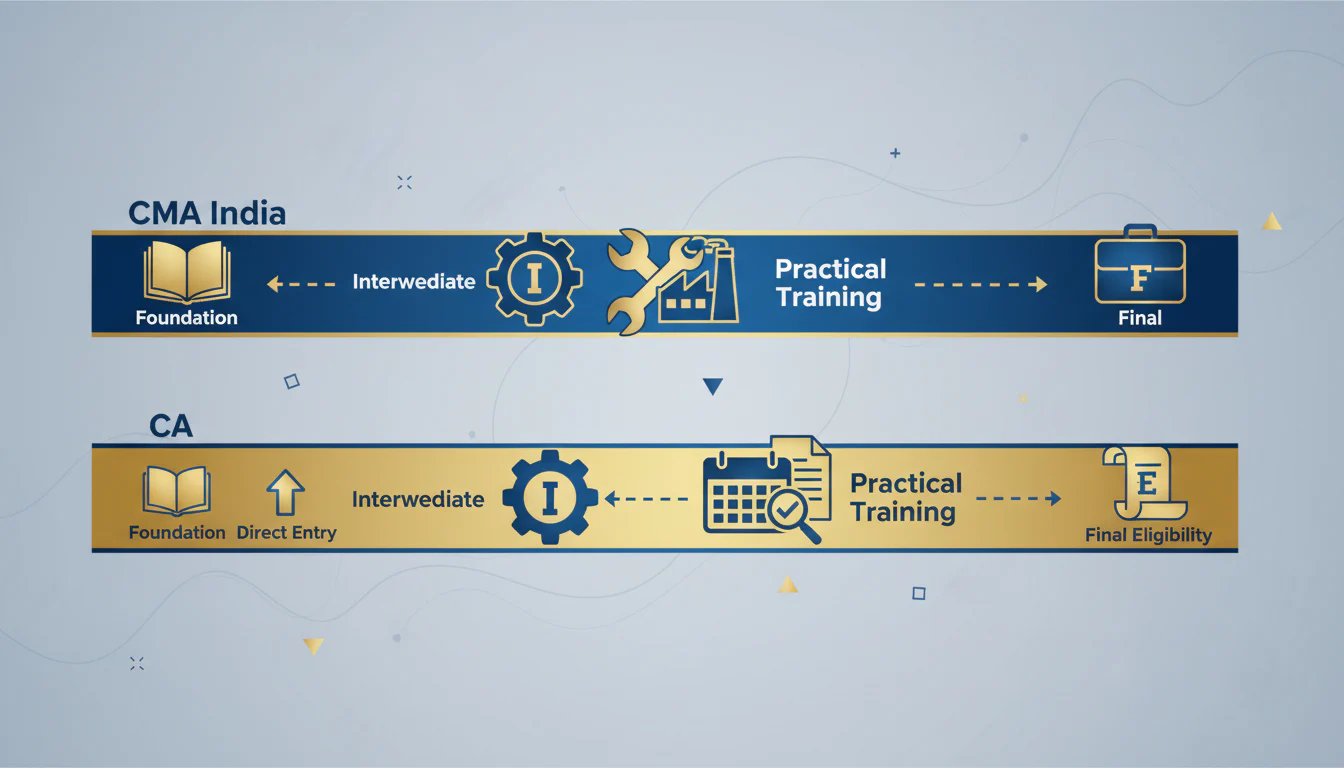
For most people choosing between CMA India vs CA for cost analysis roles, CMA India is faster and more directly aligned. Its required practical training lasts 15 months, rather than CA's two years, and its papers extend from costing into management accounting, strategic cost management, and cost audit. CA remains the broader route for audit, tax, reporting, and finance.
We compare the official time gates, syllabus-to-task fit, practical-training design, manufacturing relevance, and the situations where the broader CA route may still be the better decision. For preparation formats across qualifications, browse our courses.
How We Measure Which Path Is Faster
We do not treat a claimed “average duration” as a fact unless an institute publishes a clear cohort methodology. Exam attempts, result dates, exemptions, study schedules, and whether a learner enters through Foundation or Direct Entry all change the calendar. What we can compare reliably is the mandatory sequence each institute sets.
ICMAI requires 15 months of practical training and allows students to begin it from Intermediate registration, according to its training rules. That earlier start means training can overlap with later CMA study, which is the strongest official reason CMA India can be the faster route.
CA’s current scheme requires two years of practical training after both Intermediate groups are passed and the four-week ICITSS course is completed. The Final examination also has a training-related eligibility condition, as set out in the ICAI course FAQ. The older three-year articleship figure should not be used for a current comparison.
| Qualification | Main Route | Mandatory Practical Training | What We Can Say About Speed |
|---|---|---|---|
| CMA India | Foundation, Intermediate, Final, with direct Intermediate entry available for eligible degree holders | 15 months, startable from Intermediate registration | Shorter mandatory training and potential overlap make it the faster structured route |
| CA | Foundation, Intermediate, Final, with Direct Entry available for eligible graduates | 2 years, starting after both Intermediate groups and ICITSS | Longer fixed training commitment, even though Direct Entry can remove Foundation |
| Both Routes | Exam outcomes and registration timing affect real completion dates | Training placement affects experience quality | No official completion median supports a universal “finishes in X years” claim |
The sensible comparison is therefore not “which qualification is easy?” It is “which route has fewer non-negotiable time commitments for the work I want to do?” For a learner focused on internal cost analysis, CMA India has the clearer speed advantage. For someone who values a wider professional path enough to accept the longer training requirement, CA can still be worth that trade-off.
Syllabus Fit for Cost Analysis Work
A good cost analyst does more than prepare cost sheets. The role can involve standard-cost variances, overhead allocation, product margins, budgets, inventory decisions, pricing support, and management reporting. We built this comparison around those tasks, not around broad reputational claims.
CMA India has a longer cost-management sequence across its course. Its Intermediate papers include Cost Accounting, Financial Management and Business Data Analytics, and Management Accounting, while Final includes Strategic Cost Management and Cost and Management Audit. For readers comparing adjacent credentials, we also cover broader management accounting options.
Cost Variance Analysis
CMA India Paper 8 covers standard costing and material and labour variance analysis. Its Final Strategic Cost Management paper then expands the frame toward cost control, value-chain analysis, activity-based management, performance evaluation, forecasting, and decision techniques. The CMA syllabus also assigns 30% of Paper 8 to cost-accounting techniques.
CA also prepares students for variance work. Its Intermediate Cost and Management Accounting paper includes standard costing, overheads, activity-based costing, marginal costing, and cost-accounting systems. We would not describe CA’s coverage as weak. The real difference is that CA teaches those tools in one core Intermediate paper, while CMA India returns to cost management in later specialist papers.
Budgeting and Management Reporting
Both routes cover budgeting and budgetary control, so this is not a simple CMA-only advantage. CMA India pairs its budgeting content with a dedicated Management Accounting paper and a Financial Management and Business Data Analytics paper, giving learners more course space for internal decision support.
CA’s Intermediate Paper 4 includes budgets and budgetary control, while Paper 6 combines financial management and strategic management. Its current study material also lists cost sheets, standard costing, marginal costing, and budgeting among the 15 chapters. CA can therefore support budgeting roles well, especially where the employer values broader financial-accounting capability.
Product Costing and Cost Control
For product costing, both qualifications provide useful foundations. CMA India covers material, employee, and overhead costs, cost sheets, job costing, batch costing, contract costing, process costing, and operating costing. CA covers many of the same methods, including cost sheets, unit and batch costing, job costing, process costing, joint products, and service costing.
| Cost-Analysis Task | CMA India Coverage | CA Coverage | Practical Reading |
|---|---|---|---|
| Cost variance analysis | Standard costing, material and labour variances, strategic performance tools | Standard costing in Intermediate Cost and Management Accounting | Both are relevant, CMA continues further into strategic cost work |
| Budgeting | Budget preparation, budgetary control, Management Accounting | Budgets and budgetary control in Intermediate | Both are direct fits, CMA gives budgeting more programme-level continuity |
| Product costing | Cost sheets, overheads, process, job, batch, and operating costing | Cost sheets, overheads, ABC, process, job, batch, and service costing | Both teach the core methods employers use |
| Cost improvement | Strategic cost management, value chain, lean accounting, quality-cost concepts | Costing methods alongside a broader accountancy pathway | CMA India is more specialised for internal cost improvement |
Practical Training and Role Exposure
Training is where course design meets the work you may actually perform. We would not promise that either qualification automatically leads to a cost-analysis placement. The employer, department, supervisor, and assignments still determine whether you work on production costing, MIS, audit files, tax work, or financial reporting.
CMA India’s training objective explicitly includes applying cost and management-accounting knowledge in professional settings. It recognises work involving cost and management accounting, financial accounting, taxation, MIS, and similar responsibilities. ICMAI also includes 140 hours of soft and technical-skills training, 44 hours of tutorial workshops, and a seven-day industry-oriented programme in its training framework.
CA practical training is longer and can be highly valuable, particularly for learners who want exposure to audit, assurance, compliance, financial reporting, or finance. It is not automatically audit-only, and industrial training is possible later in the training period. Still, a learner choosing CA solely for a manufacturing cost role should actively seek assignments that build cost, plant-finance, inventory, and budgeting exposure.
We recommend treating practical training as a selection task, not an administrative formality. Our manufacturing cost skills guide can help learners identify the Excel, reporting, variance, and operational-finance skills that make either credential more useful in the workplace.
Manufacturing Relevance and Employer Signals
Manufacturing is where the CMA India comparison becomes especially concrete. Cost records depend on how a business captures materials, labour, overheads, cost centres, and product-level decisions. Those are the same building blocks a cost analyst or plant-finance professional often works with.
India’s Companies (Cost Records and Audit) Rules define a cost auditor as a Cost Accountant in practice appointed by the board. The Companies Rules also address cost records tied to materials, labour, and other production or service costs for covered companies. That regulatory connection supports CMA India’s relevance to manufacturing cost work, although it does not mean every cost-analyst vacancy requires the qualification.
We also avoid claiming that a fixed percentage of roles prefer one credential when there is no reproducible national job-posting sample. At the time of our research, ICMAI’s openings board included CMA trainee roles, Intermediate-level opportunities, and a trainee listing with 8 to 10 posts. Live listings change, so we treat them as role evidence rather than a permanent market-share statistic.
For an industry-specific view of how cost roles can develop after qualification, see our automotive role paths. The useful question is not whether one title guarantees a job. It is whether your course, training placement, and applied skills match the employer’s cost-analysis workflow.

Choosing the Right Route for Your Career
We would choose CMA India first when the immediate target is cost analysis, budget control, product costing, operational finance, cost audit, or management accounting in a manufacturing-led business. Its shorter required training period and specialist paper sequence are well matched to that goal.
We would choose CA first when the target role needs a wider accountancy foundation across audit, tax, financial reporting, and finance, even if cost analysis remains part of the job. Learners who are still testing that wider ambition can use our CA study decision resource to assess the commitment before enrolling.
The honest downside of CMA India is specialisation. It includes tax, audit, and financial-reporting content, but its strongest identity is cost and management accounting. The honest downside of CA is time and breadth. It provides solid costing education, but the course also requires substantial commitment to disciplines that may be less central to a narrowly defined cost-analysis role.
Pursuing both can make sense, but only if the workload is realistic. ICAI guidance says CA trainees need prior permission to take an additional course and may pursue only one alongside CA training when class hours do not clash, as explained in its training guidance. We would plan the calendar before registering, not after.
If CMA India is your decision, our CMA Final classes can help you assess preparation support without losing sight of the actual career outcome.
Get a Career-Focused Comparison with iProledge
At iProledge, we help learners turn this comparison into a workable study and career decision. Our counsellors can talk through your entry route, degree status, desired role, available study time, and the kind of training exposure you want. We also help you see where a cost-focused path can complement broader accountancy ambitions, without pretending that one credential fits every goal. If CMA India is your priority, we can help you assess Foundation, Intermediate, or Final preparation needs and connect preparation to the job skills employers actually expect. If CA is still in the mix, we can help you weigh the commitment honestly before you enroll. We will keep the conversation practical, focused on curriculum evidence, calendar constraints, and the work you want to do after qualifying. Start by reviewing your options with us, then choose the route you can complete with confidence at iProledge Home
FAQs on CMA India vs CA for Cost Analysis Roles
Can I Do Both CMA India and CA?
We recommend confirming ICAI permission requirements before combining both routes during CA training. Exam schedules, workload, course hours, and the timing of practical training matter too.
Which Is Better for Manufacturing Cost Roles?
We see CMA India as closer for manufacturing cost work because its curriculum reaches strategic cost management and cost audit. CA remains broader for finance.
Can Graduates Skip Foundation?
We would check degree eligibility first. Recognized degree holders may enter CMA Intermediate directly, while CA Direct Entry requires 55% for commerce graduates and 60% for others.