CA Coaching vs Self Study: 6-Stage Checklist, Foundation to Final

TL;DR
CA coaching vs self study isn't one decision. Use this 6-stage self-assessment (Foundation to Final) with real ICAI pass rates to find where coaching pays off.
CA Intermediate Group I pass rate fell to just 13.96 percent in the January 2026 cycle, according to ICAI's result data, while Group II cleared at 15.54 percent. Numbers like that mean roughly four out of five students who sit for Inter Group I in any given attempt walk out having failed it, whether they paid for coaching or not.
CA coaching vs self study is not a single decision. Coaching's value shifts by stage: optional at Foundation for students with strong basics, high-value at Intermediate and Final where pass rates hover near 10 to 20 percent, and often essential during articleship when office hours eat into study time. Five personal factors decide the right call, not the stage alone.
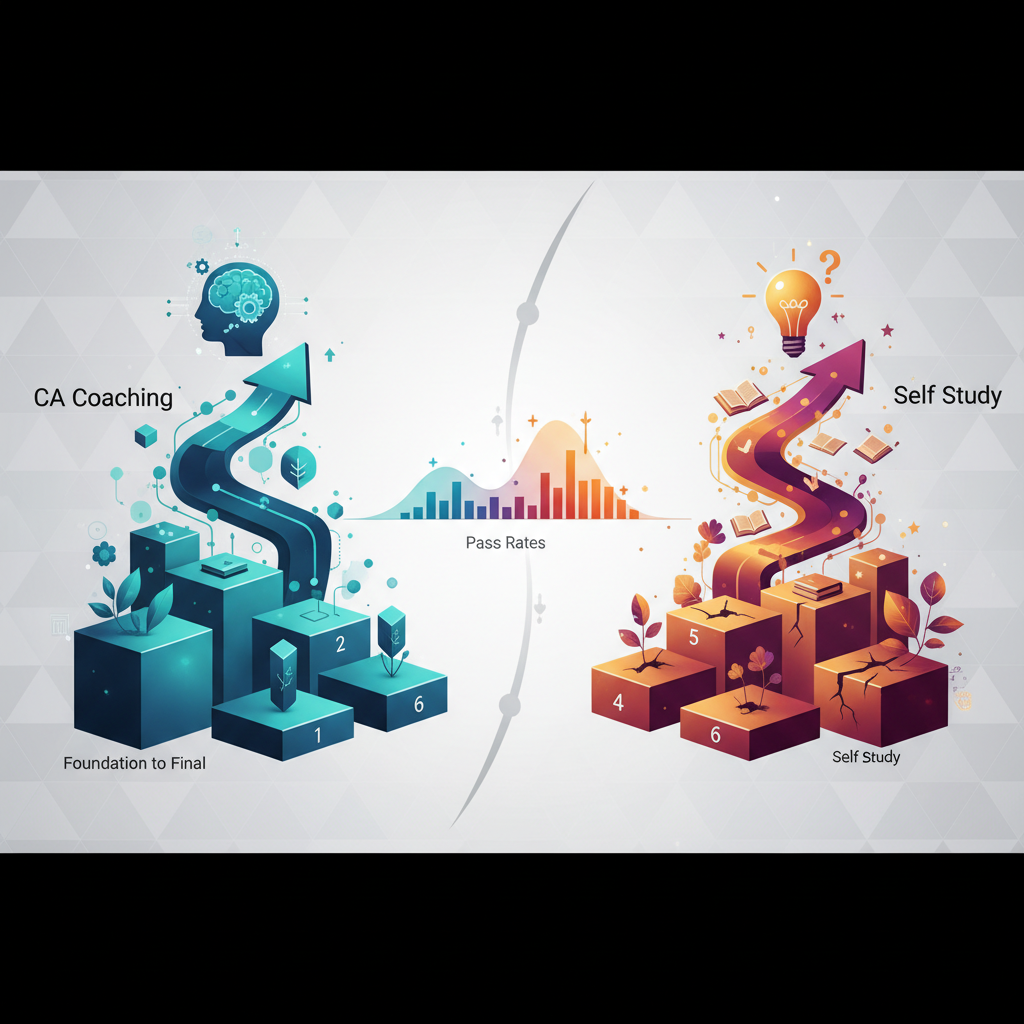
This piece breaks the CA journey into six checkpoints: Foundation, Intermediate Group I, Intermediate Group II, articleship, Final Group I and Final Group II, and gives you a five-question self-check for each one. You'll also get a pass rate table built from ICAI's own result releases and a simple flowchart to turn your score into a support model.
Why Generic CA Coaching vs Self Study Advice Fails at Each Stage
Most CA prep guides treat coaching as a yes-or-no question for the entire course, lumping Foundation, Intermediate and Final together under one blanket recommendation. That approach ignores how dramatically the syllabus, pass rates and your personal bandwidth change between levels, which is exactly where a stage-specific self-assessment earns its keep.
Foundation asks you to relearn how to study for objective and subjective papers in a compressed four to six months. Final asks you to hold six or eight papers of case-study depth in your head while working full days at a firm. Treating those as the same coaching decision is why students either overspend on classroom batches they didn't need at Foundation, or under-invest in structure right when Final and articleship collide. If you want to see how CA-track programs are structured across levels, the courses list page breaks down what each stage actually involves.
A Pakistani CA coaching analysis found that most students who abandon the course early don't quit because they lack ability. They quit because they study alone, lose direction, and have no one flagging weak areas before the exam does. That isolation problem shows up differently at each of the six stages below, which is exactly why a single blanket "self-study works" or "you need coaching" answer misses the point.
The 6-Stage CA Self-Assessment Framework
Score yourself honestly on five questions at your current stage: prior performance, study discipline, resource access, peer support and financial flexibility. Each stage below also carries a coaching-value score built from ICAI's own pass-rate data, so you can weigh personal readiness against how forgiving or brutal that particular group tends to be.

Stage 1: CA Foundation
Foundation is the entry gate.
- Prior performance: Did you score comfortably above average in Class 12 accounts, math or economics?
- Study discipline: Can you hold a 5-6 hour daily study block without anyone checking on you?
- Resource access: Do you have reliable access to ICAI modules, past papers and revision channels like our YouTube channel?
- Peer support: Do you have at least one study partner or group to stay accountable?
- Financial flexibility: Would spending on a full Foundation batch strain your budget more than it needs to right now?
Coaching-value score: Low to medium. Foundation pass rates run close to 20 percent per an analysis of ICAI data, and the syllabus doesn't yet demand the case-study reasoning later stages test for. Recommended support model: Self-study with recorded lectures, or a light online batch if you answered "no" to two or more questions above. Full classroom coaching is rarely necessary here unless you're coming from a non-commerce background. If you're weighing CA alongside a commerce degree rather than after one, the BCom CA integrated comparison covers how that timeline affects Foundation prep.
Stage 2: CA Intermediate Group I
Group I bundles Advanced Accounting, Corporate and other laws, and Taxation, historically the toughest combination in the whole course.
- Prior performance: Did you clear Foundation with strong marks in accounts and law specifically?
- Study discipline: Can you push through 300-plus page ICAI modules without losing momentum after week three?
- Resource access: Do you have a way to get doubts resolved within a day or two, not weeks?
- Peer support: Is at least one other person around you on the same exam cycle?
- Financial flexibility: Can you afford at least an online batch without cutting corners on mocks and test series?
Coaching-value score: High. Group I pass rates sat at just 13.96 percent in January 2026 and 9.43 percent the previous September, among the lowest of any CA group. Recommended support model: Online batch at minimum, hybrid if you scored two or fewer "yes" answers above. This is the stage where unresolved doubts compound fastest.
Stage 3: CA Intermediate Group II
Group II covers Cost and Management Accounting, Auditing and Assurance, and Financial Management.
- Prior performance: Are your costing and FM basics reasonably strong from Foundation or a commerce degree?
- Study discipline: Can you balance numerical practice with theory-heavy audit revision in the same week?
- Resource access: Do you have a mentor who checks your audit answer-writing style, not just content?
- Peer support: Is there someone to debate audit interpretation questions with, where there's rarely one "right" phrasing?
- Financial flexibility: Would a mid-tier online program, rather than premium classroom, fit your budget comfortably?
Coaching-value score: Medium. Group II results have swung widely, from 27.14 percent in one cycle to 15.54 percent in the next according to ICAI's Intermediate result releases, suggesting exam-pattern familiarity matters as much as content mastery. Recommended support model: Online with periodic mentor review of written answers works for most students here; classroom coaching adds less marginal value than at Group I.
Stage 4: Articleship Support
Articleship isn't an exam level.

- Prior performance: Did you clear at least one Intermediate group before starting articleship, or are both pending?
- Study discipline: Can you protect two to three focused study hours on most weekdays, even after a demanding audit season?
- Resource access: Does your firm's schedule allow weekend or evening batches, or do you need fully recorded content you can pause?
- Peer support: Are your articleship colleagues also preparing for the same exam cycle, or are you on your own?
- Financial flexibility: Does your stipend cover a paid program, or do you need a lower-cost recorded option?
Coaching-value score: High. A CA subreddit thread on self-study experiences noted that discipline mattered more than classes, but that isolation during long study stretches was harder to deal with than the syllabus itself. Recommended support model: Hybrid, recorded or weekend classroom sessions for concept revision, paired with self-paced practice during commute or office downtime. Faculty who understand articleship schedules matter more here than batch size; the faculty team is worth checking before committing to a program.
Stage 5: CA Final Group I
Final Group I typically carries the heaviest financial reporting and strategic finance content in the course, tested through long, integrated case studies rather than straightforward recall.
- Prior performance: Did you clear both Intermediate groups without needing more than two attempts combined?
- Study discipline: Can you sustain six-plus hours of focused study daily for four to six months while also working?
- Resource access: Do you have a mentor who reviews presentation and structure, not just correctness?
- Peer support: Do you have a study group specifically for Final-level discussion, distinct from your Inter circle?
- Financial flexibility: Can you commit to a full program without treating it as an optional add-on?
Coaching-value score: High. Group I cleared at 21.03 percent in the January 2026 cycle, better than Group II but still meaning roughly four in five attempts fail. Recommended support model: Classroom or hybrid, especially for case-study answer writing where structured feedback loops matter more than content delivery alone.
Stage 6: CA Final Group II
Group II leans harder into professional judgment, covering strategic cost management and advanced auditing scenarios where there's rarely a single correct answer.
- Prior performance: Are you comfortable defending an answer in writing, not just recognizing the right concept?
- Study discipline: Can you keep revising case studies in the final six weeks without switching to new topics?
- Resource access: Do you have a senior CA or faculty member who can mock-evaluate your written answers?
- Peer support: Is there a peer group actively discussing recent case law or amendments with you?
- Financial flexibility: Would investing in a focused mock-test and review program be manageable right now?
Coaching-value score: High. Group II passed at just 9.76 percent in the January 2026 cycle, the lowest of any group across the six stages. Recommended support model: Hybrid with a strong mock-test and evaluation component; self-study alone rarely surfaces the blind spots this group is designed to test for.
Pass Rate by Stage: What ICAI's Own Numbers Show
The self-assessment above works best against real numbers, not gut feel. Below is a consolidated view of the latest ICAI pass rates at each checkpoint, paired with the coaching-value score and support model recommendation from the checklist.

| Stage | Latest ICAI Pass Rate | Coaching-Value Score | Recommended Support Model |
|---|---|---|---|
| CA Foundation | ~15-20% | Low-Medium | Self-study or light online |
| CA Intermediate Group I | 13.96% (Jan 2026) | High | Online or hybrid |
| CA Intermediate Group II | 15.54% (Jan 2026) | Medium | Online with mentor review |
| Articleship period | Not exam-specific | High | Hybrid, weekend or recorded |
| CA Final Group I | 21.03% (Jan 2026) | High | Classroom or hybrid |
| CA Final Group II | 9.76% (Jan 2026) | High | Hybrid with mock focus |
Pass rates move around each cycle. CA Final combined groups cleared at 14.07 percent in May 2026 versus 18.75 percent a year earlier, per a tracking of ICAI releases. The trend matters less than the pattern: every stage after Foundation has cleared below 22 percent in the last two cycles, which is the strongest argument for treating coaching vs self-study as a stage-specific decision rather than a philosophy.
If you're weighing the same tradeoff for a different qualification, the economics don't always look identical. A separate breakdown on ACCA self-study costs shows why the cheaper-on-paper option isn't always cheaper in practice once repeat attempts are factored in.
Decision Flowchart: Match Your Score to a Support Model
Once you've answered the five questions for your current stage, turn your "yes" count into a support model using the scoring rule below. Combine it with the stage's baseline coaching-value score from the table above to get your final call.
| Your Score | What It Signals | Support Model To Choose |
|---|---|---|
| 4-5 yes | Strong discipline, access and support | Self-study or online, even at high-coaching-value stages |
| 2-3 yes | Partial gaps in discipline or resources | Online with structured mentorship, or hybrid |
| 0-1 yes | Significant gaps across the board | Classroom or hybrid, regardless of stage |
A 4-5 score at Foundation almost always means self-study is fine. The same score at Final Group II still argues for at least a hybrid model, because the stage's baseline difficulty overrides personal readiness once pass rates drop below 12 percent. If your score sits right on the border between two models, it's worth talking it through rather than guessing; the contact us page connects you with a counsellor who can walk through your specific answers.
Get Structured CA Support with iProledge
CA coaching vs self study isn't a debate you need to resolve alone, especially once you're staring down a 10 percent Group II pass rate with a job and an exam six months apart. iProledge builds support around exactly the checkpoints this checklist covers, so you get classroom intensity where a stage demands it (Intermediate Group I, Final) and lighter online formats where self-study genuinely works (Foundation, Group II revision). Instead of committing to one model for the entire journey, you can start admission into the specific batch that matches your current stage and self-assessment score, and switch formats as circumstances change between attempts. If you're unsure which stage needs the most support right now, message the counselling team on WhatsApp and walk through your checklist answers together before committing to a batch or a fee.
FAQs on CA Coaching vs Self Study
Can I Switch Between Coaching and Self-study Across CA Stages?
Yes. Many students self-study Foundation, take online coaching for Intermediate Group I, then shift to hybrid or classroom for Final, matching support to each stage's difficulty rather than one model throughout.
Is CA Foundation Coaching Necessary?
Not usually. Foundation pass rates hover near 20 percent and the syllabus rewards discipline over guided strategy, so self-study or a light online batch works for most students with reasonable commerce basics.
Is CA Intermediate Self-study Possible?
Yes, especially for Group II, but Group I's pass rate near 14 percent makes structured mentorship or an online batch worth considering, particularly if your Foundation scores were only average.
When Should I Join CA Coaching?
Join when your self-assessment shows two or fewer "yes" answers on discipline, resources or peer support, or when entering a historically low-pass-rate group like Intermediate Group I or Final Group II.
Does Articleship Change How Much Coaching I Need?
Usually yes. Office hours cut into self-study time, so most students shift toward hybrid or recorded formats during articleship rather than relying on the same self-study approach used at Foundation.
What Does Full-journey CA Coaching Cost?
Costs vary widely by city, format and how many stages you enroll for, so compare stage-wise packages directly with an institute rather than assuming one flat figure across Foundation through Final.
Are Hybrid CA Coaching Options Available?
Yes. Most institutes now offer hybrid formats combining recorded or online lectures with periodic classroom sessions or mentor reviews, which suits students balancing articleship or Final-level case-study practice.
What's the Biggest Reason Self-study CA Students Drop Out?
Isolation and lack of feedback, not lack of ability. Research on CA self-study points to demotivation from studying alone as a bigger risk factor than syllabus difficulty itself.