Courses After 12th Commerce: Pick a Route by Odds, Cost and Rules
The main courses after 12th commerce are a B.Com or BBA degree, or the Chartered Accountancy, Company Secretary and Cost Accountancy qualifications; choose by pass rate, entry cost and exam risk.

By Naveen J D, Founder · Updated 10 Oct 2026

Key takeaways
- 01The right course after 12th commerce is the one whose first exam you can realistically pass. CSEET passed 67.59% of candidates in June 2026, against 20.09% for CA Foundation in May 2026.
- 02CA, Company Secretary (CS) and Cost and Management Accountancy (CMA) do not need a B.Com or a minimum Class 12 percentage. A degree alongside them is a safety net, not a prerequisite.
- 03As of October 2026, regulator fees for a first attempt run from ₹7,200 (CMA Foundation) to ₹10,700 (CA Foundation), before coaching.
- 04At the May 2026 CA Foundation pass rate, our model gives a 36.1% chance of clearing within two sittings and 49.0% within three. Plan and budget for more than one sitting.
In this article
- 1Which courses after 12th commerce should you consider, and which first step fits you?
- 2Do you need a B.Com to start CA, CS or CMA, and can you study both?
- 3How hard is the first exam in each professional course?
- 4What are your odds of clearing CA Foundation or CSEET in one, two or three sittings?
- 5What does the first attempt cost, and what if you need three sittings?
- 6When can you next register for CA Foundation, CSEET and CMA Foundation?
- 7Can you pick a professional course if you took commerce without maths, or scored low?
- 8How does iProledge help you choose and prepare for CA, CS and CMA after Class 12?
- 9Frequently asked questions
The best-known first step after 12th commerce is also one of the hardest to clear. The Chartered Accountancy (CA) Foundation exam passed 20.09% of the 90,217 candidates who appeared in May 2026, in the result the Institute of Chartered Accountants of India (ICAI) declared on 3 July 2026.
Other first steps look very different. A Bachelor of Commerce (B.Com) or Bachelor of Business Administration (BBA) degree runs three to four years with a predictable outcome. A professional qualification is a ladder of exams, and each rung has its own pass rate, fee and registration deadline. Choosing between them is mostly a question of how much exam risk you can carry.
This page gives you a table that matches your goal to a first step. It also models your odds for CA Foundation and the Company Secretary Executive Entrance Test (CSEET), the two exams with published pass rates. It sets out the entry cost and next registration date of each route. It answers whether you need a B.Com first and whether you can do both.
Which courses after 12th commerce should you consider, and which first step fits you?
Choose a degree (B.Com or BBA) if you want campus placement, management roles or a bank job. Choose a professional qualification (CA, CS or CMA) if you want a specialist finance, law or costing career and can sit exams for years. "Foundation" is the entry-level exam of CA and CMA. This table gives the first step for each goal.
| If you... | Start with | Why |
|---|---|---|
| Want audit, tax or your own practice, and can handle a first-sitting pass rate near one in five | CA Foundation | Chartered accountants do statutory audits, the legally required check of a company's accounts. Section 141 of the Companies Act 2013 makes a chartered accountant eligible to be appointed a company's auditor |
| Want company law work, with less numeric content | CSEET, then CS Executive (the second stage of CS) | Company secretaries handle compliance (following company law and filing rules) and governance (how a company's board runs). Section 203 of the Companies Act 2013 requires certain companies to employ a whole-time company secretary |
| Want costing and budgeting inside companies, at the lowest entry fee | CMA Foundation | Cost accountants work out what products and services really cost. CMA Foundation has the lowest regulator fee of the three (see the cost table) |
| Want a UK-based global qualification and can pay in pounds | ACCA (Association of Chartered Certified Accountants) | ACCA sets its fees in pounds sterling, so the rupee cost moves with the exchange rate |
| Want a bank officer job | A degree first (B.Com or any stream) | The Institute of Banking Personnel Selection (IBPS) Probationary Officer notification asks for a graduation degree in any discipline |
| Want management, marketing or an MBA | BBA or B.Com | The degree route is built for it |
| Are not sure | B.Com plus CSEET | Our recommendation: CSEET has a published 67.59% June 2026 pass rate. CMA Foundation is the lowest-cost option at ₹7,200 to ₹7,500, but its pass rate is not published |
For the two best-known professional paths, our CA vs CS comparison of pass rates, fees and pay puts them side by side. iProledge publishes this page and coaches for CA, CS, CMA and ACCA, so we have marked where a degree is the better first step.
Do you need a B.Com to start CA, CS or CMA, and can you study both?
No. None of CA, CS or CMA requires a B.Com or a minimum Class 12 percentage. ICAI registers students who have passed or are appearing in Class 12, and allows provisional registration after Class 10. The Institute of Company Secretaries of India (ICSI) accepts students passed or appearing in Class 12 for CSEET. The Institute of Cost Accountants of India (ICMAI) takes Foundation candidates who have passed Class 10 or 10+2. Graduates are exempt from CSEET and go straight to CS Executive.
Studying both is common. The friction is attendance. Colleges set their own minimum attendance for semester exams, and coaching hours collide with it. Ask for the figure in writing before you pay an admission fee, and ask whether the college gives relief to students pursuing professional courses. An open or distance-mode B.Com from a university recognised by the University Grants Commission (UGC) is the other route.
Our recommendation is to keep the degree. If a Foundation result goes badly, you still hold a graduation certificate and lose no year.
How hard is the first exam in each professional course?
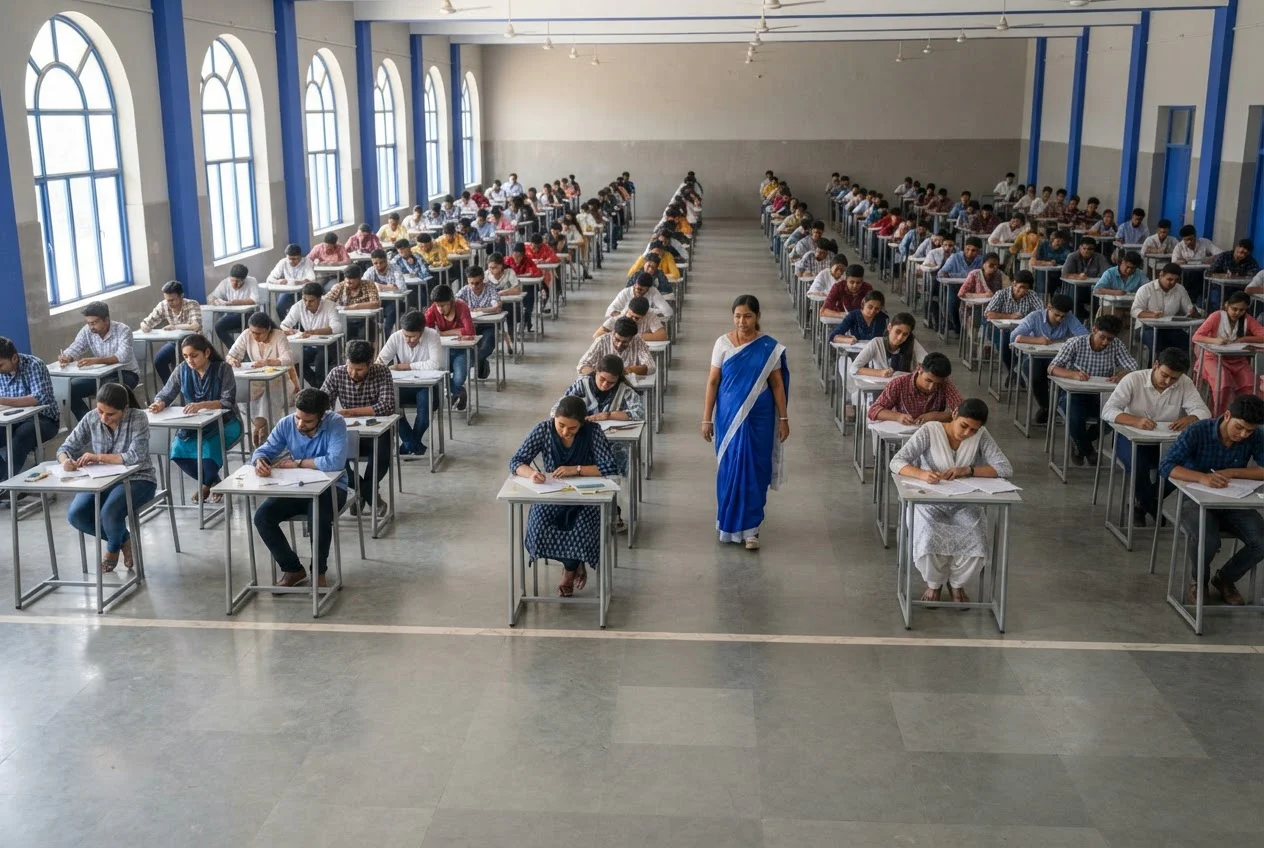
CA Foundation passed 20.09% of candidates who appeared in May 2026, while CSEET passed 67.59% in June 2026. ICMAI publishes no official pass percentage for CMA Foundation, so CMA cannot be compared on pass rate.
| Exam | Session | Pass rate | Source |
|---|---|---|---|
| CA Foundation | May 2026 | 20.09% (18,124 of 90,217 who appeared) | |
| CA Foundation | January 2026 | 19.23% (21,099 of 109,694) | |
| CA Foundation | May 2025 and September 2025 | 15.09% and 14.78% | |
| CSEET | January 2026 | About 80% | |
| CSEET | June 2026 | 67.59% |
The June 2026 CSEET was the first in the restructured offline format, so compare it with the January 2026 rate with care. The odds model below uses only the June 2026 rate. Pass rates count candidates who sat the exam, not everyone who registered.
CA Foundation has four 100-mark papers: Principles and Practice of Accounting, Business Laws, Quantitative Aptitude and Business Economics. The last two are objective. You need at least 40 in each paper and 200 of 400 overall, both in a single sitting. One paper at 40 means the other three must average 53.3 ((200 − 40) ÷ 3, our arithmetic). The 40-mark floor is where strong totals still fail. Our guide to CA Foundation pass percentage and the marks you need shows the marks paper by paper.
CSEET has four 100-mark papers since June 2026: Business Communication, Fundamentals of Accounting, Economic and Business Environment, and Business Laws and Management. Our CSEET registration and syllabus guide for the four-paper 2026 format covers the steps.
What are your odds of clearing CA Foundation or CSEET in one, two or three sittings?
At the May 2026 pass rate, a candidate has a 20.1% chance of clearing CA Foundation in one sitting, 36.1% within two and 49.0% within three. CSEET at its June 2026 rate gives 67.6%, 89.5% and 96.6%. This is our model, not an official figure.
Formula: chance of passing within n sittings = 1 − (1 − p)ⁿ, where p is the single-sitting pass rate. Inputs: p = 20.09% for CA Foundation (May 2026) and 67.59% for CSEET (June 2026). CMA Foundation is left out because ICMAI publishes no Foundation pass rate.
| Sittings | CA Foundation | CSEET |
|---|---|---|
| 1 | 20.1% | 67.6% |
| 2 | 36.1% | 89.5% |
| 3 | 49.0% | 96.6% |
The model assumes every sitting is independent and every candidate is average. Repeat candidates are not average, and your preparation matters more than the mean. Our inference is that you should prepare for the first sitting as if it is the only one, and budget for a second.
Run this check before booking a CA Foundation sitting. The 45 and 210 margins are our recommendation, not an ICAI rule.
- Take three full-length timed mocks.
- Pass: in all three mocks, every paper scores 45 or more and the total is 210 or more out of 400.
- Borderline: in any mock, a paper scores 40 to 44, or the total is 200 to 209. Retake that mock and delay booking until you pass all three.
- Fail: in any mock, a paper scores below 40. Move to the next sitting you are registered for and fix that paper first.
What does the first attempt cost, and what if you need three sittings?
As of October 2026, the regulator fees for a first attempt are ₹10,700 for CA Foundation, ₹9,000 for CSEET and ₹7,200 to ₹7,500 for CMA Foundation. Needing three sittings raises these to ₹13,700, ₹12,000 and ₹9,600 to ₹10,500. Coaching comes on top.
| Route | Registration (once) | Exam fee per sitting | First attempt | Three sittings |
|---|---|---|---|---|
| CA Foundation | ₹9,000 plus ₹200 prospectus | ₹1,500 | ₹10,700 | ₹13,700 |
| CSEET | ₹7,500 | ₹1,500 | ₹9,000 | ₹12,000 |
| CMA Foundation | ₹6,000 | ₹1,200 to ₹1,500 | ₹7,200 to ₹7,500 | ₹9,600 to ₹10,500 |
Working (our arithmetic): first attempt = registration + one exam fee. Three sittings = registration + three exam fees. Example: CA is 9,000 + 200 + 3 × 1,500 = 13,700. CSEET registration includes ICSI's Student Induction Programme and online classes.
The fee schedules are on the ICAI course fee sheet, the ICSI CSEET FAQ and the ICMAI admission page. The bodies revise fees, so confirm before you pay. ACCA fees are in pounds, so check ACCA's own schedule.
When can you next register for CA Foundation, CSEET and CMA Foundation?
As of October 2026, CA Foundation registration for the January 2027 sitting has closed. To sit in May 2027, register with ICAI by 1 January 2027. ICAI requires you to be enrolled with its Board of Studies for at least four months before the exam month, as its cut-off notice sets out.
For CSEET, as of October 2026, the published schedule shows registration for the February 2027 sitting open until 31 October 2026. Exam enrolment runs from 16 November to 15 December 2026, and the exam falls in the first week of February 2027.
For CMA Foundation, ICMAI asks applicants for the June exam to apply before 31 January, and for the December exam before 31 July, as its admission page states. As of October 2026, the next sitting you can still join is June 2027, so apply by 31 January 2027.
Can you pick a professional course if you took commerce without maths, or scored low?
Yes. CA Foundation, CSEET and CMA Foundation do not require Class 12 maths, and none sets a minimum percentage. Your marks do not decide your route. The exams do.
Maths is where the routes differ. CA Foundation includes 100 objective marks of Quantitative Aptitude, so start that revision in week one. CMA Foundation includes a Business Mathematics and Statistics paper; our CMA Foundation syllabus and 12-week study plan turns the syllabus into a weekly schedule. CSEET's four papers include no separate maths paper, which makes it the gentlest professional start. If you scored low in Class 12 or in your B.Com, the readiness check above tells you more about your chances than those marks do.
How does iProledge help you choose and prepare for CA, CS and CMA after Class 12?
We coach CA, CS, CMA and ACCA, and we start with the choice, not the batch. Bring your Class 12 subjects, your marks and any mock scores. We work through the table and the readiness check above with you and tell you which Foundation to book first, and when. Classes run online, blended or onsite, and fees depend on the batch. You can see everything we teach on our courses list.

Call us on +91 8073702708 or book a free demo class for the Foundation you are considering.
Not sure which Foundation to book first?
Frequently asked questions
No. CMA USA is a post-degree route, because the Institute of Management Accountants requires a bachelor's degree for the CMA certification. After Class 12, CMA India Foundation is the CMA you can start, and CMA USA can follow once you graduate.
Sources
- 1.ICAI: Result of CA Foundation Examination held in May 2026, ICAI
- 2.ICAI: Result of CA Intermediate and Foundation Examinations, January 2026, ICAI
- 3.ICAI: FAQs for Provisional Admission to Foundation Course, ICAI
- 4.ICAI: Cut-off date for enrolment in Foundation and Intermediate courses, ICAI
- 5.ICAI: CA course fee sheet, ICAI
- 6.ICSI: Frequently Asked Questions on Restructured CSEET, ICSI
- 7.ICMAI: CMA course eligibility, ICMAI
- 8.ICMAI: Student admission, ICMAI
- 9.TaxGuru: ICSI declares CSEET June 2026 results, TaxGuru
- 10.Outlook India: CSEET result January 2026, Outlook India
- 11.Careers360: ICSI revamps CSEET 2026, Careers360
- 12.Careers360: CSEET exam schedule, Careers360
- 13.Careers360: CA Foundation May 2026 pass percentage, Careers360
- 14.IBPS: Notification CRP PO/MT-XVI, IBPS
- 15.Ministry of Corporate Affairs, Ministry of Corporate Affairs
- 16.ACCA student page, ACCA
- 17.IMA: CMA certification, IMA
- 18.University Grants Commission, UGC