
CSEET Registration for the Four-Paper 2026 Format After Class 12
ICSI’s June 2026 restructure changed CSEET from the older single-day format into a four-paper, centre-based route. Information checked against ICSI notices available in September 2026.
6 chapters · Updated Sep 16, 2026 · By Naveen J D
- 4 papers
- The restructured CSEET has four separate 100-mark papers.
- 3 years
- CSEET registration remains valid for three years from the registration month.
- 40% + 50%
- Passing requires 40% in each paper and 50% aggregate.
In brief
Class 12 students who have passed or are appearing for 10+2 can register for ICSI’s restructured CSEET if they are Indian nationals. The route is not one payment or one exam day: register, complete SIP, enrol separately for a session, then pass four papers before moving to CS Executive.
Start by checking whether CSEET is your entry route
CSEET is the usual entry point for a student beginning the Company Secretary route after Class 12. Under ICSI’s restructured rules, you can register when you have passed or are appearing in the Senior Secondary 10+2 examination, or an equivalent qualification. The same official syllabus also states that only Indian nationals can apply. That means a Class 12 appearing student does not have to wait for final marks before starting the registration process.
CSEET is not required for every applicant. ICSI exempts ICSI Foundation pass candidates, ICAI Final pass candidates, ICMAI Final pass candidates, graduates and postgraduates, who may use the direct CS Executive route instead. For a Class 12 student, that exemption list is mainly useful as a guardrail: do not apply through a direct-entry category that you have not yet earned. The ICSI SMASH registration portal is the official starting point for a straightforward 10+2 registration.
Takeaway: A Class 12 student who is Indian and has passed or is appearing for 10+2 should normally plan for CSEET, not direct Executive registration.
Registration, SIP and exam enrolment are three different jobs
Use ICSI’s SMASH portal for CSEET registration. The portal asks for a photograph, signature, Class 10 date-of-birth certificate, Class 12 marksheet or 10+2 hall ticket for an appearing student, category certificate where relevant and an approved identity document. Its upload rules allow jpg, jpeg, png, gif, bmp and pdf files, with a 2 MB maximum file size. The photo must be 20 to 50 KB and the signature 10 to 20 KB.
Registration costs ₹7,500 and includes the Student Induction Programme, or SIP, and online classes. It remains valid for three years, but it is not an exam booking. You must complete the one-day SIP within one month of registration, then submit a separate examination enrolment for the session you want. That separate enrolment costs ₹1,500 per session. For the February 2027 session, ICSI’s live notice listed 31 October 2026 as the registration deadline. Always check the live ICSI notice rather than assuming a previous session’s date applies.
The six checkpoints before CS Executive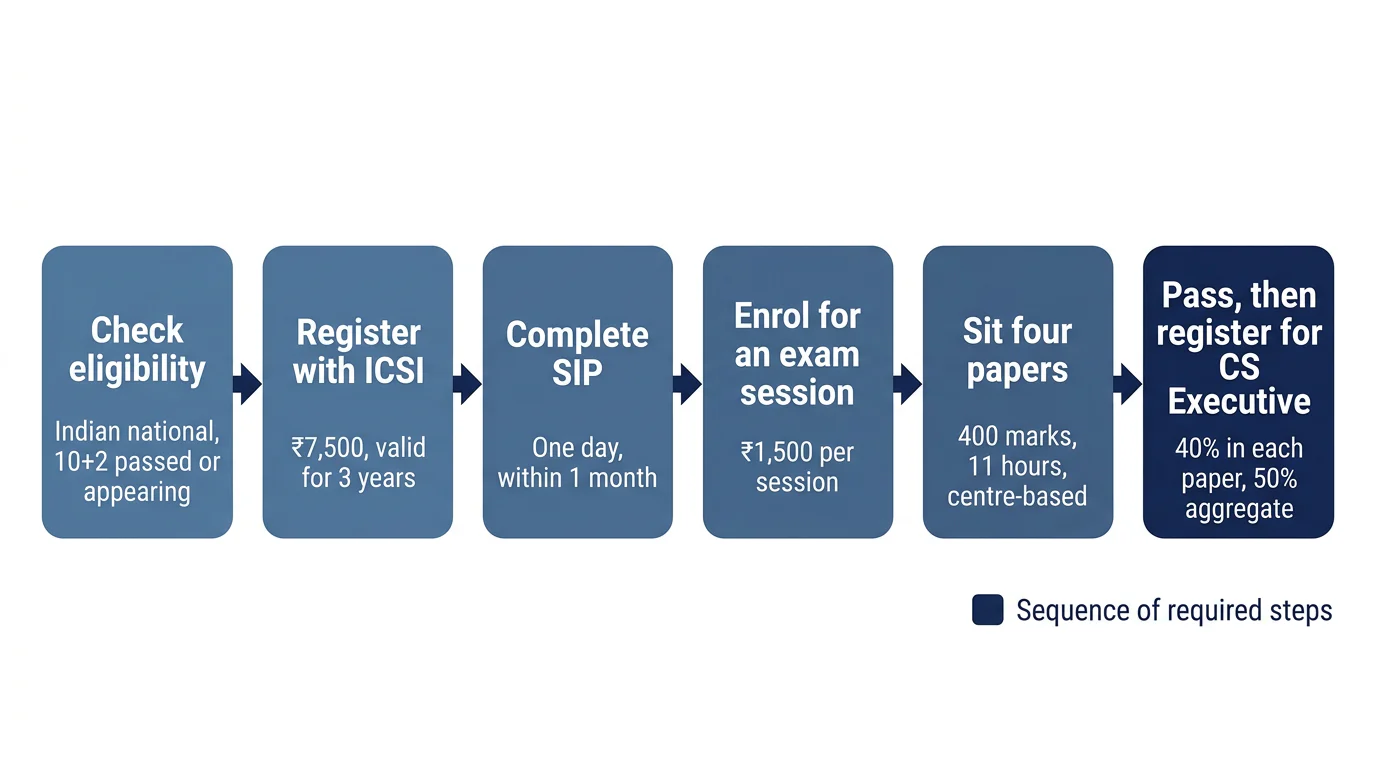
Takeaway: Finish registration and SIP early, because only then can you submit the separate exam enrolment.
The new syllabus is four papers over four examination days
The current CSEET format is not the older 200-mark remote-proctored test. ICSI’s restructured syllabus sets four 100-mark papers: Business Communication, Fundamentals of Accounting, Economic and Business Environment, and Business Laws and Management. The first three papers are subjective and allow three hours each. Business Laws and Management is OMR-based and allows two hours. Together, the published durations add to 11 examination hours across four days.
The subject mix also changed. Business Communication covers English essentials, communication, correspondence and office management. Fundamentals of Accounting includes accounting process, reconciliation, depreciation, final accounts, partnership and LLP accounts, company accounts and non-profit accounts. Economic and Business Environment divides into Economics and Business Environment, 50 marks each. Business Laws and Management divides into Business Laws, 60 marks, and Business Management, 40 marks. Begin registration through the ICSI SMASH CSEET portal, then use the current ICSI syllabus notice before choosing notes or a study plan.
Takeaway: Your preparation needs written-answer practice for three papers, not only MCQ speed.
Build your exam-window checklist around the separate fee and pass rule
ICSI holds restructured CSEET in February, June and October in centre-based mode. Its published enrolment calendar places the regular windows at 1 March to 7 April for June, 1 July to 7 August for October, and 1 November to 7 December for February. The late windows run from the 8th to the 20th of those months. A late enrolment costs ₹250, and a centre change costs ₹250, so waiting can create both cost and administrative risk.
Passing is equally important to understand before you schedule preparation. ICSI requires a minimum 40% in every paper and 50% aggregate across all four papers. The OMR-based Business Laws and Management paper has no negative marking, but that does not reduce the need to study the other three papers as written examinations. The official ICSI SMASH CSEET portal is where you can confirm the registration documents before applying.
Takeaway: Treat SIP completion, exam enrolment and each paper’s 40% threshold as non-negotiable checklist items.
Passing CSEET moves you to CS Executive, not straight to membership
After a CSEET pass, the next formal step is online registration for the CS Executive Programme. ICSI’s Executive-registration portal asks for the usual identity and qualification records, including Class 12 proof and CSEET pass proof. The current listed Executive components for a CSEET-passed student are ₹2,000 registration, ₹12,900 education fee, ₹1,000 pre-exam test fee and ₹2,500 for the Three Days Orientation Programme. Those required components total ₹18,400. The ₹500 Chartered Secretary Journal subscription is optional, making the displayed total ₹18,900 when selected.
The wider official route is Executive Programme, Professional Programme, training and membership. That sequence matters when you evaluate time, study load and future costs. Use the CSEET-to-Professional fee guide for a fuller official-fee view, and use BCom with CS versus CS after graduation if you are deciding how CS fits alongside a degree.
Takeaway: Passing CSEET unlocks Executive registration, but it is the first stage rather than the end of the CS journey.
Choose support for the format you actually face
A useful CSEET plan separates administrative work from learning work. First, prepare every upload before opening the form. Next, reserve time for SIP rather than treating it as an afterthought. Then organise preparation by paper type: written English and business communication answers, accounting problems worked by hand, explanatory economics and business-environment responses, and OMR practice for business laws and management.
Paid coaching can add structure, mock tests, recordings or doubt support, but it is optional. It is not a substitute for completing ICSI registration, SIP or exam enrolment, and it cannot change the official paper pattern or pass rule. Self-study can suit students who can consistently practise written answers and accounting questions from the official material. Guided support can suit students who need a fixed timetable or feedback. Neither route is well suited to someone who expects the old single-day, all-MCQ structure, because the restructured exam demands broader written preparation.
Takeaway: Select a study method only after you have matched it to four papers, three written exams and the official enrolment timetable.
Go deeper
Frequently asked
Yes. ICSI allows candidates who have passed or are appearing in the Senior Secondary 10+2 examination, or its equivalent, to register for CSEET. An appearing student uses the 10+2 admit card or hall ticket during registration and later needs Class 12 qualification proof for CS Executive registration.
No. CSEET registration creates your admission, has a three-year validity period and costs ₹7,500. ICSI then requires a separate examination enrolment for the session you want to attempt, with a ₹1,500 examination fee and SIP completion before enrolment.
ICSI asks for a photograph, signature, Class 10 certificate as date-of-birth proof, Class 12 marksheet or appearing-student hall ticket, category certificate where applicable, and a valid identity document. Uploads must follow the file format and size instructions shown on the ICSI registration portal.
The restructured CSEET has four 100-mark papers: Business Communication, Fundamentals of Accounting, Economic and Business Environment, and Business Laws and Management. ICSI requires at least 40% in every paper and 50% aggregate, while only the final paper is OMR-based.
Explore CS learning options after you map the ICSI route
Compare the format, support and study options that fit your preparation plan.
Explore CS programmes