
Turn the CMA Foundation Syllabus Into a 12-Week Plan After Class 12
As of September 2026, ICMAI's current Foundation curriculum has four papers. Build the first pass around module weightage, then rehearse the two-session MCQ format.
5 chapters · Updated Sep 16, 2026 · By Naveen J D
- 50 MCQs
- appear in each 100-mark Foundation paper for the December 2026 term
- 13 December 2026
- is the scheduled Foundation examination date
In brief
CMA Foundation after Class 12 has four 100-mark papers, and the most practical way to prepare is to map every official module before dividing revision time by its published weight. This guide turns ICMAI's Syllabus 2022 and December 2026 exam format into a 12-week study sequence, then separates official fees from optional coaching.
The syllabus is four papers, not four equal workloads
The CMA Foundation syllabus under ICMAI's current Syllabus 2022 has four papers: Fundamentals of Business Laws and Business Communication, Fundamentals of Financial and Cost Accounting, Fundamentals of Business Mathematics and Statistics, and Fundamentals of Business Economics and Management. ICMAI's Foundation curriculum is the controlling source when an older brochure uses different paper names.
Each paper carries 100 marks, but an equal calendar split can ignore the unequal sections inside the paper. Paper 1 gives 80% to Business Laws. Paper 2 gives 70% to Financial Accounting. Paper 3 gives 60% to Statistics. Paper 4 gives 70% to Business Economics. Those are section weights, not official promises of marks for an individual chapter.
A Class 12 student can therefore begin by making one tracker with four paper tabs, every module listed beneath the right paper, and three status fields: first pass, question practice and revision. That structure is more useful than treating a long playlist as proof of completion.
The Foundation route is the usual starting point after Class 12, but it is not the only route. Read how the CMA India course works before assuming that every academic background follows the same entry path.
Takeaway: Give each paper a place in the week, but give its heavier official section more of the practice time.
Use the module map to decide what belongs in each study block
ICMAI publishes the Foundation content paper by paper. The four official syllabus PDFs are the source for the module names and weights below: Paper 1, Paper 2, Paper 3 and Paper 4.
| Paper | Official modules and weightage |
|---|---|
| P1, Laws and Communication | Introduction 10%; Indian Contracts Act, 1872 30%; Sale of Goods Act, 1930 20%; Negotiable Instruments Act, 1881 20%; Business Communication 20% |
| P2, Financial and Cost Accounting | Accounting Fundamentals 30%; Special Transactions 15%; Final Accounts 25%; Cost Accounting 30% |
| P3, Mathematics and Statistics | Arithmetic 15%; Algebra 20%; Calculus applications 5%; Data Representation 5%; Central Tendency and Dispersion 15%; Correlation and Regression 15%; Probability 15%; Index Numbers and Time Series 10% |
| P4, Economics and Management | Basic Concepts 15%; Forms of Market 20%; Money and Banking 20%; Economic and Business Environment 15%; Management 30% |
Use the map as a coverage test. A practice score can be recorded against a module, such as probability or final accounts, instead of being filed only as a vague weak-paper result. The trade-off is that a module tracker creates administration work. Keep it short enough to update after each practice session, or it becomes another task that displaces study.
Takeaway: Track performance at ICMAI module level, because a paper-level score is too broad to tell you what to revise next.
A 12-week plan should move from coverage to timed decisions
This is an editorial study rhythm, not an ICMAI timetable. In Weeks 1 to 4, complete a first pass across all four papers: start with P1 Introduction and Contracts, P2 Accounting Fundamentals, P3 Arithmetic and Algebra, and P4 Basic Concepts. Then move through Sale of Goods, Special Transactions, Forms of Market, Negotiable Instruments, Final Accounts, Money and Banking, Business Communication, Cost Accounting, Statistics and Management.
In Weeks 5 and 6, replace broad reading with weighted question practice. Give extra practice blocks to Business Laws in P1, Financial Accounting in P2, Statistics in P3 and Business Economics in P4 because each is the larger official section in its paper. Weeks 7 and 8 are for timed two-paper rehearsals. Weeks 9 and 10 repair recurring mistakes by module. Weeks 11 and 12 are for full mocks and short revision passes.
Twelve-week execution rhythm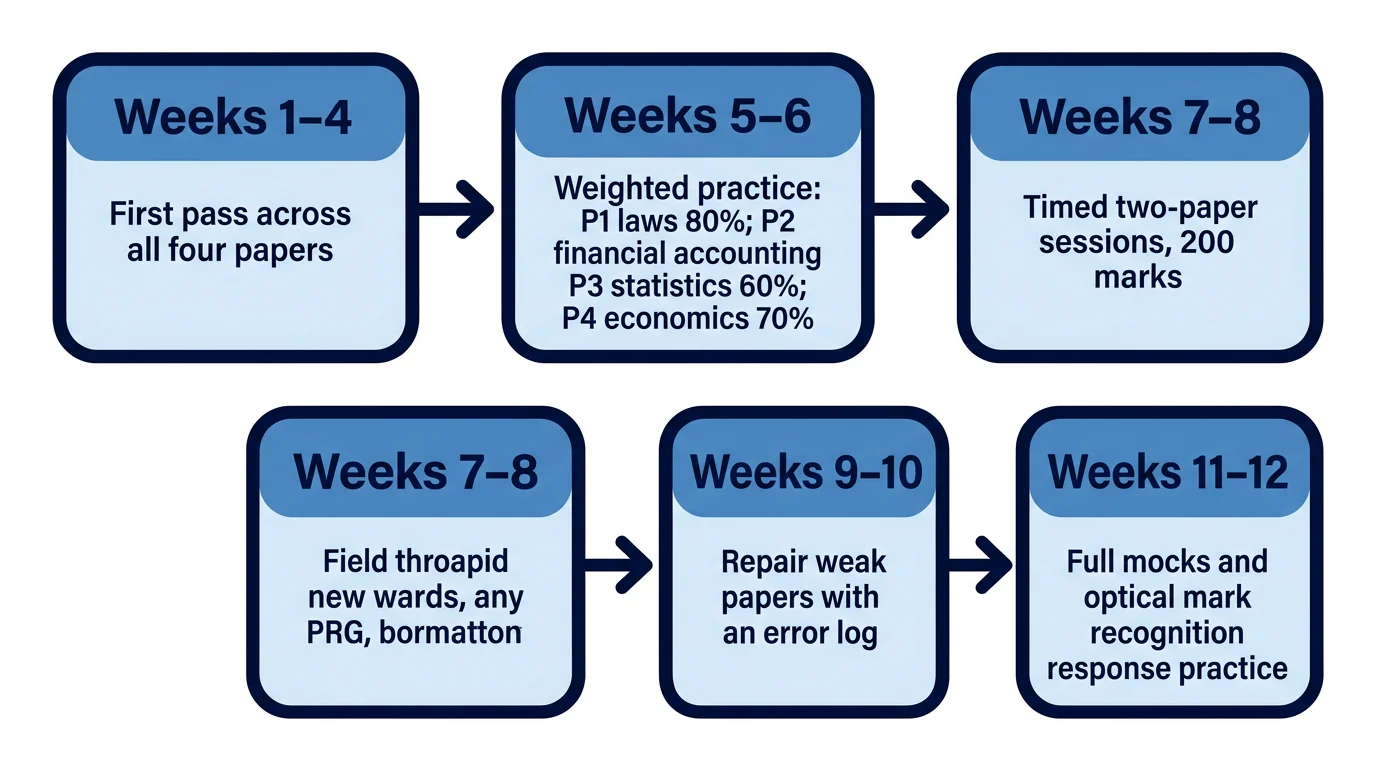
A 12-week approach is not well suited to a student who has only a few weeks before the examination. In that case, reduce scope deliberately: finish the official high-weight sections, identify the weakest paper early and practise the current question format rather than pretending a full first pass is still possible.
Takeaway: Finish coverage before the midpoint, then use the final six weeks to practise, diagnose and retest.
The December format changes what a useful mock looks like
For the December 2026 term, ICMAI schedules Foundation on Sunday, 13 December. Papers 1 and 2 run from 10:00 to 12:00 IST, and Papers 3 and 4 run from 14:00 to 16:00 IST. Each paper has 50 multiple-choice questions worth two marks, and the centre-based offline optical mark recognition format has no negative marking. The December 2026 ICMAI notice is the source to recheck for dates and instructions.
Passing requires at least 40% in every paper and 50% aggregate, as set out in the CMA India coaching comparison. A strong score in one paper therefore does not remove the need to repair another paper below the minimum.
The CMA India course-fee guide lists a ₹6,000 Foundation course fee, while the December 2026 exam notice lists ₹1,500 for an inland exam application. Keep the official course and exam costs separate from private tuition, and use the budget planner when planning the wider route.
Takeaway: A Foundation mock should rehearse two papers in one sitting and identify whether every paper can clear the 40% floor.
Buy support for a documented problem, not for a syllabus label
Start with evidence from your plan: modules not completed, repeated calculation errors, paper-specific scores below the pass floor, unfinished timed questions or doubts that stay unresolved. A student who can cover the modules and improve from mock feedback may need only a calendar and disciplined practice. A student whose error log keeps exposing the same gap may benefit from structured teaching, marked mocks or faster doubt support.
The trade-off is straightforward. Fixed classes can create routine and access to feedback, but they can also consume time when the batch moves through a module you already understand. Self-study offers control and may cost less, but it requires you to set the calendar, create enough timed practice and act on weak results. Neither route removes the need to learn the official syllabus.
iProledge offers CMA India support in online and offline formats. Before enrolling, use the CMA India coaching comparison to ask what a specific batch includes, including materials, mock feedback, recordings, delivery mode and access period.
Takeaway: Paid support is useful when it addresses a visible practice, feedback or scheduling problem that your own tracker has already identified.
Go deeper
Frequently asked
ICMAI's Syllabus 2022 has Business Laws and Business Communication, Financial and Cost Accounting, Business Mathematics and Statistics, and Business Economics and Management. Use the paper codes P1 to P4 in your tracker so practice scores, missed modules and revision tasks remain easy to compare.
Yes. ICMAI permits Foundation admission after Class X, while a student needs to have passed Class XII or an accepted equivalent before appearing in the Foundation examination. Candidates with certain recognised qualifications may have a direct route to Intermediate, so check the current ICMAI rule before paying for a Foundation route.
The December 2026 Foundation notice states that there is no negative marking. This makes an attempted answer preferable to leaving a question blank when you can make a reasoned choice, but it does not replace careful reading or timed practice with the optical mark recognition response sheet.
No. ICMAI's course and examination payments are official costs, while private coaching is optional and should be quoted separately. Before buying support, ask what the batch covers, including delivery mode, materials, mock tests, recording access, taxes and the time period for access.
Choose support only after the plan exposes a real gap
Compare the timetable, mock feedback and doubt-support terms you need for your CMA India preparation.
Compare CMA coaching support