
For Big Four Audit Careers in India, CA vs ACCA Depends on Role
CA (ICAI)
India’s chartered-accountancy route, including statutory-audit eligibility for a CA in practice.
₹49,000 registration fees on the Foundation route; ₹56,500 with one May 2026 India attempt at each stage
ACCA
An international accountancy qualification with jurisdiction-specific practice rights.
2026 components include £89 registration, £140 annual subscription and £83 ethics module
VerdictCA wins when your goal includes statutory company audit in India. ACCA can be the better fit for employer roles that accept it, especially when its four annual exam sessions and relevant-experience model match your situation.

By Naveen J D, Founder · Reviewed 17 Sept 2026
In brief
For statutory company audit in India, CA is the relevant route because the law requires a chartered accountant in practice. ACCA can suit audit-related, reporting and finance roles where an employer accepts it, but role requirements and relevant experience decide hiring. Neither qualification guarantees a Big Four role.
Choose CA (ICAI) if…
- Choose CA if you want the route that can meet India’s company-auditor eligibility criterion once you are a CA in practice and meet applicable requirements.
- Choose CA if you want the ICAI pathway of 4 Foundation, 6 Intermediate and 6 Final papers with a prescribed 2-year practical-training period.
Choose ACCA if…
- Choose ACCA if the roles you are targeting explicitly accept ACCA and you can build the required relevant experience.
- Choose ACCA if four annual exam sessions, in March, June, September and December, work better for your study schedule than CA Foundation and Intermediate’s three annual sessions.
- Choose ACCA if you meet its India entry criteria or have an exemption route based on prior qualifications.
CA (ICAI) vs ACCA, feature by feature
✓marks the stronger side on that row — unmarked rows are a tie or a judgment call.
Starting after school
CA (ICAI)
Foundation registration can begin after Class 10; candidates must have appeared in Class 12 before sitting Foundation.
ACCA
The India 10+2 route requires five passed subjects including English and Mathematics or Accounts, with 65% in at least two and over 50% in the others.
Exam structure
CA (ICAI)
16 exam papers: 4 Foundation, 6 Intermediate and 6 Final, plus 4 self-paced online modules for Final eligibility.
ACCA
Up to 13 exams: 3 Applied Knowledge, 6 Applied Skills, 2 Essentials and 2 Options, plus an ethics module.
Supervised experience
CA (ICAI)
2 years of practical training, starting after both Intermediate groups and ICITSS.
ACCA
At least 36 months of relevant experience, 9 performance objectives and supervisor sign-off for membership.
Exam-session frequency
CA (ICAI)
Foundation and Intermediate examinations are held in January, May and September.
ACCA ✓
Session-based exams run in March, June, September and December, with a maximum of 4 exams per session and 8 distinct exams per calendar year.
Company-auditor eligibility in India
CA (ICAI) ✓
The Companies Act 2013 specifies a chartered accountant in practice, or a qualifying firm, for appointment as company auditor.
ACCA
ACCA membership does not replace the Companies Act’s chartered-accountant-in-practice criterion.
Published fee components
CA (ICAI)
₹49,000 in listed Foundation-route registration fees, before exam fees, tuition, resits and incidental costs.
ACCA
Sterling registration, annual subscription, ethics, exam, exemption and local CBE fee components vary by route and timing.
Where each one pulls ahead
CA is not a Big Four guarantee
CA can provide the statutory-audit route in India, but employers can still set experience, technical and role-specific requirements.
ACCA is not an India audit-signing substitute
ACCA practice and audit authority depend on the jurisdiction, and ACCA alone does not meet India’s company-auditor appointment criterion.
A job description can outweigh a general comparison
Read the actual firm, team and level requirements because employers may accept the same qualification set while requiring different experience.
The fee and employer examples below are as of September 2026.
Audit-signing eligibility is the dividing line
The Companies Act 2013 makes a chartered accountant in practice eligible for appointment as a company auditor in India. That makes CA the route to choose if your long-term goal includes signing statutory company audit reports, subject to the applicable practice and appointment requirements.
ACCA is not a substitute for that India-specific appointment criterion. ACCA’s own practice guidance says public-practice and statutory-audit authority depend on the jurisdiction and its local rules.
What the two pathways require
CA has 4 Foundation papers, 6 Intermediate papers and 6 Final papers under ICAI’s New Scheme. After passing both Intermediate groups and completing ICITSS, the prescribed practical-training period is 2 years. ICAI also requires 4 self-paced online modules for Final eligibility. ICAI’s course FAQ sets out those requirements.
ACCA has up to 13 exams, an Ethics and Professional Skills Module, and a Practical Experience Requirement. ACCA’s qualification structure specifies 3 Applied Knowledge exams, 6 Applied Skills exams, 2 Strategic Professional Essentials and 2 Options. ACCA membership also requires 36 months of relevant experience, 9 performance objectives and supervisor sign-off.
What each credential requires before it can do its job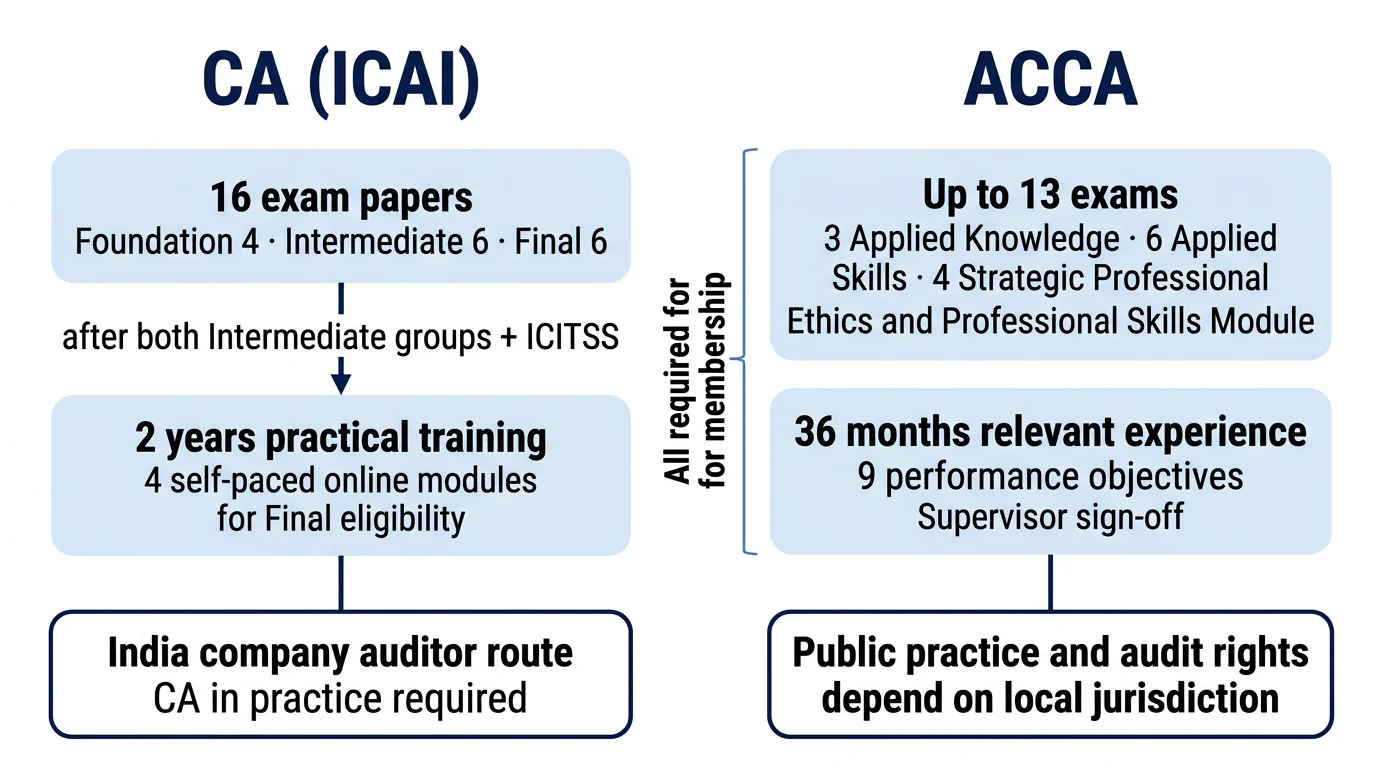
Published fees answer different questions
ICAI lists ₹9,000 for Foundation registration, ₹18,000 for both Intermediate groups and ₹22,000 for both Final groups. Those registration charges total ₹49,000 on the Foundation route. Adding one India attempt at each stage using ICAI’s May 2026 exam fees, ₹1,500 for Foundation, ₹2,700 for both Intermediate groups and ₹3,300 for both Final groups, produces ₹56,500 before tuition, resits, travel and other costs. ICAI’s 2026 fee chart provides the exam-fee figures.
For India in 2026, ACCA’s fee page lists £89 initial registration, £140 annual subscription and £83 for the ethics module. It also lists £151 per Applied Skills paper at standard entry, £268 for Strategic Business Leader and £191 for Strategic Business Reporting and each Strategic Professional option. Applied Knowledge CBE fees are set by the local centre, so there is no one reliable ACCA total for every student.
A Big Four job title can change the answer
An employer can accept both qualifications while setting different experience thresholds. EY’s 2026 Kolkata Financial Reporting Senior listing accepts CA, ACCA (UK) or CPA and asks for 2 to 5 years of relevant experience. Its Bengaluru Core Audit Senior listing distinguishes qualified-CA freshers from candidates with 1 or more post-qualification years in CA, ACCA or CPA plus relevant assurance experience. EY’s careers listings are examples of role-specific requirements, not a Big Four-wide hiring rule.
Before choosing, read the actual job description for the team and level you want. A qualification is one requirement among experience, technical knowledge and other listed criteria.
Continue your comparison
Keep reading



Frequently asked
ACCA membership alone does not meet the Companies Act 2013 criterion for appointment as a company auditor in India. The Act specifies a chartered accountant in practice, or a qualifying firm, so ACCA is not a replacement for that India-specific eligibility.
Requirements vary by role, service line and seniority. EY India listings provide examples of roles accepting CA, ACCA or CPA, but they also specify relevant experience and technical requirements. A listing from one firm or team is not a Big Four-wide hiring policy.
The published fee structures are not directly comparable. ICAI lists rupee registration and exam fees by CA stage, while ACCA lists sterling registration, subscription, module and paper fees, with Applied Knowledge CBE fees set by local centres and annual subscriptions depending on study duration.
For CA, candidates can register for Foundation after Class 10 and sit the Foundation examination after appearing in Class 12. ACCA’s India entry route requires passes in five subjects, including English and Mathematics or Accounts, with at least two scores of 65% and the others above 50%.
Explore the study support that fits your route
Browse iProledge programmes for CA and ACCA preparation, then compare the level, delivery mode and support you need.
Explore programmes