BCom Graduate Job Readiness: 6 Day-One Actions to Avoid a Two-Year Gap


TL;DR
Build BCom job readiness from Semester 1 with Excel, internships, accounting software, portfolio projects, and targeted applications.
A BCom degree can open doors, but it does not automatically make a graduate job-ready. India’s youth unemployment rate for people aged 15 to 29 was 9.9% in the 2025 PLFS, which makes early preparation more valuable.
Start in Semester 1: choose two or three entry roles, build Excel and accounting-software evidence, create one professional profile, and schedule a relevant internship before final year. By graduation, show two role-specific work samples, a targeted resume, and interview stories that prove you can handle entry-level finance or accounts tasks.
This BCom graduate job readiness guide explains why graduates get stuck, what to do each semester, and how to turn classroom learning into proof employers can assess.
Why a BCom Degree Alone Can Lead to a Long Job Search
Long job searches usually combine a crowded entry-level market with weak evidence of role fit, not a single personal failure. BCom graduate job readiness starts before graduation because employers can compare many similarly qualified applicants. The goal of BCom graduate job readiness is to leave college with usable proof, not merely a completed marksheet.
Here is how to spot the risk early.
The challenge is real, especially for educated young people. The ILO’s 2024 report found that youth graduate unemployment was 29.1% in 2022. That figure is historical and not BCom-specific, but it shows why a degree should be paired with visible skills and practical evidence.
| Common Gap Pattern | Why It Hurts | Better Day-One Move |
|---|---|---|
| Waiting until final year | There is little time to build or improve evidence | Start one project in Semester 1 |
| Applying to every role | The resume appears unfocused | Choose two or three related roles |
| Listing skills without proof | Employers cannot assess capability | Attach each skill to a project or task |
| Collecting unrelated certificates | Learning looks disconnected from a job target | Choose training that supports one target role |
| Having no work exposure | Interviews lack concrete examples | Complete one role-relevant internship |
A BCom graduate job readiness plan does not require an expensive credential for every gap. It requires honest role selection and a sequence of work that can be shown in a resume, portfolio, or interview. Start by identifying skill gaps that match the work you want to pursue.
The Six Day-One Actions That Build Job Readiness
The most effective BCom graduate job readiness habits are small, repeated actions that produce evidence: a clean spreadsheet, a role shortlist, feedback from work, and a focused resume. Starting early gives you enough time to revise weak work, test interests, and avoid treating a final-semester certificate as a rescue plan.
Use these BCom graduate job readiness actions as a practical baseline.
-
Choose target roles: Pick two or three connected options, such as accounts executive, finance assistant, audit trainee, operations analyst, or customer-facing banking support.
-
Build Excel proof: Create simple workbooks using budgets, ledgers, invoice trackers, receivables ageing, charts, and basic formulas.
-
Create an evidence folder: Save project files, certificates, feedback, presentation decks, and notes on what you actually did.
-
Build a professional profile: List your current course, target roles, practical skills, and project outcomes in clear language.
-
Learn one relevant tool: Practise an accounting workflow in Tally or QuickBooks, based on the roles you selected.
-
Plan one substantial internship: Seek a role with a defined task, a real supervisor, and an output you can explain later.
The official accounts role profile lists commerce education alongside Excel, Tally, journals, ledgers, accounting processes, analytical ability, and communication. That is the practical standard your evidence should meet.
Do not build a BCom graduate job readiness plan around random courses. Use course options only after deciding which skills are useful for your intended role.

Semester-By-Semester BCom Job Readiness Plan
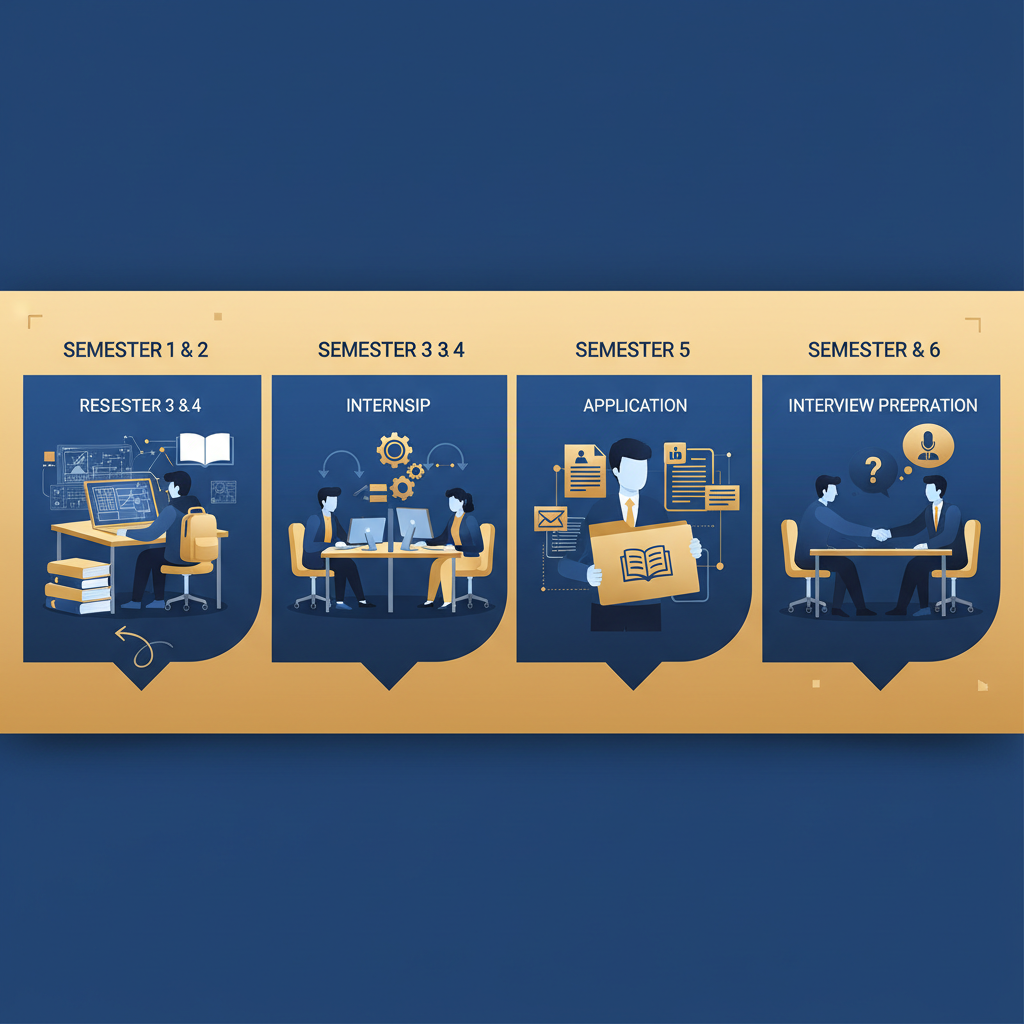
Your BCom graduate job readiness plan should follow the academic calendar, so every semester leaves behind something usable in an application. The point is not to pack every week with certificates. It is to move from direction, to technical practice, to supervised work, to portfolio proof, then to focused applications.
Build BCom graduate job readiness evidence one semester at a time.
| Semester | Action | Outcome Or Proof |
|---|---|---|
| Semester 1 | Identify two or three target roles and create a professional profile | Role shortlist and clear career direction |
| Semester 2 | Build Excel fundamentals with accounting or business data | One shareable spreadsheet project |
| Semester 3 | Learn an accounting-software workflow and begin internship outreach | Practice file and application tracker |
| Semester 4 | Complete one role-relevant internship or supervised project | Feedback, work sample, and resume bullet |
| Semester 5 | Build a mock financial model, audit case, or receivables analysis | Portfolio case study with recommendations |
| Semester 6 | Tailor applications, practise aptitude tests, and rehearse interview stories | Targeted resume and interview evidence |
The most useful projects resemble tasks in entry-level work. A finance-focused student can build a budget-versus-actual report. An accounts-focused student can create an invoice tracker and receivables ageing report. Follow a job-readiness roadmap if you need help turning each semester into a manageable weekly routine.
If you are already in Year 2, skip the guilt and start with your current position. Choose target roles this week, make one project this month, and apply for relevant experience before the next academic break.
What Employers Want Beyond the Degree
What employers want beyond a BCom degree is not mysterious: they look for task-level capability and credible examples. BCom graduate job readiness means translating coursework into an ability to reconcile, analyse, communicate, and use business tools. A resume becomes stronger when every claimed skill points to a project, placement, or practical output.
Use this BCom graduate job readiness checklist to make your resume more specific.
| Employer Signal | What To Show On Your Resume |
|---|---|
| Excel capability | Budget workbook, formula use, pivot-based report, or dashboard |
| Accounting knowledge | Ledger, invoice, reconciliation, or receivables project |
| Analytical thinking | Finding a variance, explaining a trend, or making a recommendation |
| Communication | Presentation, written summary, client support, or team coordination |
| Role fit | Resume bullets tailored to the chosen entry-level role |
For finance-oriented roles, the official financial analyst profile describes quantitative analysis, spreadsheets, charts, forecasting, budgeting, and communication. Use those tasks to choose projects that demonstrate genuine BCom graduate job readiness.
Skills are increasingly important in hiring. A 2025 recruiting survey found 93% of talent professionals considered accurate skill assessment crucial for improving quality of hire. That does not mean the degree is irrelevant. It means the degree works best when supported by evidence.
A professional pathway can be useful when it fits your goal, time, and finances. Before committing, compare BCom and CA routes against the roles you actually want.
Which Internships and Certifications Strengthen a BCom CV?
Internships and certifications can strengthen BCom graduate job readiness, but neither works as a decorative line on a resume. An internship counts when it gives you a defined task and evidence of the outcome. A certification helps when it teaches a workflow you can show, discuss, and connect to a chosen entry-level role.
Prioritise practical relevance over quantity to protect BCom graduate job readiness.
The Economic Survey describes internships as a way to bridge academic knowledge and industry requirements. Look for work where you can explain the problem, your contribution, the tool used, and the final output.
-
Accounts internship: Reconcile records, track invoices, assist with documentation, or prepare a monthly report.
-
Finance internship: Support budgeting, research, reporting, forecasting, or data cleaning.
-
Audit internship: Organise evidence, test transactions, document observations, or prepare working papers.
-
Operations internship: Track business data, improve a process, or prepare a performance summary.
-
Certification choice: Select Excel, accounting software, financial modelling, tax basics, or another capability only when it supports a target role.
If a professional accounting qualification is part of your plan, review available exemptions before choosing a pathway.
How to Build a Portfolio with No Job Experience
A portfolio solves a common BCom graduate job readiness problem: students know the theory but cannot show how they would use it. You do not need employer data or confidential files. Build small, clearly labelled practice cases that demonstrate method, judgement, accuracy, and a concise business recommendation.
Start this BCom graduate job readiness portfolio with two projects that mirror entry-level tasks.
-
Mock accounts case: Create a ledger, invoice register, receivables ageing report, and short note explaining overdue-payment priorities.
-
Mock finance case: Build a three-month budget, compare actual versus planned spending, create charts, and recommend one action.
-
Audit-style case: Review a fictional set of transactions, flag documentation gaps, and write a short evidence checklist.
-
Cost analysis case: Compare material, labour, or overhead assumptions and explain a possible cost-control action.
Keep each project to a readable format: one workbook, one short summary, and a few clear screenshots or charts. A cost-accounting practice guide can help you turn classroom concepts into a structured portfolio exercise.
Build Your Plan with iProledge
iProledge can help you turn a broad BCom degree into a focused early-career plan without pretending that one course or credential guarantees a job. The useful work is choosing a direction, sequencing practical skills, finding relevant evidence, and practising how to explain that evidence with clarity during applications and interviews.
Begin with the next practical step, not another vague promise.
Bring your role shortlist, current semester, and strongest project to iProledge. A counsellor can help you decide what to build first, whether a professional accounting pathway fits your goals, and how to connect degree subjects to a credible portfolio. This is where BCom graduate job readiness becomes a practical plan you can carry into classes, internships, and applications, with visible evidence at each stage. Start your next step at iProledge Home.
FAQs on BCom Graduate Job Readiness
These answers address questions that delay BCom graduate job readiness. Use them to choose a next action, then check each employer’s current requirements for the role and location.
Start your BCom graduate job readiness work with the action that produces visible proof soonest.
What If I Am Already in Year 2?
Start by choosing two target roles, completing one Excel project, and applying for relevant internships. Document every task, feedback point, and result in a simple evidence folder.
Which Internships Count for BCom Students?
Choose internships where you handle a defined business task, receive supervisor feedback, and leave with a work sample. Role relevance and evidence matter more than title prestige.
How Do I Build a Portfolio with No Job Experience?
Build two fictional but realistic cases using public or self-created data, then show calculations, assumptions, charts, and recommendations. Explain what decision each analysis would help a manager make.
Do Tally or QuickBooks Certifications Guarantee a Job?
No. Software training supports BCom graduate job readiness only when you can demonstrate a relevant workflow, explain your choices, and connect the work to an accounting or finance role.
How Should I Explain a Gap After Graduation?
Do not hide it. State the period honestly, explain the productive work completed, such as training, projects or family responsibilities, then redirect the interview to current evidence.