
Glossary
CSEET syllabus
Also called: Company Secretary Executive Entrance Test syllabus · Restructured CSEET syllabus

By Naveen J D, Founder · Reviewed 24 Sept 2026
Definition
The CSEET syllabus is ICSI’s four-paper entry-test curriculum for the CS Executive route, applicable from June 2026. It covers Business Communication, Fundamentals of Accounting, Economic and Business Environment, and Business Laws and Management. The first three papers are subjective, while the fourth is OMR-based.
In practice
- CSEET requires preparation for four separate papers, not one combined examination day.
- Subjective answer practice is relevant to the first three three-hour papers, while Paper 4 requires OMR-based practice.
- A score below 40% in any one paper prevents a CSEET pass, even if the overall aggregate exceeds 50%.
- Direct-entry exemptions mean some candidates should confirm their CS Executive route before paying for CSEET registration.
The official paper list
ICSI’s CSEET academic portal sets out the restructured four-paper syllabus.
| Paper | Subject | Format | Duration |
|---|---|---|---|
| 1 | Business Communication | Subjective | 3 hours |
| 2 | Fundamentals of Accounting | Subjective | 3 hours |
| 3 | Economic and Business Environment | Subjective | 3 hours |
| 4 | Business Laws and Management | OMR-based | 2 hours |
Paper 4 contains Business Laws for 60 marks and Business Management for 40 marks.
What each paper tests in plain language
Business Communication tests English usage and professional communication. The syllabus includes grammar, vocabulary, comprehension, communication methods, business correspondence and business terminology.
Fundamentals of Accounting tests whether a candidate can understand and use basic accounting principles. The scope includes recording transactions, bank reconciliation, depreciation, final accounts, partnership and LLP accounts, company accounts and non-profit accounts.
Economic and Business Environment tests basic economics in an Indian context alongside the forces that shape businesses. Economics and Business Environment are 50 marks each within the paper.
Business Laws and Management tests foundational commercial-law knowledge plus basic management understanding. The law portion covers company law, contracts, partnership and LLP, sale of goods and negotiable instruments. The management portion covers management foundations, functions, principles and management knowledge for company secretaries.
Rules that affect preparation
ICSI’s CSEET academic portal identifies the restructured syllabus and related official notices. The pass requirement is at least 40% in each paper and 50% aggregate in one sitting, with no paper exemption or mark carry-forward.
Business Laws and Management has no negative marking in its OMR-based paper. The restructured examination is centre-based and runs in February, June and October.
Registration route and timing
Candidates who have passed or are appearing in Senior Secondary, 10+2, or an equivalent examination can apply for CSEET if they are Indian nationals. ICSI also lists direct-to-CS-Executive exemptions for specific qualifications and study stages.
CSEET registration is valid for three years from the registration month, while a CSEET result is valid for one year from declaration. Use the related guides to check registration details, fees across the CS route, course duration, and whether BCom with CS or CS after graduation better matches your route.
The current examination shape
ICSI’s CSEET academic portal publishes the restructured syllabus applicable from June 2026 onward. The useful distinction is not just the subject names: three papers require subjective answers, while the fourth is OMR-based.
Paper formats at a glance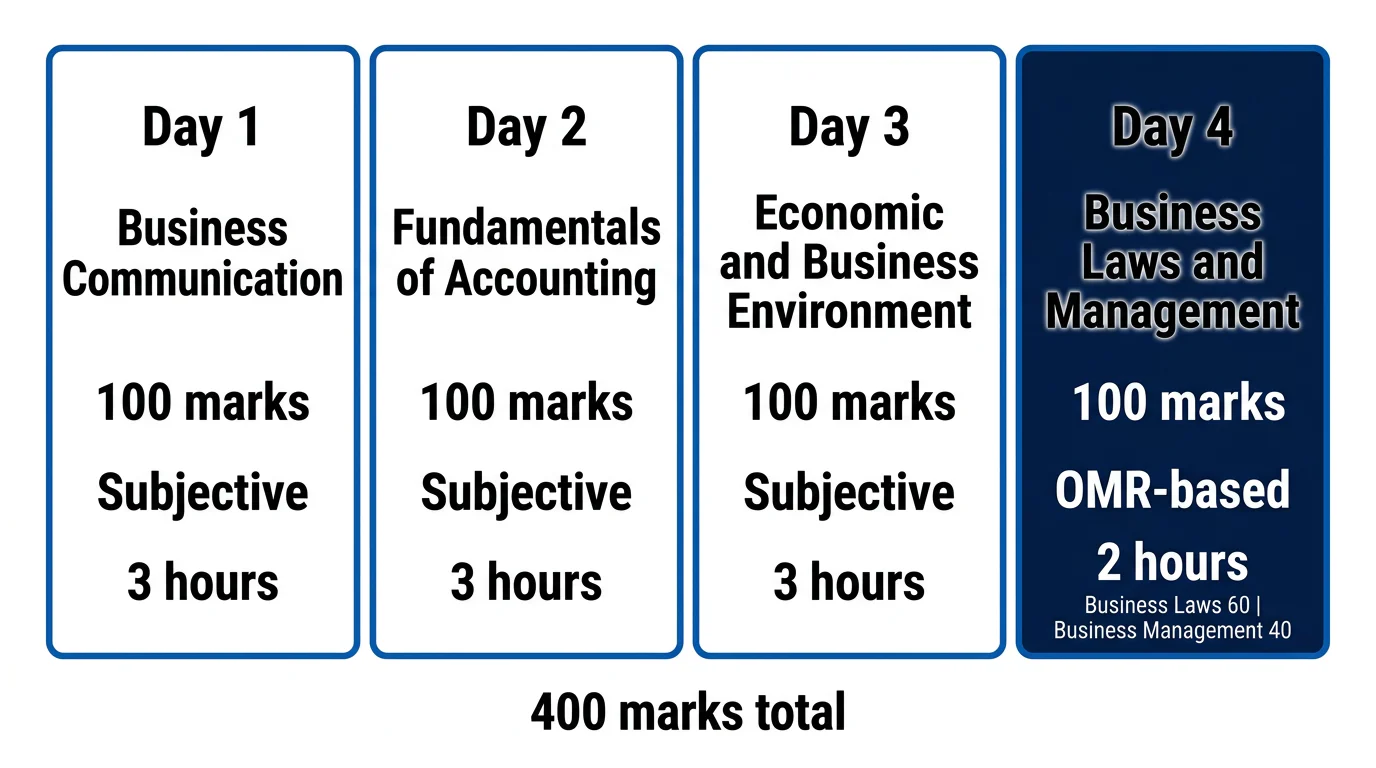
The four papers are held on separate days. A candidate needs at least 40% in every paper and 50% across all four papers in one sitting, so strength in one subject cannot offset a score below the paper minimum in another.
Related terms
Keep reading


Frequently asked
The CSEET syllabus has four 100-mark papers: Business Communication, Fundamentals of Accounting, Economic and Business Environment, and Business Laws and Management. The first three are subjective papers, while Business Laws and Management is OMR-based and is divided into Business Laws for 60 marks and Business Management for 40 marks.
No. The restructured CSEET syllabus applicable from June 2026 uses four papers of 100 marks each, for 400 marks in total. Older search results may describe the former 50-mark-paper structure, so candidates should check that a syllabus page names Fundamentals of Accounting and Business Laws and Management.
A candidate must score at least 40% in each of the four CSEET papers and at least 50% in aggregate in one sitting. ICSI provides no exemption or carry-forward of marks in CSEET, so a paper below 40% prevents a pass even when the total aggregate is higher than 50%.
The restructured CSEET is centre-based and is held three times a year, in the first week of February, June and October. Business Communication, Fundamentals of Accounting and Economic and Business Environment are subjective three-hour papers, while Business Laws and Management is an OMR-based two-hour paper.
ICSI lists exemptions for CS Foundation pass students, graduates and postgraduates, CA Intermediate pass students, CMA Final pass students, and specified students in final-year or integrated undergraduate programmes. Eligibility details can depend on the qualification and provisional-registration status, so candidates should check the applicable ICSI route before registering.
Choose CS class support around the four-paper format
Compare teaching format, materials, testing and recording access before enrolling.
Compare CS class formats