CMA Inter Syllabus: 8 Papers, Pass Rules and Group Choice
The CMA Inter syllabus is Syllabus 2022: eight 100-mark papers in two groups. Pass with 40% in every paper you sit and 50% of the total, for one group or both together.

By Naveen J D, Founder · Updated 10 Oct 2026

Key takeaways
- 01CMA Inter has eight 100-mark papers under Syllabus 2022: Group I is Papers 5 to 8, Group II is Papers 9 to 12. Sitting one group, you need 40% in each of its papers and 50% of the aggregate of its non-exempted papers. Sitting both groups together, you need 40% in all eight papers and 50% of the 800-mark aggregate.
- 02As of October 2026, 60 or more in a paper of a group you did not pass earns an exemption for the next three consecutive terms.
- 03In June 2026, 19.68% of both-group candidates (2,144 of 10,897) cleared both groups, against 23.93% of Group I-only and 30.64% of Group II-only candidates.
- 04Our recommendation: most working candidates should sit one group per term, Group I first.
In this article
- 1What is the CMA Inter syllabus, and which papers does it cover?
- 2How do you pass CMA Inter: one group, or both groups together?
- 3What do the latest CMA Inter results say about attempting both groups?
- 4Should you attempt one CMA Inter group or both in a single term?
- 5How should you split study time across the eight CMA Inter papers?
- 6Which CMA Inter coaching plan suits your marks and target term?
- 7Frequently asked questions
A candidate can score 210 out of 400 in a CMA Intermediate (CMA Inter) group and still fail it, while another scores 190 in the same group and passes. The difference is whether one group or both were sat in the term. The Institute of Cost Accountants of India (ICMAI) tests a candidate who sits both groups together on all eight papers and 800 marks.
Sitting both groups is also the riskier route. In June 2026, only 2,144 of the 10,897 candidates who sat both groups, or 19.68%, cleared both, according to ICMAI's results as tabulated by Careers360.
This page gives the current paper list, a checker that tests your marks against the correct rule for one group and for both, the three-term exemption limit, and a plain answer on whether to attempt one group or two.
It also settles the syllabus-year labels, such as 2016, 2018 and 2019, that still fill search results, and says what to check before planning a 2027 attempt.
What is the CMA Inter syllabus, and which papers does it cover?
The CMA Inter syllabus is Syllabus 2022: eight papers numbered 5 to 12, in two groups of four, each worth 100 marks. ICMAI's Intermediate curriculum page is headed "Syllabus - 2022" and links one PDF per paper.
| Group | Paper | Name | What it tests |
|---|---|---|---|
| I | 5 | Business Laws and Ethics | Business law and professional ethics |
| I | 6 | Financial Accounting | Preparing and reading financial statements |
| I | 7 | Direct and Indirect Taxation | Income tax and indirect tax (taxes on goods and services, such as GST, the Goods and Services Tax) |
| I | 8 | Cost Accounting | Costing methods, standard costing, marginal costing, budgets |
| II | 9 | Operations Management and Strategic Management | Operations techniques and business strategy |
| II | 10 | Corporate Accounting and Auditing | Company accounts and auditing |
| II | 11 | Financial Management and Business Data Analytics | Cost of capital, capital budgeting, data analytics |
| II | 12 | Management Accounting | Decision tools, budgets, variances |
Study from the ICMAI PDF for each paper. Taxation and law papers also depend on the amendments applicable to your term.
As of October 2026, Syllabus 2022 applies to the December 2026 exams. ICMAI has begun the transition to a new Syllabus 2026, so check ICMAI's student circulars for the term from which it applies before planning a 2027 attempt. Material labelled 2016, 2018 or 2019 belongs to retired syllabuses.
The format of recent papers, as published on ICMAI's question paper list, is 30 marks of multiple-choice questions and 70 marks of descriptive questions: seven questions of 14 marks, any five to be attempted.
How do you pass CMA Inter: one group, or both groups together?
You pass one group by scoring at least 40% in each of its four papers and at least 50% of the aggregate of its non-exempted papers. You pass both groups sat together by scoring at least 40% in each of the eight papers and at least 50% of the 800-mark aggregate. Both rules are in the ICMAI prospectus, as of October 2026.
Test your own marks with this checker:
| Case | Marks | Total | Every paper at 40 or more? | Aggregate at 50% or more? | Result |
|---|---|---|---|---|---|
| One group | 58, 58, 58, 36 | 210 of 400 | No (36) | Yes | Fail |
| One group | 40, 40, 40, 80 | 200 of 400 | Yes | Yes | Pass |
| One group | 45, 45, 45, 45 | 180 of 400 | Yes | No | Fail |
| One group, one paper exempted | 50, 50, 50 (three papers sat) | 150 of 300 | Yes | Yes | Pass |
| Both groups | Group I: 45, 45, 50, 50 (190); Group II: 55, 55, 50, 50 (210) | 400 of 800 | Yes | Yes | Pass |
| Both groups | Group I: 50, 50, 50, 50 (200); Group II: 45, 45, 45, 45 (180) | 380 of 800 | Yes | No | Fail, although Group I reaches 200 |
| Both groups | Seven papers at 60, one at 38 | 458 of 800 | No (38) | Yes | Fail |
Two lessons follow from the table. A high total never rescues one paper under 40. And if you sit both groups, a strong group can offset a weaker one, while a weak total fails you even when one group looks safe.
As of October 2026, a score of 60 or more in a paper of a group you did not pass earns an exemption for the next three consecutive terms, according to the ICMAI prospectus. An exempted paper is left out of the 50% aggregate test.
Our recommendation: aim for 50 or more in every paper, not 40. That 10-mark cushion per paper absorbs one hard question set. Score each full mock paper by paper and treat your lowest paper as the one that decides the result. Our guide to choosing a CMA test series explains how to pick mocks that give you this paper-by-paper view.
What do the latest CMA Inter results say about attempting both groups?
The latest results show that clearing both groups together is harder than clearing either group alone. In June 2026, 19.68% of both-group candidates cleared both, while 23.93% of Group I-only and 30.64% of Group II-only candidates passed. The figures are ICMAI's results as tabulated by Careers360.
| Term | Group I only | Group II only | Both groups: cleared both | Both groups: cleared one |
|---|---|---|---|---|
| June 2026 | 6,813 of 28,471 (23.93%) | 5,358 of 17,488 (30.64%) | 2,144 of 10,897 (19.68%) | 1,397 of 10,897 (12.82%) |
| December 2025 | 7,222 of 29,375 (24.59%) | 4,702 of 14,803 (31.76%) | not used | not used |
Our calculation for June 2026, reading "cleared one" as exactly one group: cleared neither = 1 − (1,397 + 2,144) / 10,897 = 1 − 3,541 / 10,897 = 67.5%. About two in three candidates who sat both groups left with neither group cleared.
Group II's pass rate is about 7 points above Group I's in both terms (30.64 against 23.93 in June 2026; 31.76 against 24.59 in December 2025). Fewer candidates sit Group II alone (17,488 against 28,471 in June 2026). Our inference is that those candidates may be better prepared, so the gap does not show that Group II is easier. For results across all three CMA levels, see our CMA pass percentage analysis.
Should you attempt one CMA Inter group or both in a single term?
Attempt one group per term unless you study full time and have a commerce background. The results above are one reason; the exam timetable is the other. ICMAI's December 2026 timetable runs the eight papers on eight consecutive days, 10 to 17 December, from 2pm to 5pm. As of October 2026, Group I falls on 10, 12, 14 and 16 December, and Group II on 11, 13, 15 and 17.
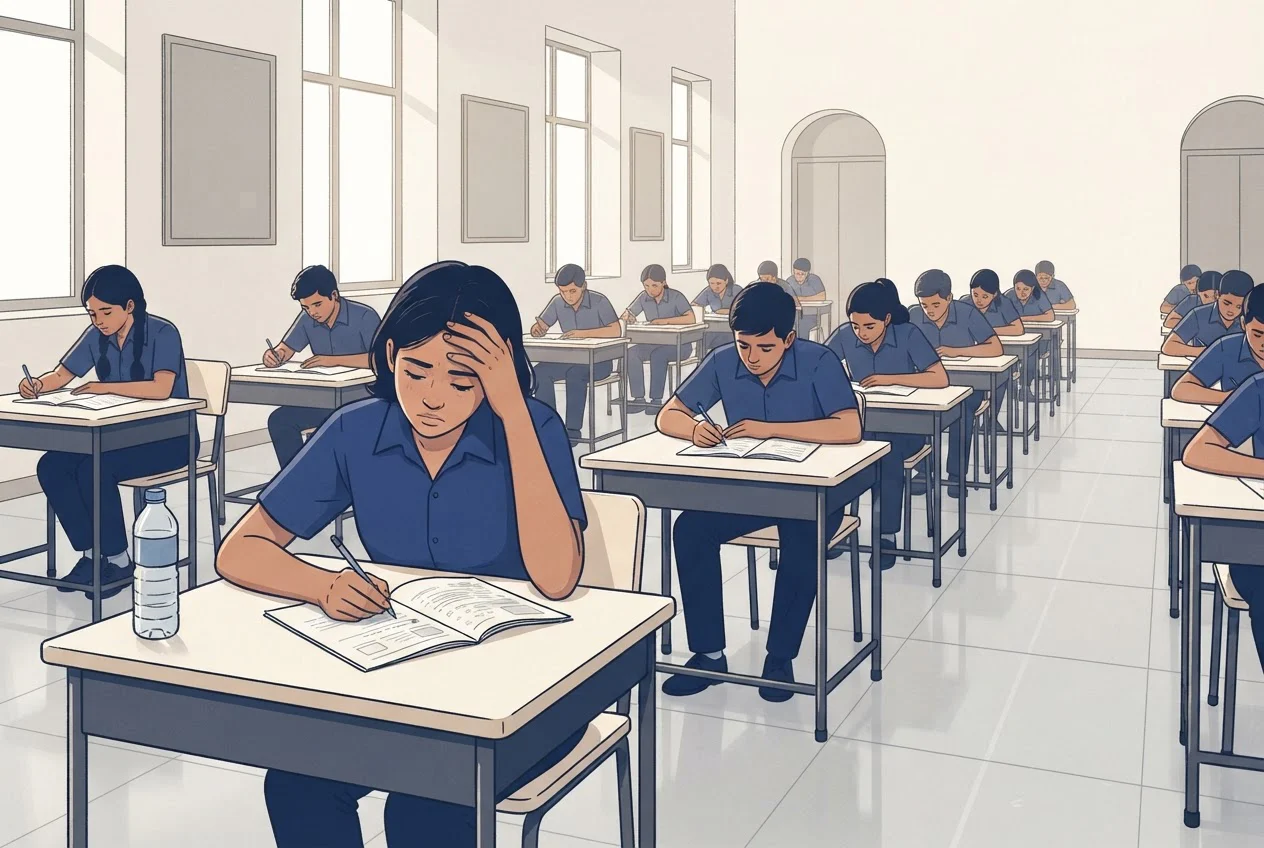
A one-group candidate therefore gets a rest day between papers. A both-group candidate sits eight three-hour papers in a row. ICMAI publishes the timetable for each term, so check the one for your attempt.
| Your situation | What we recommend | Why |
|---|---|---|
| Commerce graduate studying full time | Both groups is workable; plan the eight-day run | Marks can offset across groups, but 19.68% cleared both in June 2026 |
| Working full time, or new to commerce | Group I first, then Group II next term | Our recommendation, not an ICMAI sequencing rule: Cost Accounting (Paper 8) covers standard costing and budgets that Management Accounting (Paper 12) goes on to use |
| Cleared one group earlier | Sit only the other group | A cleared group stays cleared |
| 60 or more in one paper of a failed group | Carry the exemption | Valid for three consecutive terms |
How should you split study time across the eight CMA Inter papers?
Give the number-heavy papers the largest share of study time. Our model, not an ICMAI figure: take one group over 12 weeks at 15 study hours a week, which is 180 hours.
| Group I (our model) | Hours | Group II (our model) | Hours |
|---|---|---|---|
| Cost Accounting | 50 | Management Accounting | 50 |
| Financial Accounting | 45 | Financial Management and Business Data Analytics | 45 |
| Direct and Indirect Taxation | 45 | Corporate Accounting and Auditing | 45 |
| Business Laws and Ethics | 40 | Operations Management and Strategic Management | 40 |
The assumption is that costing, accounting and finance papers reward timed problem practice, so they get more hours than the law and strategy papers. In Cost Accounting and Management Accounting, spend those hours on marginal costing, standard costing and budgetary control. Rework these questions under a timer instead of rereading solutions. Move 5 to 10 hours towards whichever paper scores lowest in your first full mock.
Which CMA Inter coaching plan suits your marks and target term?
Choose by how much live teaching and mock testing you need. We teach CMA Inter in three plans, with recorded classes and exhaustive syllabus coverage in each. Our Bangalore CMA Inter coaching page explains how live classes, mocks and mentoring fit together.
- Super 60: live classes offline and online, unit and mock tests with feedback, hard-copy and soft-copy study material, free registration support and unlimited access to our learning management system (LMS).
- Pro: live online classes, unit and mock tests with feedback, soft-copy study material, free registration support and unlimited LMS access.
- Lite: recorded classes and soft-copy material, without mock tests.
The checker above works on mock marks, which is why we put tests and feedback in Super 60 and Pro. Fees depend on the plan, so talk to our CMA Inter team with your latest mock marks and your target term, and we will help you choose a plan and a group order.
Get help choosing your CMA Inter plan and group order
Frequently asked questions
You can register if you passed 10+2 and the ICMAI Foundation course, or hold a degree from a recognised university. Engineering students who have finished the second year, and qualified engineers, also qualify. Degree candidates awaiting results can register provisionally, with 18 months to confirm. See ICMAI's course eligibility page and our explainer on CMA eligibility in India.
Sources
- 1.ICMAI, Syllabus 2022: Intermediate Course Curriculum
- 2.ICMAI, course overview and CMA prospectus (passing rules and exemptions)
- 3.ICMAI, Intermediate course eligibility
- 4.ICMAI, question paper list
- 5.ICMAI, student circulars
- 6.ICMAI, December 2026 Intermediate and Final examination timetable
- 7.Careers360, CMA Intermediate pass percentage by term (ICMAI results, June 2026 and December 2025)
- 8.iProledge, CMA Inter plans