What Does Chartered Accountancy Actually Demand? Chartered Accountancy Study Demands and Support


TL;DR
At iProledge, we explain that Chartered Accountancy study demands concept mastery, sustained practice, revision, and written application across Foundation, Intermediate, training, and Final. We map the official routes and show when test evidence points to structured support, including how to assess a provider or decide whether a crash course genuinely fits.
CA is demanding because progression depends on clearing several gates, not simply completing lectures. In the May 2026 attempt, the Foundation pass rate was 20.09% in May 2026, a useful reminder that preparation quality matters as much as time spent.
Chartered Accountancy study demands sustained concept learning, repeated problem practice, revision, and exam-standard written application across several stages. Paid support becomes useful when you cannot diagnose recurring errors, keep pace with a realistic plan, or obtain timely feedback in difficult subjects. It never replaces independent practice, ICAI material, or consistent revision.
We explain the official route, the work each subject requires, and how to decide whether self-study, targeted help, or a more structured format fits your situation.
What Does Chartered Accountancy Actually Demand?
The real demand is cumulative. Each stage asks you to understand ideas well enough to use them in unfamiliar questions, retain them through revision, and show your reasoning in the format the exam rewards. Watching a class can start that process, but it cannot substitute for solving, writing, checking, and repairing errors yourself.
The course also changes the kind of work required as you progress. Foundation introduces four papers and a mix of subjective and objective assessment. Intermediate requires applied work across six papers, with case-based MCQs and descriptive answers. Final adds advanced, integrated decision-making after practical training. ICAI’s current New Scheme syllabus is therefore best approached as a long preparation system, not a sequence of isolated batches.
A student should expect four recurring jobs throughout the path:
- Learn concepts: Build understanding before attempting shortcuts or memory tricks.
- Practise independently: Solve questions without depending on a teacher’s working.
- Revise deliberately: Return to weak chapters before they become repeat-attempt problems.
- Write for assessment: Present calculations, provisions, assumptions, and conclusions clearly under time limits.
That distinction matters when choosing support. If you can complete those jobs consistently, self-study can be effective. If one of them repeatedly breaks down, use our self-study checklist to identify the specific failure before paying for a broad course.
Which CA Route and Milestones Apply to You?
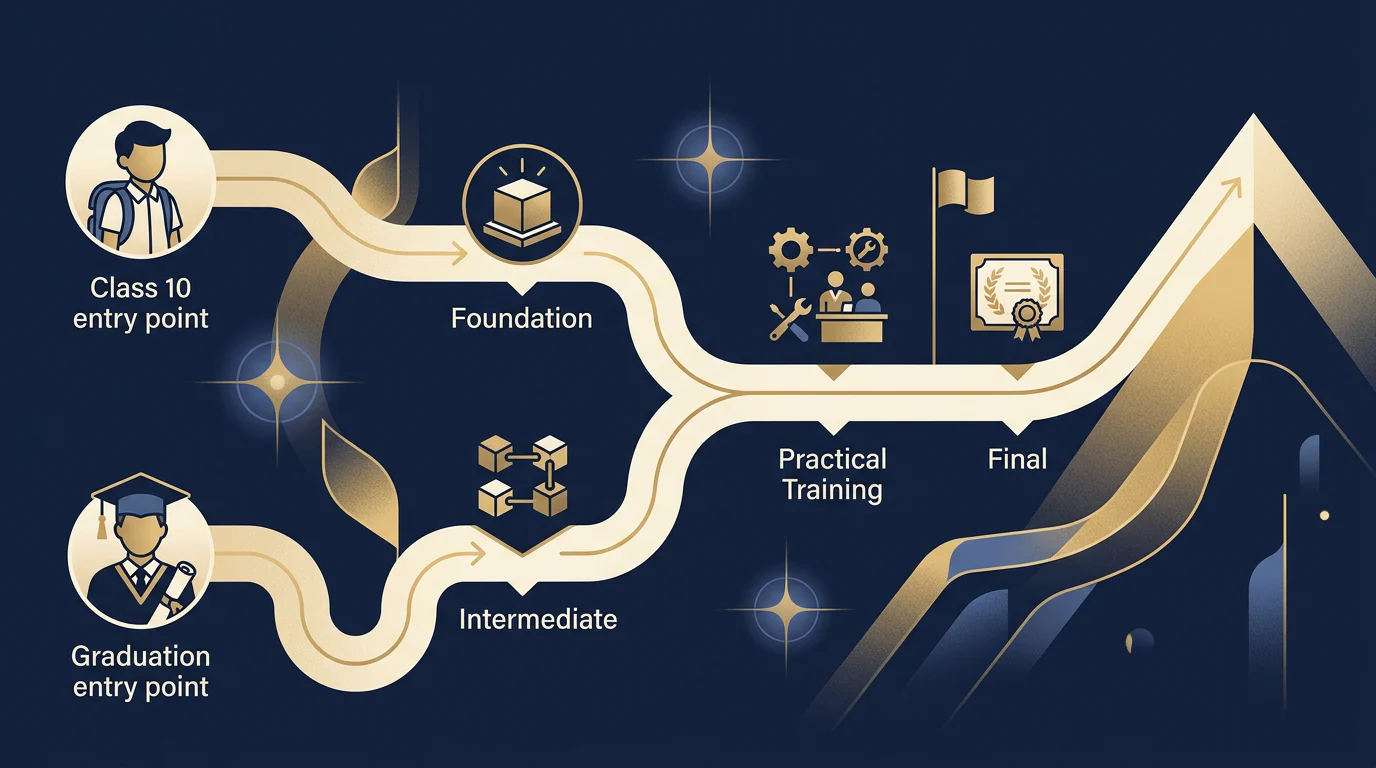
Before evaluating coaching, confirm the route you are actually eligible to take. A student may register for Foundation after passing Class 10, but must have appeared in Class 12 and completed the required four-month registration period before sitting Foundation. Graduates and postgraduates may instead use direct entry to Intermediate if they meet the applicable qualification threshold.
For direct entry, commerce graduates or postgraduates need at least 55%, while non-commerce graduates or postgraduates need at least 60%. Candidates who have passed the Intermediate level of ICSI or ICMAI can also register through direct entry. ICAI also allows provisional registration for final-year graduates, subject to completing the degree with the required marks and the Intermediate study period. These current route rules are set out in the ICAI course FAQ.
What Does the Foundation Route Require?
Foundation has four 100-mark papers: Accounting, Business Laws, Quantitative Aptitude, and Business Economics. Passing requires at least 40% in every paper and 50% in aggregate. The route is suitable for students who want to build professional-accounting habits early, including those who are still completing school.
The important planning point is that the four-month registration rule is an eligibility minimum, not proof that every student will be ready in exactly four months. Your baseline in accounting, mathematics, written English, and study discipline should shape the preparation plan.
What Does Direct Entry to Intermediate Require?
Direct entry avoids Foundation, not the need to build fundamentals. A graduate entering Intermediate still needs to handle Advanced Accounting, corporate law, taxation, costing, audit, financial management, and strategic management. Students entering from a non-commerce degree should be especially honest about whether they need concept rebuilding before moving at an accelerated pace.
Intermediate candidates must be registered for at least eight months before the relevant examination month. We recommend using that period to establish a first full syllabus pass, not merely to collect lecture-completion certificates.
What Happens After Intermediate?
After passing both Intermediate groups and completing ICITSS, a student can begin the required two years of practical training. Final eligibility also includes Final registration, completion of practical training within ICAI’s prescribed window, Advanced ICITSS, and all four Self-Paced Online Modules. Use our stage coaching guide if your support need changes between Foundation, Intermediate, articleship, and Final.
How Should You Study CA Subjects?
CA subjects do not reward one study method equally. Numerical papers require repeated independent solving, while law and audit require recall plus clear written application. The most useful study plan assigns a method to each subject instead of treating every chapter as another set of notes to reread.
At Intermediate, ICAI uses 30% case-scenario or case-study MCQs and 70% descriptive questions across all six papers. That makes timed application and answer presentation part of the work, not an optional extra after lectures. The assessment pattern is confirmed in the official course FAQ.
| Subject Area | What To Practise | Evidence Of Readiness |
|---|---|---|
| Accounting | Adjustments, standards, workings, and full questions | Solve an unfamiliar question without copying a format |
| Law | Provision recall and fact application | Write a rule, apply it, and reach a conclusion |
| Taxation | Amendments, computations, classifications, and working notes | Complete a mixed computation accurately under time pressure |
| Costing | Formula selection, method logic, and reconciliation | Explain why a method applies before calculating |
| Audit | Standards, requirements, and scenario-led writing | Produce structured answers rather than loose points |
| Finance | Formula selection, interpretation, and calculations | Finish mixed numerical questions accurately and on time |
A good revision cycle is simple but demanding: attempt a question, classify the error, repair the underlying chapter, and retest under timing. If you keep repeating the same mistake after doing that work, use our study-gap guide to decide whether the issue is a concept gap, a practice gap, or a feedback gap.
When Is CA Coaching Useful Rather Than Optional?
Coaching is useful when it solves a diagnosed learning problem. It is not automatically useful because the syllabus feels large, a friend enrolled, or an exam date is approaching. A student who can learn from ICAI material, practise independently, mark errors honestly, and maintain revision can often use self-study well.
The five problems below are more reliable decision signals than course popularity or promotional claims.
Is the Problem Concepts or Planning?
A concept problem appears when the same misunderstanding returns in different questions. For example, you may know a solution pattern but fail when the facts change. Planning problems look different: you understand the work, but weekly targets roll forward until revision becomes impossible.
Concept problems call for targeted teaching and doubt resolution. Planning problems need a realistic weekly sequence, a smaller backlog, and scheduled review points. A full course may be excessive if the issue is only planning.
Is the Problem Practice or Feedback?
Practice problems appear when a worked answer feels obvious but an independent attempt falls apart. Feedback problems appear when you know an answer was weak but cannot identify whether marks were lost through technical error, incomplete working, poor presentation, or misread requirements.
A test series with meaningful answer review can be more valuable than more lectures for this type of student. Compare the format, not just the promised syllabus coverage, through our course-format comparison.
Is the Problem Accountability?
Accountability is the right diagnosis when a student has a reasonable plan, understands the chapters, and still repeatedly avoids the difficult work. Live checkpoints, fixed deadlines, or a small review group can help create follow-through, but they still require the student to practise alone.
| Diagnosed Problem | Support Format To Consider | What It Should Deliver |
|---|---|---|
| Concepts | Subject-specific teaching or doubt sessions | Clear explanation followed by targeted practice |
| Planning | Mentor-led weekly plan | Realistic milestones and backlog recovery |
| Practice | Timed test series and graded problems | Independent attempts and error analysis |
| Feedback | Evaluated descriptive answers | Specific reasons for lost marks and corrections |
| Accountability | Live checkpoints or small-group review | Deadlines, follow-up, and visible progress |
Before choosing a faculty-led format, review faculty profiles and ask whether the support actually addresses your diagnosed problem. A polished lecture library does not solve missing answer evaluation, and a strict schedule does not repair an unresolved accounting concept.
How Should You Evaluate a CA Course or Crash Course?
The right provider should make it easy to verify what you are buying. Ask who teaches each subject, how amendments are handled for your exact attempt, whether tests are evaluated, how doubts are answered, how long access lasts, and what the total cost includes. Begin comparing course formats only after you know which support format you need.
Amendment control deserves particular attention in law and taxation. ICAI publishes applicability guidance for each examination cycle, so a provider should state its update policy clearly instead of expecting students to infer it from a batch label. Check the May 2026 guidance as an example of why attempt-specific updates matter.
A crash course is sensible only when you have already covered the core syllabus, can identify a narrow gap through a timed test, and have enough time for practice after revision sessions. It is not a good substitute for rebuilding several weak foundations. The latest sensible time to enrol is therefore before the course would need to introduce basics from scratch, not a calendar date advertised as urgent.
Use this due-diligence checklist before committing:
- Faculty continuity: Confirm who will teach, answer doubts, and review work.
- Amendment policy: Confirm written coverage for your precise examination attempt.
- Tests: Check frequency, syllabus mapping, and timed conditions.
- Answer review: Ask whether descriptive answers receive individual, usable feedback.
- Access: Verify device limits, validity, extensions, and replay conditions.
- Fees: Confirm the complete amount, taxes, instalments, and any separately charged materials.
When you are ready to compare your findings with a practical next step, use our admission guidance rather than choosing a format solely because it is marketed as fast.
Talk to iProledge About Your CA Study Plan
At iProledge, we start with the student’s evidence, not a generic sales script. Bring a recent mock, your completed chapters, your available weekly study blocks, and the point where preparation keeps stalling. We will help you separate a concept gap from a planning, practice, feedback, or accountability gap, then identify the support format that fits it. That can mean structured classes, a targeted test and answer-review plan, or a self-study route with clearer checkpoints. We also encourage you to compare faculty continuity, amendment coverage, access terms, and total fees before making a commitment. Our aim is a preparation decision you can explain, not a rushed enrolment because an exam date is near. Our counsellors can also help you turn that evidence into a short, practical next-step plan that protects your revision time. If you are deciding between self-study, full support, or a narrowly targeted reset, begin with iProledge home.
FAQs on Chartered Accountancy Study Demands
Can I Register for CA Foundation After Class 10?
Yes. ICAI permits Foundation registration after Class 10, but you must have appeared in Class 12 and completed the required registration period before taking Foundation.
Who Qualifies for CA Intermediate Direct Entry?
Commerce graduates or postgraduates need 55% for direct entry, while non-commerce graduates or postgraduates need 60%. Eligible ICSI or ICMAI Intermediate pass candidates can also register.
Should I Choose Structured CA Support?
Choose structured help when test evidence reveals recurring concept, timing, feedback, planning, or accountability failures that you cannot fix through disciplined self-study and ICAI resources.
When Does a Crash Course Fit CA Preparation?
A crash course fits revision-ready candidates who understand the core syllabus, know their exact gap, and can practise under time pressure. It cannot replace foundational rebuilding.