iProledge on CA Final Pass Rate Reality: Why Repeat Attempts Persist Even with Coaching


TL;DR
Latest CA Final pass rate data, repeat-attempt realities, syllabus updates, coaching limits, and practical preparation priorities.
For candidates who sat both groups, the latest 14.07% in May 2026 is a useful CA Final pass rate reality check. It shows how demanding one sitting can be, but it does not track each candidate's full attempt history.
CA Final pass rates make repeat attempts understandable, but official data cannot prove that three or four attempts are typical or that coaching causes better results. The exam combines paper-level thresholds, aggregate requirements, current-law updates, and applied case work. Coaching helps only when it turns those requirements into disciplined revision and feedback.
We will unpack the latest CA Final pass rate data, the factors results can genuinely support, the claims responsible guidance should avoid, and the preparation habits worth prioritising.
CA Final Pass Rate Data Across the Latest Three Sittings
The CA Final pass rate should be read sitting by sitting, not as a personal probability or a verdict on a candidate's ability. Candidates appearing for one group and candidates appearing for both groups are different pools, so the figures cannot be added together.
| Attempt | Group I | Group II | Both Groups |
|---|---|---|---|
| September 2025 Results | 24.66%, 12,811 of 51,955 | 25.26%, 8,151 of 32,273 | 16.23%, 2,727 of 16,800 |
| January 2026 Results | 21.03%, 11,282 of 53,652 | 9.76%, 3,726 of 38,169 | 10.97%, 2,446 of 22,293 |
| May 2026 Results | 12.00%, 6,555 of 54,606 | 20.49%, 8,725 of 42,573 | 14.07%, 3,345 of 23,776 |
Across these three sittings, the combined CA Final pass rate ranges from 10.97% to 16.23%. That 5.26-point spread is why a single viral pass-rate number is a poor basis for predicting one student's result. It is more useful as a signal to prepare deliberately, build margin above the minimum, and treat every paper as material.
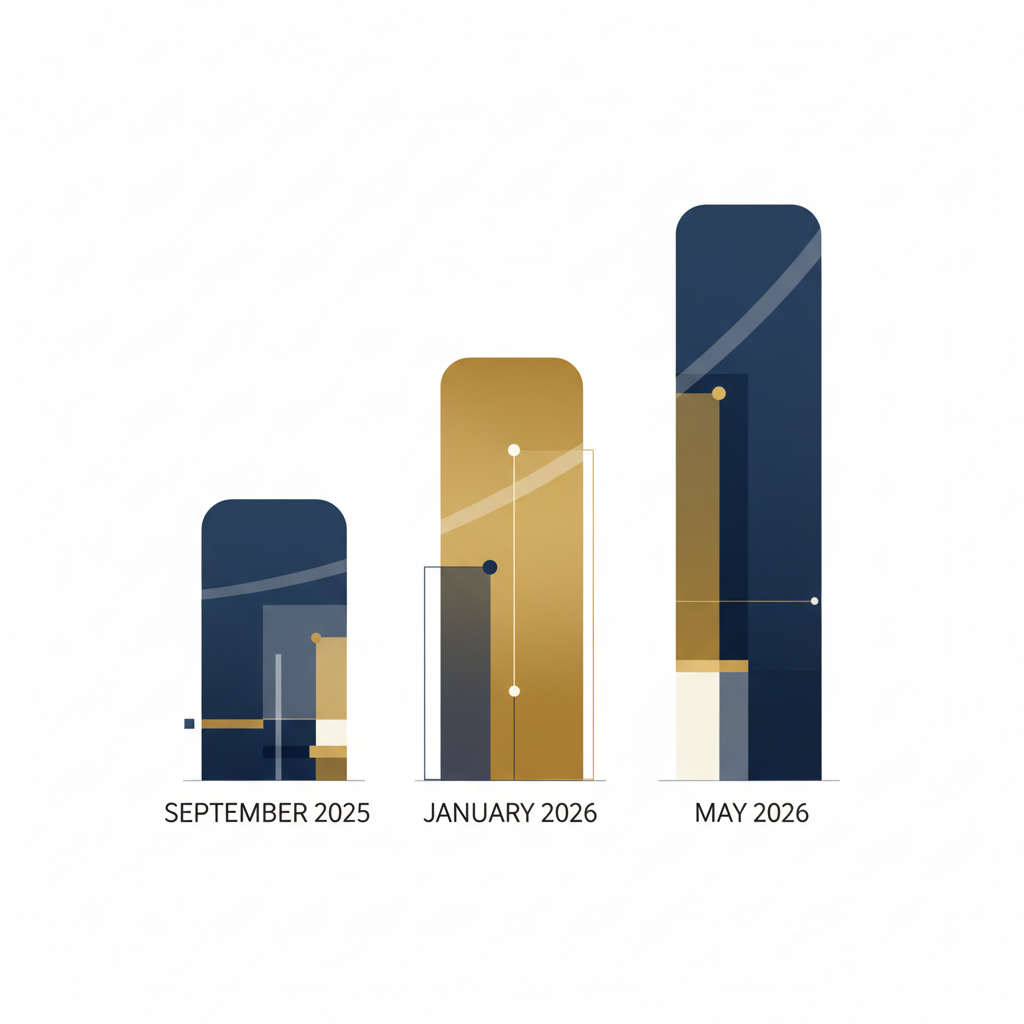
We encourage students to use a CA Final pass rate table as context, then move quickly to controllable actions. Our CA coaching checklist helps compare structure, revision access, mock feedback, and doubt support without treating any class format as a shortcut.
What the CA Final Pass Rate Can and Cannot Prove
A low result percentage can explain why repeat attempts happen, but it cannot show why any particular candidate did not clear. Official releases do not identify first-time candidates, repeat candidates, coaching enrolment, weekly study hours, or subject-wise national pass rates.
| What Published Results Show | What They Do Not Show |
|---|---|
| Candidates appeared and passed by Group I, Group II, and both groups | A candidate's lifetime number of attempts |
| Pass-rate variation between exam sittings | Whether coaching caused a better result |
| The outcome for a defined exam sitting | Which subject has the lowest national pass rate |
| Group-level success rates | Average study hours of successful candidates |
The examination rules also matter. Candidates can take both groups together or take one group and the other later, but passing requires at least 40% in every paper and 50% aggregate in a group, or across both groups when taken together under the applicable route. Those exam regulations make a weak paper capable of delaying an otherwise solid attempt.
This is the honest answer to “why do people take multiple attempts despite coaching?” A CA Final pass rate can show that many candidates do not clear both groups in a sitting. It cannot quantify coaching quality or prove a fixed three-attempt or four-attempt pattern. Our coaching ROI framework is built around questions students can actually verify before committing time or money.
Four Evidence-Based Pressures Behind Repeat Attempts
The useful question is not whether the exam is simply “brutal.” It is which demands must be managed simultaneously, and which of those demands a student can reduce through a sharper preparation system.
Threshold Structure and Six-Paper Coverage
The CA Final pass rate reflects an examination with six papers and two separate thresholds: a paper-level minimum and an aggregate requirement. Strong preparation in five papers cannot automatically offset a score below the required mark in the remaining paper.
That is why we advise students to track both paper-level and group-level performance. A realistic plan protects the weakest paper rather than only revising favourite subjects. Reviewing our faculty can also help students assess whether they will receive paper-specific guidance rather than generic motivation.
Applied Case Work and Integration
The final paper is formally titled Integrated Business Solutions, a multidisciplinary case study with strategic management. ICAI guidance explains that this format draws on core Final subjects and self-paced modules, making it an application task rather than a memory-only exercise. The case-study guidance supports building practice around interpretation, decision-making, and connecting topics under time pressure.
A CA Final pass rate does not provide a difficulty index for each question. Still, the assessment format makes full-length practice valuable because candidates must identify what a case is asking before they can apply the relevant rule, standard, or calculation.
Current Material and Amendment Tracking
Older notes can remain useful, but they must be checked against the material applicable to the next attempt. For May 2026, the official Final material included revision test papers, judicial or statutory updates, updated editions, and case-study resources. The official material list demonstrates why an amendment log is a practical revision tool.

We recommend treating the applicable material as a live checklist. First confirm the edition, then note changes, then test those changes in questions. Students who need to organise resources across subjects can start with our courses and choose support based on the exact gaps they need to close.
Coaching Quality and Feedback Loops
No public national dataset compares CA Final pass rate outcomes by coaching enrolment, batch size, provider, doubt resolution, or study hours. It would be irresponsible for us to convert a coaching claim into a percentage advantage.
What can be assessed is the support process. Students should ask whether updates are timely, whether doubts have a clear response route, whether mock answers are reviewed, and whether revision is built into the calendar. Coaching becomes useful when it creates feedback loops that the student actually completes, not when it merely increases lecture hours.
What First-Attempt Preparation Can Realistically Prioritise
There is no verified national profile of what every first-attempt passer does. There are, however, sound preparation practices that suit the exam's threshold rules and applied format.
ICAI scheduled two mock-test series for May 2026, beginning 16 March and 1 April. That two mock series is a useful model: test, diagnose, revise, then test again. It is far more actionable than trying to imitate someone else's daily timetable.
- Revision cycles: Revisit each paper repeatedly rather than saving an entire subject for one final reading.
- Mock analysis: Record whether each lost mark came from recall, interpretation, presentation, calculation, or time pressure.
- Amendment control: Keep one attempt-specific update log, then test every entry through questions.
- Paper protection: Aim for a safe score in every paper, not a high score in only the strongest areas.
Practice testing and distributed practice have strong general learning support in a major learning-technique review. That research is not CA-Final-specific, but it supports our preference for retrieval, spaced revision, and timed questions over repeated passive rereading. Our YouTube prep sessions can complement that work with topic-focused guidance.
Build an Attempt-Readiness System
A CA Final pass rate is useful only if it changes what happens next on a student's calendar. Instead of choosing a vague target such as “study harder,” create a paper-by-paper readiness view that identifies what is complete, what is outdated, and what has been tested.
Start with your applicable study material, then add mock dates before filling in revision slots. If a mock reveals a weak paper, move that paper forward rather than waiting for the final month. This approach respects the 40% paper floor and makes aggregate planning more realistic.
A practical readiness system should include:
- Material verification: Confirm that every book, amendment note, and case-study resource matches the intended exam sitting.
- Timed evidence: Complete full papers in exam-like conditions, not only chapter-wise questions.
- Error logging: Classify repeat mistakes so revision time targets causes, not just chapters.
- Doubt escalation: Set a clear deadline for unresolved doubts and use our WhatsApp support when you need a direct next step.
Build Your CA Final Plan with iProledge
At iProledge, we help you replace vague effort with an attempt-specific system. We begin by mapping each paper, its current applicable material, and the revision time left after classes or work. Then we build a realistic weekly plan around timed practice, error analysis, amendment checks, and doubt escalation. Our aim is not to promise a pass rate that no responsible educator can guarantee. It is to make every controllable part of preparation visible and actionable.
If you need structure, we can help you compare coaching support with self-study needs, identify where your mock scores are leaking marks, and choose the next step without inflated claims. We also keep the conversation practical: what you have finished, what has changed, and what must be tested before exam day. When you are ready to make the next attempt intentional, measurable, and calmer, speak with our iProledge counselling team
FAQs on CA Final Pass Rate
Which CA Final Subjects Have the Lowest Pass Rates?
ICAI does not publish subject-level national pass rates. We cannot call any CA Final paper the lowest-pass subject without verified official data for each paper.
Does Coaching Improve CA Final Pass Rates?
No published national dataset compares CA Final outcomes by coaching enrolment. Coaching can add structure, updates, feedback, and doubt support, but cannot guarantee a better result.
How Many Study Hours Are Realistic for CA Final?
There is no official hourly benchmark. Build a realistic CA Final plan from available weeks, articleship or work schedule, syllabus status, mock results, and revision capacity.