
iProledge BCom with CA Pathways: Regular, Distance, or Integrated?
Compare BCom with CA pathways: regular, distance, and integrated options for attendance, articleship, cost, recognition, and coordination.

Choosing a BCom alongside CA is a scheduling decision as much as an academic one. In May 2026, the CA Foundation 20.09% pass rate showed why a coordinated plan matters, even though coordination does not make ICAI examinations easier.
BCom With CA Pathways come in three forms: regular college with separately arranged CA preparation, a distance or online degree with CA, or an integrated programme. The quality difference is operational, not automatic: attendance, timetable control, articleship compatibility, degree ownership, and written support determine whether the combination works.
We compare the three routes from Class 12 through CA Final, including practical training rules, real syllabus overlap, recognition checks, costs, and what happens when plans slip.
Which BCom with CA Pathway Fits Your Day-To-Day Reality?
The right route is not the one that claims to be fastest. It is the one whose daily obligations fit together without forcing you to choose between compulsory attendance, revision time, university assessments, and later practical training.
| Decision Factor | Regular BCom Plus Separate CA | Distance Or Online BCom Plus CA | Integrated BCom-CA Programme |
|---|---|---|---|
| Degree Awarding Body | College or university | University offering the approved programme | Must be identified in writing |
| Attendance | Usually campus-led and potentially frequent | Depends on the approved mode and contact requirements | Depends on the university and programme timetable |
| CA Teaching | Student chooses separately | Student chooses separately | May be bundled, but confirm faculty and inclusions |
| Timetable Control | Student coordinates college and CA | Student largely self-coordinates | Provider may coordinate, but verify the policy |
| Articleship Compatibility | Can become difficult with daytime classes | Often more flexible | Depends on actual class timings after Intermediate |
| Campus Experience | Strongest | Limited or absent | Varies by delivery model |
| Flexibility | Lowest | Usually highest | Varies widely |
| Main Risk | Calendar conflict | Weak self-management or recognition oversight | Assuming “integrated” means everything is automatically handled |
| Exit Option | Standalone BCom remains available | Standalone BCom remains available | Depends on degree ownership and fee policy |
Regular college works well for students who genuinely want campus life, peer learning, and a conventional degree experience. The catch is that CA preparation remains your responsibility outside class hours. If you are choosing classes independently, our CA coaching checklist can help you decide how much structure you need.
Distance or online study can remove the daily commute and make revision more controllable. It does not remove university assessments, self-discipline, or the need to verify that the exact degree programme is recognised for your admission session.
An integrated programme can be the most organised option when one timetable genuinely connects degree teaching, CA classes, mock exams, mentoring, and absence handling. It becomes a poor fit when the word “integrated” only describes a marketing package while the university, training provider, and student each assume somebody else owns the coordination.
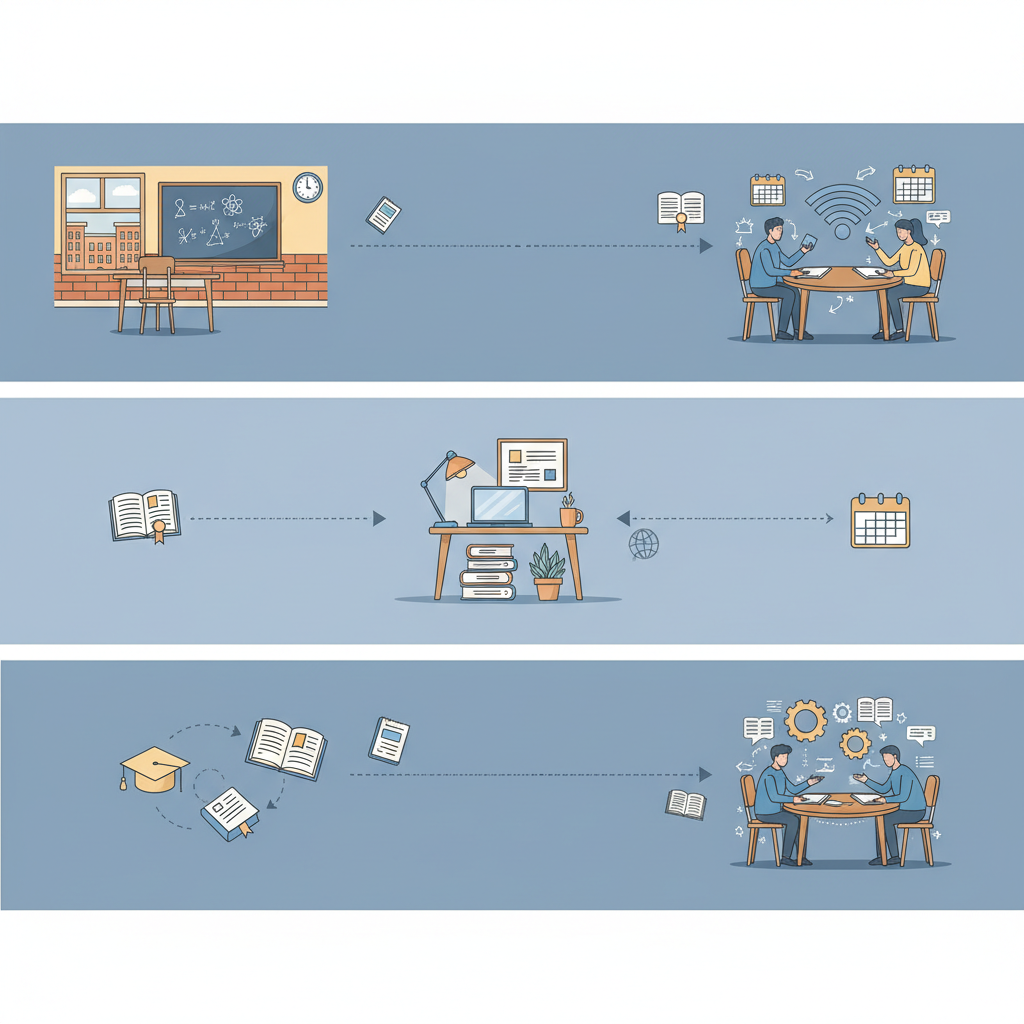
How Does BCom with CA Work from Class 12 to Final?
For most students, the degree and CA journey run concurrently at first, then become more demanding when Intermediate, practical training, and Final preparation enter the picture. BCom does not replace any ICAI stage, and it does not create an automatic exemption from CA examinations.

Under the New Scheme, a student may register for Foundation after Class 10, first sit Foundation after appearing in Class 12, then move to Intermediate after passing Foundation and Class 12. ICAI requires an eight-month Intermediate study period before the relevant attempt, while practical training begins only after both Intermediate groups and ICITSS are complete, according to the ICAI course rules.
Regular College Plus Separate CA Preparation
This route usually starts with a full-time BCom timetable and separately selected CA classes, recorded lectures, or self-study. In the first two years, the main task is protecting revision time around college lectures, internal assessments, and semester exams.
After Intermediate, a regular degree timetable can become the critical issue. If BCom classes still run during articleship hours, the student needs written clarity from both the college and the articleship principal. A strong campus experience is valuable, but it should not be confused with automatic timetable flexibility.
Distance or Online BCom Plus CA
This route keeps the degree and CA course separate, but it can give students more control over when they study. It is often practical for students who want to prioritise CA revision, reduce commuting, or preserve flexibility when articleship begins.
The trade-off is accountability. You need a calendar for degree assignments, examinations, CA registration cut-offs, revision, mocks, and practical training. We recommend building those habits early with a student roadmap, rather than waiting until Intermediate.
Integrated BCom-CA Programme
An integrated programme should make coordination easier, not merely collect two fee streams under one label. Before enrolling, establish who awards the BCom, who teaches the CA syllabus, who runs mock exams, who responds when university exams collide with ICAI dates, and what happens after a failed attempt.
The most useful test is simple: ask for the academic calendar, fee schedule, faculty responsibility, attendance policy, and disruption policy in writing. If those documents are unclear, the programme may still be a viable degree arrangement, but it is not yet a proven coordination system.
| Stage | Regular College Plus Separate CA | Distance Or Online BCom Plus CA | Integrated BCom-CA Programme |
|---|---|---|---|
| Class 12 To Foundation | College admission and CA Foundation preparation run separately | Degree admission and Foundation preparation run separately | Provider may sequence Foundation support with admission |
| BCom Years 1 And 2 | College calendar leads | Student manages degree and CA calendar | Programme calendar may align teaching |
| Intermediate Preparation | University workload can compress revision | Greater study-time flexibility | Confirm mock and revision support |
| After Both Intermediate Groups | Articleship may conflict with daytime college | Usually easier to align with training | Verify post-Intermediate timetable in writing |
| Final Preparation | Depends on articleship workload and degree completion | Depends on training workload and self-management | Depends on the actual mentoring and leave framework |
If you want help comparing written calendars and policies before choosing, message us through WhatsApp support.
When Can Articleship Begin During BCom?
Articleship can begin while a BCom is still underway, but it is not something to treat casually. The practical training gate is set by ICAI, while attendance and degree completion requirements remain controlled by the university.

Students can commence practical training after passing both Intermediate groups and completing the four-week ICITSS. The training period is two years. If you continue another course during articleship, ICAI’s Form 112 guidance requires permission for an additional course, including regular college or correspondence study.
What Needs to Be Checked Before Articleship
A regular BCom student should obtain the college timetable, attendance policy, internal assessment rules, semester examination schedule, and any leave procedure. The articleship principal also needs to know whether classes or exams could overlap with working hours.
Distance or online students should not assume that flexibility means no obligations. Check examination centres, contact sessions, assignment deadlines, and whether the programme requires any fixed academic activities during training periods.
Where Calendar Conflicts Usually Appear
-
College Attendance: Regular lecture requirements can reduce CA revision time long before articleship begins.
-
University Examinations: Semester papers may land close to Foundation or Intermediate preparation windows.
-
ICAI Milestones: ICITSS must be completed before practical training, so it needs its own protected slot.
-
Articleship Hours: Daytime degree classes can conflict with practical training, even when the student has managed both courses successfully before.
-
Coaching Mocks: Mock tests and revision batches are only useful if they are scheduled around unavoidable university commitments.
Use the admissions stage to ask these questions, not the articleship stage. Our admission guidance can help you turn the answer into a documented comparison before committing to a route.

What Overlap, Recognition, Cost, and Backup Do You Actually Get?
Subject overlap is real, but it is often overstated. Accounting, business law, economics, cost concepts, tax foundations, and finance may appear in both BCom and CA. The assessment depth, prescribed material, case application, and examination format can still be very different.

Semester-Level Subject Overlap
| BCom Stage | Genuine Overlap | Partial Overlap | CA-Only Or Materially Deeper Work |
|---|---|---|---|
| Semesters 1 And 2 | Financial accounting, business economics, law basics | Quantitative methods, business communication | Foundation-level question practice and ICAI coverage |
| Semesters 3 And 4 | Corporate accounting, tax foundations, cost accounting | Company law, financial management | Intermediate GST, audit and ethics, strategic management |
| Semesters 5 And 6 | Advanced accounting, direct-tax concepts, finance | Auditing, management accounting | Case-based Intermediate papers and ICAI-specific standards |
| After BCom | None | None | Final papers, self-paced modules, practical training, Advanced ICITSS |
The useful question is not, “Do these subjects share a name?” Ask whether the BCom unit covers the same depth, whether the assessment trains the same skill, and whether the semester timing helps the CA attempt you are targeting. We use this distinction when helping students compare degree and professional-study plans.
For students treating BCom as a serious backup rather than a loose add-on, our skill-gap guide explains how to keep the degree employment-ready while CA preparation continues.
Degree Recognition and Ownership
A BCom is only as portable as its awarding university and programme recognition. For distance and online study, UGC regulations treat recognised undergraduate awards as equivalent to corresponding conventional awards, but you should still confirm the exact programme, admission session, delivery mode, transcript wording, and postgraduate requirements with the receiving institution. The UGC equivalence rules make programme-level verification essential.
Before choosing an integrated route, ask for the university name on the degree, the issuing authority for marksheets, the study mode shown on records, and the policy if you leave the CA support component. A degree should remain a usable backup option even if CA takes longer than planned.
Costs and Disruption Cases
ICAI’s fixed registration fees for Foundation, Intermediate both groups, and Final both groups total ₹49,000. One domestic first examination sitting at each level adds ₹7,500, making the basic ICAI registration and first-sitting total ₹56,500 before training courses, degree tuition, coaching, travel, accommodation, or repeat attempts. The current ICAI fee chart lists ₹1,500 for Foundation, ₹2,700 for Intermediate both groups, and ₹3,300 for Final both groups.
| Cost Or Disruption | What To Compare |
|---|---|
| Degree Tuition | Exact university fee schedule, taxes, annual increases, and refund rules |
| CA Teaching | Coverage by level, mock tests, mentoring, recordings, and extension policy |
| Travel And Accommodation | Actual commute, hostel, rent, and examination-centre costs |
| Repeat Attempts | Applicable exam fee for each additional sitting, plus revision and living costs |
| Failed CA Attempt | Whether degree progression continues and whether support renews or expires |
| Missed BCom Semester | Re-exam process, attendance consequences, and effect on graduation date |
| Delayed Articleship | ICITSS completion, BCom timing, principal availability, and training start date |
| Provider Change | What remains portable: ICAI registration, university enrolment, materials, and fees |
A failed attempt usually delays the CA timeline, not the degree itself. A missed BCom semester can delay graduation while CA registration continues within its own validity rules. Changing a teaching provider does not erase ICAI registration, but it can change your access to recordings, mocks, faculty, and fee credits. For a wider decision framework, see our professional coaching ROI guide.
Why Choose iProledge for BCom with CA Pathways?
Choosing a BCom with CA route should feel less like buying a bundle and more like checking a working system. At iProledge, we start with the questions that change daily life: who awards your degree, which classes are compulsory, whether CA revision is protected near university exams, and what support continues after an unsuccessful attempt. We help students compare written timetables, fee components, teaching ownership, mock schedules, and the flexibility needed when articleship begins. Our counselling is useful when you want a clear distinction between a degree arrangement and CA preparation, rather than a vague promise of integration. We also help you identify documentation gaps before you rely on a timetable, fee promise, or verbal assurance. We invite you to use our programme comparison conversations to make a reasoned choice, not simply a convenient one. You can meet our faculty, review course options, then start with iProledge Home.
FAQs on BCom with CA Pathways
Can I Do BCom and CA Together?
Yes. You can complete degree semesters while registering and preparing for CA stages. The practical question is whether attendance, exams, coaching, and later articleship can coexist.
Can Articleship Start During BCom?
Possibly, but only after both Intermediate groups and ICITSS are complete. You must also follow Form 112 requirements and ensure course timings do not conflict with training.
Is an Integrated Programme a Different CA Route?
No. CA registration, examinations, practical training, and Final eligibility remain ICAI requirements. Integration can coordinate teaching and timetables, but it does not replace the professional pathway.
Is a Distance or Online BCom Recognised?
Yes, when the exact programme and admission session are recognised by UGC. Confirm the awarding university, delivery mode, transcript wording, and the receiving institution’s postgraduate rules.
Does BCom Subject Overlap Reduce CA Requirements?
No. Subject overlap can reduce duplicate learning, but it does not waive ICAI papers, registration periods, ICITSS, practical training, self-paced modules, or required examination standards.
Which BCom with CA Pathway Is Best?
Choose regular college for campus priority, distance or online study for flexibility, and an integrated programme only when its policies are documented in writing.