
Indian Candidates Get a Two-Part CMA USA Syllabus and Study Map
Use IMA’s current content outline to separate syllabus coverage, examination format, certification requirements and official fees before choosing a study sequence.
6 chapters · Updated Sep 16, 2026 · By Naveen J D
In brief
The CMA USA syllabus has two exam parts covering 12 major competencies, and Indian candidates may take the parts in either order. Passing exams is not the same as earning certification: IMA membership, verified education and qualifying experience remain separate requirements.
Separate enrolment, exam attempts and certification
CMA USA has three distinct milestones. First, join IMA and enrol in the CMA programme. Second, register for and pass both exam parts. Third, complete the requirements for IMA to award the CMA designation. IMA allows candidates to take either exam part before finishing the education and experience requirements, which means a final-year student, fresh graduate and working professional can use different timelines.
The distinction matters because an exam pass alone does not create certification status. IMA requires active membership, a bachelor’s degree from an accredited college or university or a related professional certification, two continuous years of qualifying management-accounting or financial-management experience, and passes in both parts. IMA’s CMA enrolment guidance also says both parts must be passed within three years of programme entry.
For an Indian degree, confirm the institution and document route before relying on a general statement about eligibility. The experience requirement may be completed before, or within seven years after, passing the examination. Internships, trainee roles and clerical work do not count as qualifying experience.
Read the official map before choosing materials
Use the IMA Content Specification Outline effective 1 September 2024 as the syllabus source. Part 1, Financial Planning, Performance, and Analytics, covers External Financial Reporting Decisions at 15%, Planning, Budgeting, and Forecasting at 20%, Performance Management at 20%, Cost Management at 15%, Internal Controls at 15%, and Technology and Analytics at 15%.
Part 2, Strategic Financial Management, covers Financial Statement Analysis at 20%, Corporate Finance at 20%, Business Decision Analysis at 25%, Enterprise Risk Management at 10%, Capital Investment Decisions at 10%, and Professional Ethics at 15%. ICMA explains in its 2024 Content Specification Outlines that these percentages approximate question coverage at the major-topic level. Individual subtopics have no published weight, and all 12 major domains have Level C coverage.
How the two CMA parts divide the syllabus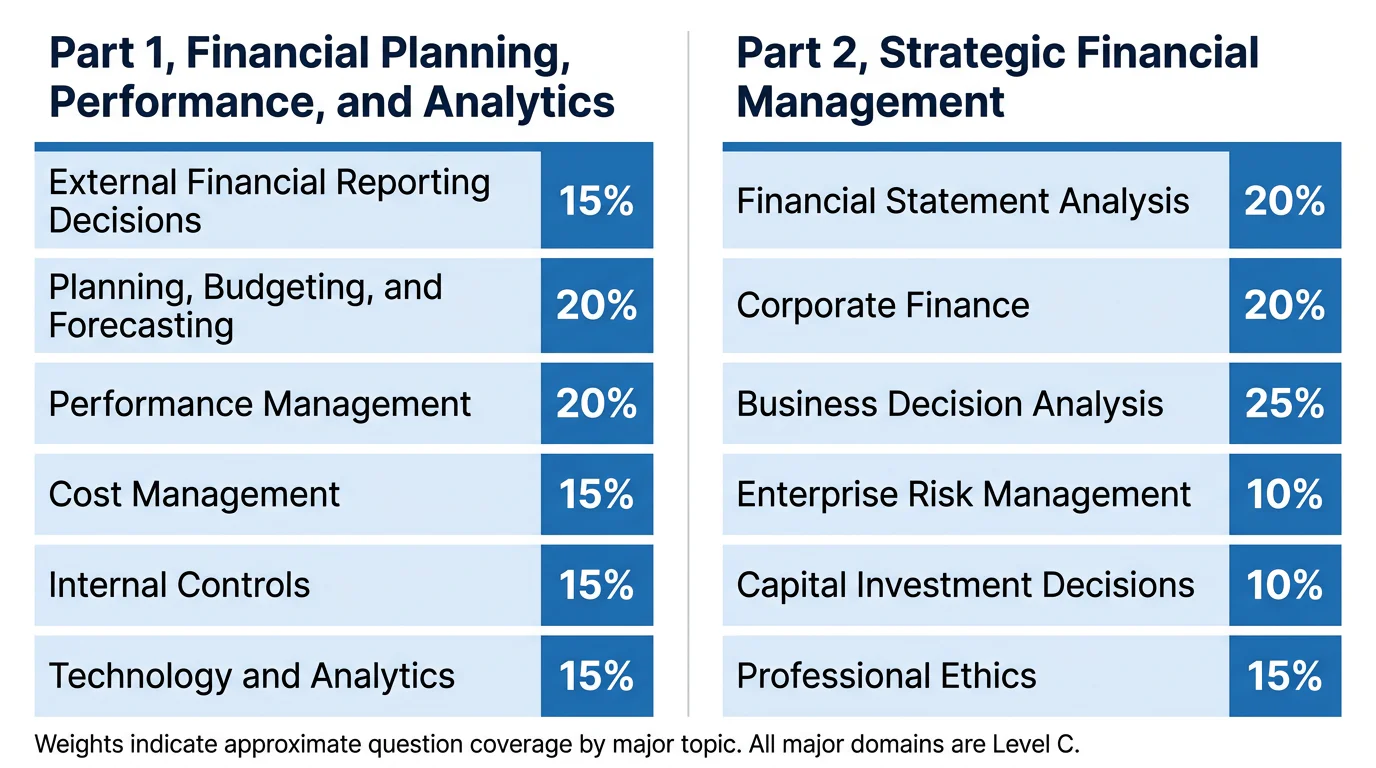
Level C means preparation must extend beyond recalling definitions. Candidates need to apply, analyse, synthesise and evaluate ideas in business situations. The outline also assumes prior knowledge of financial-statement preparation, business economics, time value of money, statistics and probability.
Prepare for case-based questions, not the old essay format
For English-language candidates in India, the current examination pattern changed from the September/October 2026 testing window. Each exam part now has 100 multiple-choice questions to complete in three hours, then two case-based question sets to complete in one hour. A candidate must earn at least 50% of multiple-choice points before the case-based section becomes available, and cannot return to the multiple-choice section after leaving it.
IMA describes each case-based question as a short business case of approximately 250 words followed by tasks such as drag-and-drop, fill-in-the-blank, select-from-a-list and calculations. The IMA case-based-question update says this changes the response format, not the content candidates study.
Each part is scored separately on a 0–500 scaled-score range, with 360 required to pass. The scaled score should not be treated as a raw percentage target, because the score scale is used to report results consistently across exam forms.
Budget official IMA charges separately from preparation
As of September 2026, IMA lists separate membership, entrance and exam-registration charges. For a professional member, the annual IMA membership fee is $295, the CMA entrance fee is $300, and each exam part costs $545. For a student member, IMA lists $49 annual membership, a $225 entrance fee and $407 per exam part. The corresponding initial two-part totals are $1,685 for a professional member and $1,088 for a student member.
IMA’s CMA enrolment page lists a $30 annual CMA maintenance fee after certification. The initial totals exclude future renewals, tax, card charges, transcript costs and any optional preparation. Student membership also has its own eligibility condition, including enrolment in at least six college or university credit hours.
Keep a coaching quote in a separate column from IMA charges. That makes it easier to compare a self-study route with a live, recorded or hybrid course without counting the same compulsory examination cost twice.
Choose the first part by your starting point, not by brochure order
IMA does not make Part 1 a prerequisite for Part 2. A practical study sequence starts with the foundation IMA assumes, then selects the part that has the clearest overlap with your current knowledge and available study time. Part 1 can be a useful first route for candidates working with budgets, cost analysis, operational reporting, controls, KPIs or finance systems. Its two largest domains are Planning, Budgeting, and Forecasting and Performance Management, each at 20%.
Part 2 can be a useful first route for candidates already comfortable with financial statements, corporate funding, capital budgeting, valuation or strategic decisions. Business Decision Analysis is 25%, the largest individual domain in the current outline. Neither route is automatically easier, and taking both parts in the same window is not a requirement.
A one-part-at-a-time plan is not ideal for everyone. Candidates with protected study time may prefer a tighter sequence, while candidates balancing work or university deadlines may need more recovery time between registrations. Use the exam window only after you can protect concept learning, mixed practice and timed case-based work.
Use support only where it changes your preparation outcome
Structured preparation can help when a candidate needs a fixed timetable, question feedback, help recovering after missed sessions or accountability around mock performance. It is less useful when the real issue is unresolved degree documentation, lack of qualifying work experience or an exam date chosen before the candidate is ready. Those are separate planning problems.
Before paying for any course, ask how current case-based practice is handled, how mock feedback identifies weak domains, whether recordings remain available after missed classes, and what access rules apply if an exam window changes. A large video library alone does not demonstrate feedback, recovery support or current CBQ practice.
For candidates who choose structured support, iProledge states that its CMA USA batches use a maximum of 30 learners, live and recorded classes, regular doubt-clearing and question-bank and mock-test support. Its personal-support comparison is useful for turning those claims into questions to ask before enrolling.
Go deeper
Frequently asked
IMA publishes one Content Specification Outline for the CMA examinations, with two parts and 12 major competencies. For English-language candidates in India, the important local timing point is the assessment format: case-based questions became the standard from the September/October 2026 testing window.
No. IMA allows candidates to take either CMA exam part before completing their education and work-experience requirements. However, the CMA designation is awarded only after IMA verifies the required education, two continuous years of qualifying experience, active membership and passes in both parts.
IMA permits either order, so neither part is a formal prerequisite. Part 1 may fit candidates whose work overlaps with budgeting, costing, controls or analytics, while Part 2 may fit candidates already comfortable with financial analysis, corporate finance, capital budgeting and business decisions.
For 2026, IMA lists a $1,088 first-attempt two-part total for an eligible student member and $1,685 for a professional member. Those totals include membership, the CMA entrance fee and two exam registrations, but exclude later renewals, taxes, card charges, document costs and optional preparation.
Compare the support behind your CMA USA study plan
Review the current batch, practice and feedback questions before choosing a preparation route.
Compare CMA USA support